TLDR;
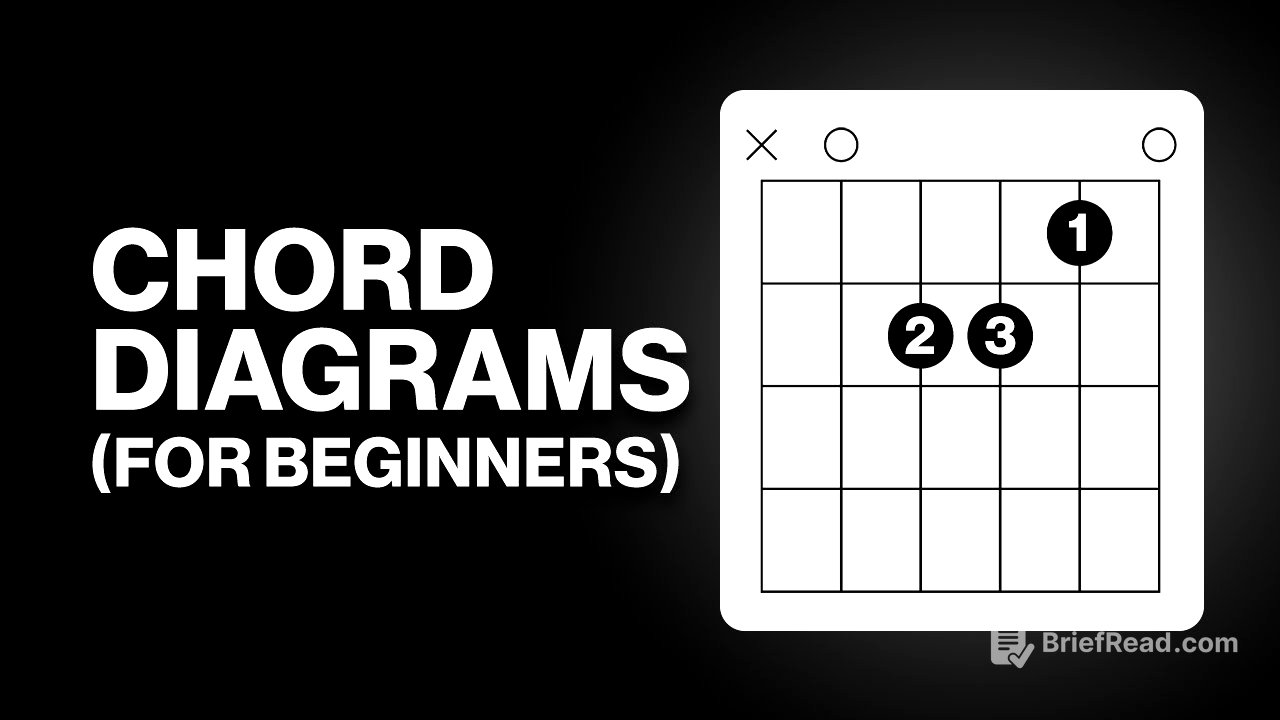
This video serves as an essential guide for absolute beginners learning to read guitar diagrams, which are crucial for playing chords and scales. It explains various components of chord diagrams, including string names, fret numbers, and finger placements, and introduces the concept of scales on the fretboard. By the end, viewers will be equipped to understand chord charts and basic musical notation, making their guitar practice more effective.
- Understanding chord diagrams and how to interpret them.
- Learning finger placements and how to read scales on the fretboard.
- Familiarity with different ways chords may be notated.
Understanding Chord Diagrams [0:00]
The video begins by emphasizing the importance of chord diagrams for beginners on guitar. It provides a step-by-step introduction to these diagrams, explaining the guitar's string layout, starting with the low E string as the thickest and high E as the smallest. Diagrams usually represent frets with horizontal lines, while finger placements are indicated with numbers. Viewers learn that chords are labeled at the top, where a capital letter signifies major chords, and a lowercase "m" indicates minor chords. It also covers how to mute certain strings and how to denote an open string.
Playing Chords: Finger Placement [3:18]
This chapter dives deeper into specific chord examples. The instructor illustrates how to play the A minor and C chords while focusing on where to place fingers on the fretboard and which strings to mute. Guidelines are provided on not pressing directly on the fret and the importance of using correct finger numbers to ensure proper playability. In cases where finger numbers aren't displayed, beginners are encouraged to experiment to find comfortable finger placements.
Reading Notes on the Fretboard [4:08]
The instructor outlines how diagrams can be used not only for chords but also for identifying notes on the fretboard. He mentions that the note at the nut of the guitar represents the open string note, proceeding through the scale to display notes on higher frets. Though this video does not cover every note's location, the instructor references an additional video where this topic is explored in more depth.
Understanding Major Scales [4:44]
In this section, the focus shifts to reading a major scale. The chapter explains that a small number on the side of the diagram identifies the fret, showing where to play each note of the scale. The example provided is the C major scale, demonstrating finger placements on different strings and frets. Viewers are guided through the process of building the scale step-by-step.
Navigating Different Diagram Views [5:48]
The instructor clarifies potential confusion regarding how diagrams may vary in orientation. He notes that when looking down at the guitar, the layout will show the low E string on the bottom, reinforcing the need for beginners to adapt to this standard view. He discusses different contexts in which frets and strings may be displayed differently and emphasizes the importance of recognizing string thickness or the labeling of frets to avoid confusion.
The Importance of Guitar Tabs [8:40]
The final section stresses the significance of learning to read guitar tabs as a skill that will facilitate song learning and playing. Tabs are versatile as they can represent scales and various patterns, drastically simplifying the learning process. Viewers are encouraged to check out a linked video for a beginner's guide on reading tabs, which will complement their understanding of diagrams and scales.