TLDR;
This video provides a detailed explanation of triacylglycerol (TAG) metabolism, covering both its synthesis (lipogenesis) and breakdown (lipolysis). It explains the key enzymes, cellular locations, and regulatory mechanisms involved in these processes, highlighting the roles of insulin, glucagon, and other hormones. The video also touches on the importance of perilipin in regulating lipolysis.
- TAG synthesis occurs primarily in the liver and adipose tissue.
- Insulin promotes lipogenesis, while glucagon and other hormones stimulate lipolysis.
- Lipolysis involves the breakdown of TAG into glycerol and fatty acids.
- Perilipin plays a crucial role in regulating access of lipases to TAG stores in adipocytes.
Introduction to Triacylglycerol Metabolism [0:10]
The video introduces the topic of triacylglycerol (TAG) metabolism, covering both its synthesis (lipogenesis) and breakdown (lipolysis). It outlines the learning objectives, which include describing the biosynthesis of TAG, detailing the metabolic reactions involved, identifying the relevant organs and cellular sites, understanding the regulation of these processes, and describing the hydrolysis of TAG (lipolysis). The key points of TAG metabolism in both the well-fed and fasting states are also previewed.
Key Points of Triacylglycerol Metabolism [0:42]
In the well-fed state, also known as lipogenesis, fatty acids and glycerol form triacylglycerols (TAGs). Insulin, the hormone of the well-fed state, favors lipogenesis and inhibits lipolysis. Insulin also causes the phosphorylation of enzymes and stimulates TAG synthesis in the liver and adipose tissue. During fasting, starvation, or in cases of diabetes mellitus, TAGs are broken down through lipolysis, also known as the hydrolysis of TAGs. TAGs are hydrolyzed to form three fatty acids and glycerol. Epinephrine and norepinephrine, important hormones during fasting, stimulate the phosphorylation of enzymes and promote lipolysis in adipose tissue.
Biosynthesis of Triacylglycerol (Lipogenesis) [1:52]
TAG synthesis, or lipogenesis, predominantly occurs in the smooth endoplasmic reticulum of the liver and adipose tissue. In adipose tissue, TAGs are synthesized for energy storage, while in the liver, they are synthesized and secreted in the form of VLDL (very-low-density lipoproteins). VLDL, aided by lipoprotein lipase, transports triacylglycerol to various tissues like adipose tissue and muscles for utilization. Glycerol, the backbone of triacylglycerol, must be activated to glycerol-3-phosphate via phosphorylation by glycerol kinase.
Activation of Fatty Acids and Glycerol [2:28]
Fatty acids and glycerol must be activated before TAG synthesis can occur. Fatty acids are activated to form fatty acyl-CoA, a reaction catalyzed by fatty acyl-CoA synthetase. This process involves two high-energy phosphates. Glycerol is activated to glycerol-3-phosphate, a reaction catalyzed by glycerol kinase. Glycerol kinase is present in the liver but absent in adipose tissue.
Synthesis of Triacylglycerol in Liver and Adipose Tissue [3:43]
Two mechanisms exist for synthesizing glycerol-3-phosphate. In the liver, glycerol is phosphorylated by glycerol kinase, while in adipose tissue, glycerol-3-phosphate is derived from dihydroxyacetone phosphate (DHAP), an intermediate of glycolysis. DHAP is produced from glucose and reduced to glycerol-3-phosphate by the enzyme glycerol-3-phosphate dehydrogenase. In both the liver and adipose tissue, glycerol-3-phosphate is acylated.
Acylation of Glycerol-3-Phosphate [5:01]
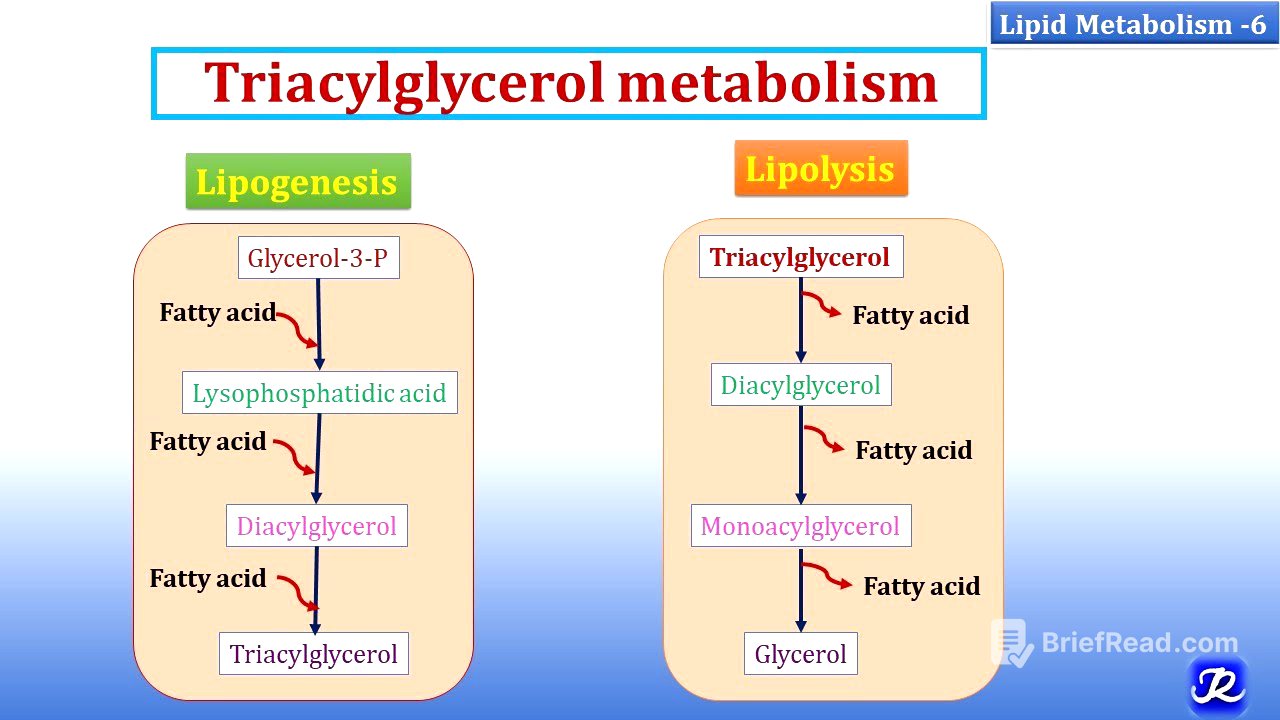
Glycerol-3-phosphate accepts a fatty acyl group, forming lysophosphatidic acid. Lysophosphatidic acid then accepts a second fatty acyl group, resulting in the formation of phosphatidic acid. Phosphatidic acid is then dephosphorylated by phosphatidic acid phosphatase to form diacylglycerol. Finally, diacylglycerol accepts a third acyl group, leading to the synthesis of triacylglycerol.
Regulation of Lipogenesis [6:05]
The enzyme phosphatidic acid phosphatase is a key regulatory enzyme in TAG synthesis.
Lipolysis: Breakdown of Triacylglycerol [6:19]
Lipolysis is the complete breakdown of triacylglycerol into glycerol and three fatty acids. Triacylglycerol is first hydrolyzed by adipose triglyceride lipase (ATGL), releasing the first fatty acid and forming diacylglycerol. Hormone-sensitive lipase (HSL) then acts on diacylglycerol to release the second fatty acid, forming monoacylglycerol. Finally, monoacylglycerol lipase hydrolyzes monoacylglycerol to release the third fatty acid, forming glycerol.
Fate of Glycerol and Fatty Acids After Lipolysis [7:16]
After lipolysis, glycerol is transported to the liver, where it is activated to glycerol-3-phosphate and can be used for TAG synthesis. Glycerol can also be converted into dihydroxyacetone phosphate (DHAP), which can then enter glycolysis to form pyruvate or gluconeogenesis to form glucose. Fatty acids are taken up by peripheral tissues and oxidized to form acetyl-CoA, which enters the TCA cycle to generate NADH and FADH2. These reduced coenzymes then donate electrons to the electron transport chain to generate ATP. Some fatty acids are re-esterified to glycerol-3-phosphate.
Hormonal Regulation of Triacylglycerol Metabolism [8:09]
Triacylglycerol metabolism is regulated by hormones. Insulin, the hormone of the well-fed state, favors lipogenesis and inhibits lipolysis. Glucagon and epinephrine, hormones of fasting and starvation, favor lipolysis. Insulin promotes the uptake of glucose via GLUT4 receptors, which are present on adipocytes. Insulin also increases the activity of pyruvate dehydrogenase, converting pyruvate to acetyl-CoA, which increases citrate levels and promotes fatty acid synthesis.
Insulin's Role in Lipogenesis and Lipolysis [8:55]
Insulin increases the activity of acetyl-CoA carboxylase, a key enzyme in fatty acid synthesis. Insulin also dephosphorylates and inactivates hormone-sensitive lipase (HSL), inhibiting lipolysis. Thus, insulin favors lipogenesis.
Glucagon's Role in Lipolysis [9:49]
Glucagon inhibits lipogenesis. Glucagon, along with epinephrine, activates adenylyl cyclase, leading to the formation of cyclic AMP (cAMP). cAMP activates protein kinase A, which phosphorylates hormone-sensitive lipase (HSL), activating it and promoting lipolysis.
Mechanism of Action of Fasting and Starvation Hormones [10:11]
During fasting and starvation, glucagon and epinephrine activate adenylyl cyclase, which converts ATP to cAMP. cAMP activates protein kinase A, which phosphorylates hormone-sensitive lipase (HSL), activating it and promoting lipolysis. Hormone-sensitive lipase hydrolyzes triacylglycerol to form monoacylglycerol, thus favoring lipolysis. Other hormones, like cortisol, growth hormone, and thyroid hormone, also activate lipolysis by increasing cAMP levels and phosphorylating hormone-sensitive lipase.
Insulin's Counter-Regulatory Effects [11:26]
In the well-fed condition, insulin has a counter-regulatory effect. It induces protein phosphatase, which dephosphorylates and inactivates hormone-sensitive lipase, thus inhibiting lipolysis. Insulin also converts cyclic AMP to 5' AMP by activating phosphodiesterase, decreasing cAMP levels and inhibiting lipolysis. Thus, insulin favors lipogenesis and inhibits lipolysis.
Role of Perilipin in Lipolysis [12:05]
Perilipin is a protein present on the surface of lipid droplets containing triacylglycerol. It protects triacylglycerol from hormone-sensitive lipase under basal conditions. Glucagon and epinephrine activate adenylyl cyclase, leading to the formation of cyclic AMP, which activates protein kinase A. Protein kinase A then phosphorylates perilipin.
Perilipin's Coordination of Lipolysis [12:50]
Phosphorylation of perilipin allows the binding of active hormone-sensitive lipase to the lipid droplet, promoting lipolysis. The active hormone-sensitive lipase can then hydrolyze triacylglycerol to form monoacylglycerol. Perilipin coordinates the storage and hydrolysis of triacylglycerol in adipocytes under different conditions, according to the metabolic needs of the body.