TLDR;
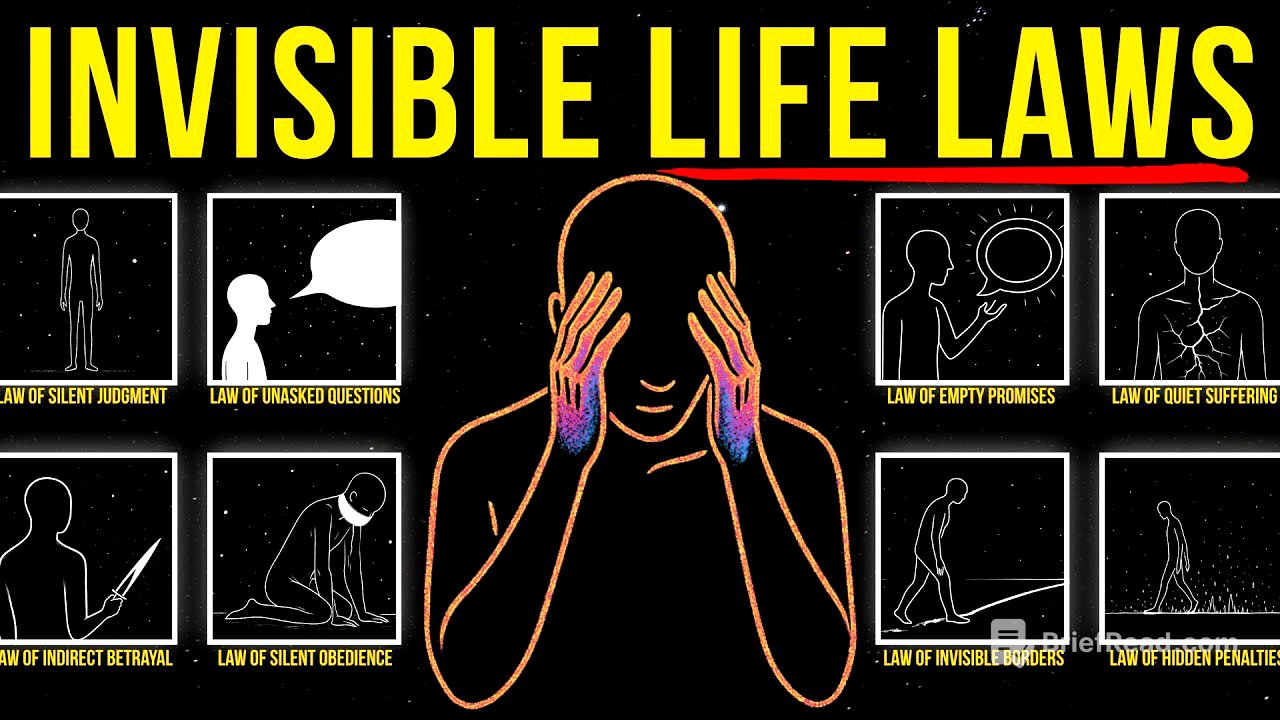
The video explores various invisible laws that govern human behavior and relationships without conscious awareness. These laws reveal the unseen pressures and expectations that influence actions, thoughts, and decisions, from unspoken debts and hidden judgments to the effects of passive approval and indirect betrayal.
- The law of unseen debt highlights the emotional and social obligations accumulated over time.
- The law of empty promises emphasizes the impact of unfulfilled assurances on trust and expectations.
- The law of passive approval illustrates how silence can condone negative actions and inactions.
- The law of hidden expectations discusses the weight of societal norms and unexpressed demands on individuals.
- The law of imagined threats encapsulates how fear and anxiety can distort reality.
- The law of inequitable trade exposes the imbalance in exchanges that often leaves one party disadvantaged.
- The law of silent judgment signifies the constant evaluation and scrutiny faced from oneself and others.
Law of Unseen Debt [0:00]
The concept of the law of unseen debt revolves around the emotional and social obligations that accumulate over time, often unnoticed. Individuals may feel the weight of unreturned favors, unspoken truths, and social interactions that create a sense of indebtedness. These emotional and social debts accumulate and can lead to anxiety and discomfort when the individual realizes they owe more than they consciously acknowledge, affecting their mental well-being and relationships.
Law of Empty Promises [6:52]
The law of empty promises focuses on the disappointment and emotional turmoil that arise from unfulfilled commitments. It emphasizes how societal expectations of trust can lead individuals to feel let down when promises fail. This law explains the cyclical nature of hope and betrayal and how unmet expectations sow seeds of doubt and resentment, influencing future interactions and creating emotional barriers.
Law of Passive Approval [14:40]
The law of passive approval describes the silent complicity in negative actions through inaction or indifference. When individuals choose not to speak up against injustices or unethical behavior, their silence serves as an implicit endorsement of the actions occurring around them. This law illustrates the danger of societal acceptance of harmful norms and the need for active engagement and dissent to counteract oppression and wrongdoing.
Law of Silent Obedience [22:44]
The law of silent obedience describes how societal pressure encourages compliance without vocal agreement. Individuals often conform to unspoken rules and norms, acting in ways that align with group expectations while suppressing their own authentic desires. This law explores how cultural nuances and subtle cues direct behavior and can create an environment where dissent feels uncomfortable or out of line, leading individuals to conform in silence.
Law of Invisible Handshakes [30:40]
The law of invisible handshakes refers to unspoken agreements that shape interactions and expectations within social contexts. Individuals navigate social spaces through these unrecognized contracts that establish norms of behavior, often determining how one interacts with others. This law underscores the importance of social dynamics and the implications of complying with these implicit agreements that govern personal and professional relationships.
Law of Unspoken Judgment [38:34]
The law of unspoken judgment delves into the constant, silent evaluations that individuals face from others and themselves. These judgments can create feelings of inadequacy and self-doubt, inhibiting authentic self-expression. The law emphasizes how the fear of judgment impacts behavior, leading to conformity and suppressing individuality as individuals strive to align with perceived social standards.
Law of Hidden Penalties [44:17]
The law of hidden penalties refers to the unseen costs of social and emotional actions that manifest over time. Individuals may endure personal costs, such as stress or anxiety, as a result of unmet expectations or unreciprocated kindness. This law highlights the long-term consequences of small actions and decisions that accumulate unnoticed until they manifest as significant emotional burdens.
Law of Echoed Failures [53:36]
The law of echoed failures illustrates how past mistakes can reverberate in one's mind, leading to heightened anxiety and avoidance of future risks. Individuals often wrestle with self-doubt and fear of failure, which can prevent them from embracing new opportunities. This law underscores the mental barriers created by negative past experiences that can inhibit personal growth and resilience.
Law of Perceived Control [1:01:29]
The law of perceived control discusses how individuals often believe they have agency over their choices when, in reality, many decisions are guided by external influences. People may feel empowered by the illusion of choice, yet these choices are often limited by societal norms or marketing strategies. This law emphasizes the importance of acknowledging the true nature of control in decision-making processes.
Law of Imposed Freedom [1:08:26]
The law of imposed freedom describes the illusion of choice presented in modern society, where individuals are led to believe they have endless options while being constrained by external forces. This law highlights how the perception of freedom can be stifling, as people are conditioned to stay within predefined boundaries. It underscores the necessity for individuals to challenge societal expectations and redefine what freedom means to them.
Law of Unclaimed Victories [1:16:58]
The law of unclaimed victories emphasizes the importance of acknowledging personal successes, no matter how small. When individuals fail to celebrate their achievements, they may feel stagnant or unaccomplished. This law highlights how unacknowledged victories can bind individuals to a narrative of inadequacy, preventing them from recognizing their progress and potential.
Law of Chosen Sacrifice [1:22:40]
The law of chosen sacrifice highlights the consequences of willingly giving up personal needs or desires in favor of external expectations or relationships. While sacrifice is often viewed as noble, it can lead to feelings of resentment and loss of identity when taken to extremes. This law underscores the need for individuals to find balance in their commitments and ensure that they are not sacrificing too much of themselves for the sake of pleasing others.
Law of Quiet Suffering [1:30:21]
The law of quiet suffering addresses the internal struggles individuals experience that often go unnoticed by others. This form of suffering is typically repressed and ignored, leading to emotional burdens that can affect a person's well-being. The law reveals the importance of acknowledging and addressing these hidden pains rather than burying them beneath the surface.
Law of Unspoken Guilt [1:38:14]
The law of unspoken guilt describes the heavy emotional burden individuals carry from things left unsaid or actions taken without proper resolution. This guilt can lead to self-deprecation and a sense of inadequacy, stemming from a fear of disappointing others. The law emphasizes that acknowledging and communicating these feelings is vital for emotional health and healing.
Law of Unseen Chains [1:45:34]
The law of unseen chains illustrates the subtle social and emotional constraints that bind individuals, often without their conscious realization. These invisible barriers can limit personal growth and self-expression, as people adapt their behaviors to conform to societal expectations. Recognizing these chains is essential for reclaiming agency and pursuing authenticity.
Law of Unforced Compliance [1:53:15]
The law of unforced compliance examines how individuals often comply with authority or social expectations without explicit coercion, simply because it feels easier. This silent acceptance becomes a form of compliance that can stifle individual autonomy and dissent. The law encourages individuals to critically assess their compliance and find ways to resist the pressures to conform.
Law of Invisible Borders [2:00:12]
The law of invisible borders refers to the unspoken lines that dictate societal norms and acceptable behaviors. These boundaries can restrict personal freedom and creativity and lead individuals to conform to established frameworks rather than explore new possibilities. Recognizing these borders is crucial for individuals seeking to challenge societal expectations and expand their horizons.
Law of Silent Influence [2:07:01]
The law of silent influence discusses how subtle cues and environmental factors can shape preferences and decisions without conscious awareness. Individuals may believe their choices are entirely their own, yet many are the result of orchestrated influences designed to steer their behavior. This law underscores the importance of being mindful in decision-making processes to separate true desires from manipulated impulses.
Law of Hidden Expectations [2:12:52]
The law of hidden expectations addresses the unvoiced standards that individuals feel compelled to meet in various social contexts. These unspoken demands create pressure to conform to others' ideals, often at the expense of personal desires and authenticity. Understanding these expectations is essential for individuals to break free from societal norms and prioritize their own values.
Law of Unasked Questions [2:20:03]
The law of unasked questions reveals how unexamined doubts can shape beliefs and decisions, resulting in compliance with unspoken rules. The reluctance to confront difficult questions allows systems of power to thrive unchallenged. Recognizing this law fosters courage to address uncertainties and seek truth, ultimately leading to personal growth.
Law of Unknown Responsibilities [2:27:11]
The law of unknown responsibilities highlights the burdens and expectations individuals unwittingly carry as participants in societal structures. These obligations can shape one's identity and choices, often leading to feelings of guilt or inadequacy. Awareness of these hidden responsibilities allows individuals to re-evaluate their commitments and prioritize their own needs.
Law of Secret Comparisons [2:33:08]
The law of secret comparisons explores how individuals continually measure themselves against others, often without realizing it. This unspoken comparison can lead to feelings of inadequacy and distorted self-worth. Recognizing this law encourages individuals to understand their unique value and lessen the hold of external judgments.
Law of Unseen Votes [2:39:55]
The law of unseen votes illustrates how decisions are influenced by subtle social dynamics and collective opinions rather than individual free will. These invisible votes shape preferences and beliefs, often without conscious realization. Understanding this law empowers individuals to recognize their agency and question the forces shaping their choices.
Law of Unspoken Hierarchies [2:47:01]
The law of unspoken hierarchies examines how power dynamics operate silently within social contexts. These hierarchies dictate behavior, expectations, and relationships without overt acknowledgment. Recognizing these dynamics is essential for individuals to redefine their roles and challenge imbalances in power.
Law of Indirect Betrayal [2:54:22]
The law of indirect betrayal describes how individuals can inadvertently harm those they trust by prioritizing their own needs or fears. This form of betrayal often goes unnoticed and lacks direct confrontation, making it even more painful. Understanding this law fosters awareness of how personal choices can impact relationships and encourages individuals to prioritize honesty and transparency.
Law of Quiet Deception [3:00:12]
The law of quiet deception addresses how gentle manipulations and soft lies can mask underlying truths. These subtle deceptions can damage trust and complicate relationships without overt malice. Recognizing this law is crucial for maintaining transparency and fostering genuine connections.
Law of Inequitable Trade [3:06:10]
The law of inequitable trade explores how exchanges often disproportionately favor one party, resulting in hidden losses for the other. Individuals may feel they are making fair trades, but underlying imbalances can lead to long-lasting consequences. This law encourages awareness of value exchanges to ensure fair and equitable relationships.
Law of Unbalanced Mirrors [3:14:23]
The law of unbalanced mirrors emphasizes how perceptions of oneself can be skewed by comparison to others. Individuals often judge themselves more harshly than they evaluate others, leading to distorted self-images. Recognizing this law allows for healthier self-reflection and fosters a more balanced perspective on individuality.
Law of Shadowed Truths [3:20:48]
The law of shadowed truths highlights how hidden narratives and suppressed realities shape individual experiences. These concealed truths can affect perceptions and interactions, often leading to a fractured understanding of oneself and one's environment. Acknowledging these shadowed truths is essential for authentic living.
Law of Silent Agreements [3:28:00]
The law of silent agreements refers to the unspoken agreements that individuals make within relationships and social contexts. These agreements can lead to unrecognized complicity in harmful dynamics. By understanding the nature of these agreements, individuals can regain agency and redefine boundaries.
Law of Hidden Desires [3:34:05]
The law of hidden desires examines the unacknowledged yearnings that influence thoughts and behaviors. These concealed wishes can shape decisions and actions, often resulting in self-sabotage or dissatisfaction. Recognizing and confronting these desires is essential for achieving fulfillment and authenticity.
Law of Unseen Consequences [3:39:49]
The law of unseen consequences reveals how small actions can lead to significant, often unforeseen, impacts. Individuals may not recognize the ripple effects of their decisions, leading to regret or unintended harm. Understanding this law encourages mindfulness in decision-making and awareness of potential outcomes.
Law of Passive Resistance [3:45:19]
The law of passive resistance highlights the subtle ways individuals can resist compliance without direct confrontation. This form of resistance can disrupt power dynamics and create change without overt rebellion. Recognizing and harnessing passive resistance can empower individuals to reclaim agency while navigating complex social interactions.
Law of Unspoken Pity [3:52:59]
The law of unspoken pity describes how feelings of sympathy can lead to inaction. While feeling pity may elicit a sense of compassion, it often lacks the impetus needed for meaningful change. This law emphasizes the importance of moving beyond mere sympathy to foster genuine empathy and action.
Law of Imagined Threats [3:59:21]
The law of imagined threats examines how unfounded fears can shape behavior and decision-making. These perceived dangers can cripple individuals' choices and prevent them from pursuing opportunities. Awareness of these imagined threats is essential for reclaiming freedom and facing life's challenges.
Law of Invisible Scripts [4:04:59]
The law of invisible scripts reveals how societal norms and expectations dictate behavior without individuals' conscious recognition. These scripts influence decisions, values, and lifestyle choices, often leading to feelings of inadequacy or unfulfillment. Becoming aware of these scripts allows individuals to challenge and redefine their paths.
Law of Silent Judgment [4:10:48]
The law of silent judgment highlights the constant evaluations individuals experience from others and themselves. This relentless scrutiny can lead to anxiety and self-doubt, ultimately affecting self-expression. Understanding this law encourages compassion for oneself and others, reducing the weight of unacknowledged judgments.