TLDR;
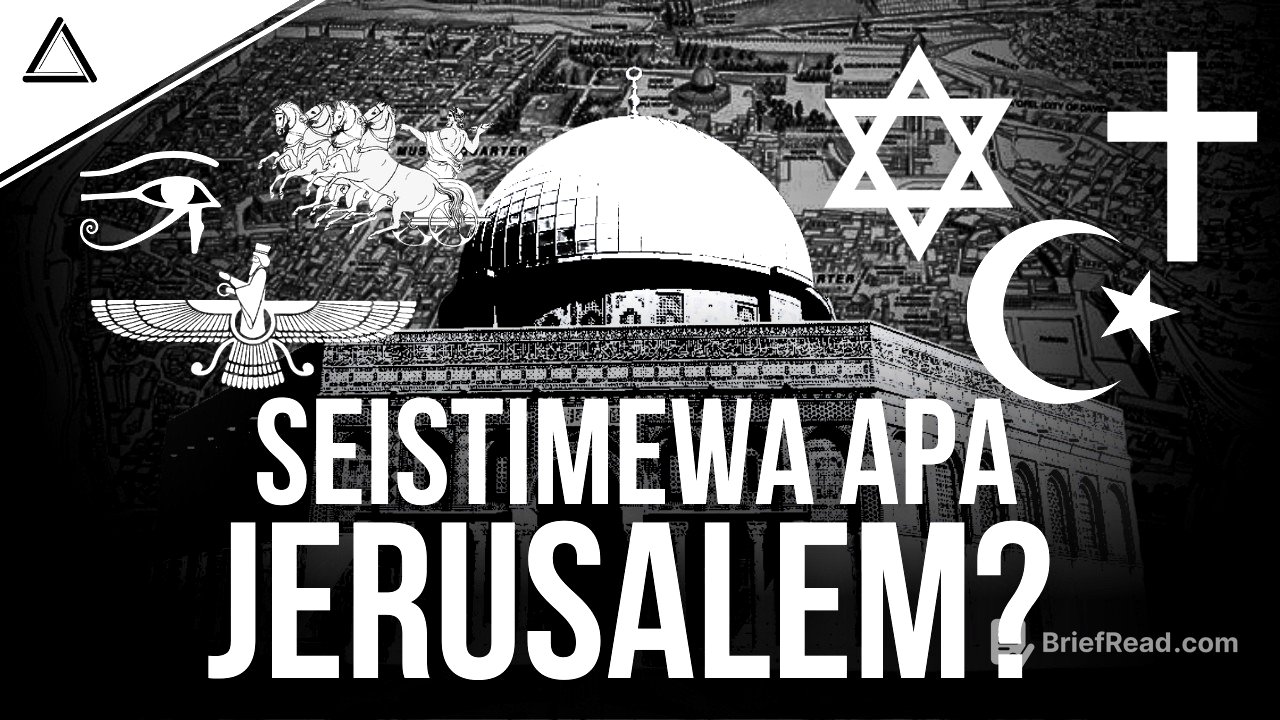
The video discusses the complex history and significance of Jerusalem across various civilizations and religions. It explores the city’s numerous conquests, destruction, and rebuilding over thousands of years, highlighting the spiritual meaning attributed to it by Judaism, Christianity, and Islam.
- Jerusalem has been destroyed twice, besieged 23 times, and taken over 44 times.
- The city holds immense importance not only for neighboring civilizations but also globally, as it is viewed as sacred across three major religions.
Introduction [0:00]
Jerusalem has held pivotal importance for thousands of years. Throughout its history, it has faced destruction, sieges, and conquests, resulting in numerous deaths. The video aims to uncover why Jerusalem has been so contested and what it represents for different civilizations. By examining its ancient origins, connections to major empires, and religious narratives, the audience is invited to discuss and understand the significance of Jerusalem from multiple perspectives.
Asal Usul Jerusalem [1:54]
The name Jerusalem likely derives from ancient forms like Urialim or Rusalimum, linked to the Egyptian diplomatic communications from the 14th century BCE. Archaeological evidence suggests Jerusalem developed during the 4th millennium BCE, evolving from a fortified city to a strategic point during the Bronze Age. Its continuous growth demonstrated an organized society, with early forms of governance established before its religious significance grew within various monotheistic traditions.
Nebukadnezar II Dari Babilonia [11:05]
By the 7th century BCE, Jerusalem was affected by geopolitical struggles, particularly between Babylon and Egypt. In 586 BCE, Nabuchadnezzar II of Babylon conquered Jerusalem, leading to the destruction of the First Temple and the collapse of Judah's sovereignty. This event marked a monumental tragedy in Jewish history, fueling religious narratives about divine punishment for disobedience, and emphasizing Jerusalem's vulnerability during power transitions.
Cyrus The Great Dari Persia [14:24]
Following Babylon’s instability, Cyrus the Great of Persia emerged, defeating Babylonian forces in 539 BCE and implementing a more tolerant policy. He allowed Jewish exiles to return to Jerusalem and rebuild the Second Temple, signifying a moment of restoration, viewed as divine intervention in Jewish collective memory. This era reshaped Jerusalem into a renewed religious center under Persian governance.
Alexander The Great Dari Makedonia [19:18]
Alexander the Great began his conquest of Persia, capturing Jerusalem in the late 4th century BCE. Historical accounts, like those from Flavius Josephus, describe Alexander's respectful treatment towards the city. Under his reign, Hellenistic influences pervaded Jerusalem as it became integrated into the broader cultural landscape, impacting local customs and religious practices significantly.
Pompey The Great Dari Romawi [23:24]
In 63 BCE, Pompey the Great intervened in a conflict between rival Hasmonean factions, leading to the Roman conquest of Jerusalem. The city fell under Roman administration, marking the end of the Hasmonean independence. Roman governance established new political dynamics while maintaining a traditional religious structure, altering Jerusalem’s role within Judaism and setting the stage for further conflicts.
Pemberontakan Bar Kokhba [27:36]
In the early 2nd century CE, Bar Kokhba led a significant rebellion against Roman rule, striving for Jewish autonomy. The uprising initially succeeded but was ultimately crushed, resulting in severe consequences for the Jewish community. Following the rebellion, Jerusalem was rebuilt as Aelia Capitolina, with a significant change in its social fabric and the status of its Jewish population.
Kristen Pada Era Bizantium [30:53]
As the Roman Empire transitioned to Byzantium, Jerusalem became a crucial Christian pilgrimage site. The city was transformed under the guidance of Constantine the Great, who officially legalized Christianity, leading to the construction of significant religious sites. This period solidified Jerusalem's role as a spiritual center for Christianity while ongoing political tensions arose due to its contested status.
Islam Dan Jazirah Arab [35:24]
The emergence of Islam in the 7th century CE reshaped Jerusalem once again. Under Khalifah Umar ibn Khattab, the city was peacefully incorporated into the Islamic Caliphate, marking its significance as a major religious center. The Islamic tradition attributes deep spiritual value to Jerusalem, recognizing its history and holy sites, notably the Al-Aqsa Mosque and the Dome of the Rock.
Di Tengah Perang Salib [38:45]
The Crusades initiated vast military campaigns by European Christians aimed at reclaiming Jerusalem and the Holy Lands from Muslim rule. The First Crusade succeeded in 1099 but led to severe violence against local populations. Over the centuries, multiple Crusades followed with fluctuating control over the city, reflecting ongoing Christian-Muslim tensions until the area stabilized under Mamluk control.
Dalam Kendali Dinasti Mamluk [43:42]
By the mid-13th century, the Mamluk Sultanate gained control over Jerusalem after defeating Crusader remnants. The Mamluks emphasized the city’s religious significance, investing in religious infrastructure while presenting Jerusalem as a center of Islamic learning and pilgrimage. Despite its diminished political power, the city flourished as an Islamic spiritual hub during this time.
Dibawah Kesultanan Utsmaniyah [46:39]
In 1517, the Ottoman Empire absorbed Jerusalem, maintaining its religious importance while integrating the city into a larger administrative structure. The Ottomans enhanced the city’s infrastructure, allowing it to thrive as a religious and social center for multiple faiths. Throughout the Ottoman era, Jerusalem navigated complex relationships between religious communities amidst increasing European interest and local modernization efforts.
Perang Dunia 2 Dan Setelahnya [50:54]
The aftermath of World War II saw a significant shift in the region, with rising tensions between Jewish and Arab communities in Palestine. The British mandate struggled with growing nationalism among Palestinians and the influx of Jewish immigrants. This led to increasing conflicts, culminating in the 1948 Arab-Israeli War, which resulted in the partitioning of Jerusalem into East and West.
Refleksi Narasi Yerusalem [56:01]
Jerusalem is a focal point of complex identities and spiritual significance across three religions. Its history reflects a continuous struggle for power and meaning rather than mere territorial disputes. The paradox of its sacredness, intertwined with conflict exclusivity, presents the ongoing challenge of establishing enduring peace among diverse narratives within this storied city.