TLDR;
This lecture discusses the religious motivations behind the colonization of New England and the Mid-Atlantic colonies, emphasizing that these regions were founded for religious reasons rather than profit. It highlights the complex nature of religious freedom in colonial America, demonstrating that groups escaping persecution often mirrored the intolerance they faced. The lecture covers the Protestant Reformation, focusing on Martin Luther's challenges to the Catholic Church, the rise of the Anglican Church in England under Henry VIII, and the subsequent emergence of various dissenting religious groups.
- Colonies were founded for religious freedom, contrasting profit-driven earlier settlements.
- Many groups persecuted in England showed intolerance towards other faiths in the New World.
- The Protestant Reformation, led by Martin Luther, significantly influenced religious dynamics in England.
- Henry VIII's establishment of the Anglican Church marked a pivotal shift in religious authority.
Religious Foundations of Colonization [0:00]
The lecture opens by explaining that New England and the Mid-Atlantic colonies were established primarily for religious reasons, contrasting with earlier colonies like Jamestown, which prioritized profit. While America is often viewed as a haven for religious freedom, the reality is more nuanced, as many groups escaping persecution in England were intolerant towards others in the New World. This sets the stage for understanding the complexities of American religious identity and its impact on political culture.
The Protestant Reformation Overview [4:00]
To comprehend the religious motivations behind colonization, the lecture emphasizes the importance of the Protestant Reformation. Martin Luther, a German monk, initiated this movement by challenging church practices like the sale of indulgences, which were viewed as tickets to heaven. This period marked a critical shift in religious thought, with Luther arguing for salvation by faith alone, opposing the Church's emphasis on good works. His actions catalyzed a broader movement that questioned the authority of the Pope and promoted individual interpretations of scripture.
Luther's 95 Theses and Its Aftermath [12:00]
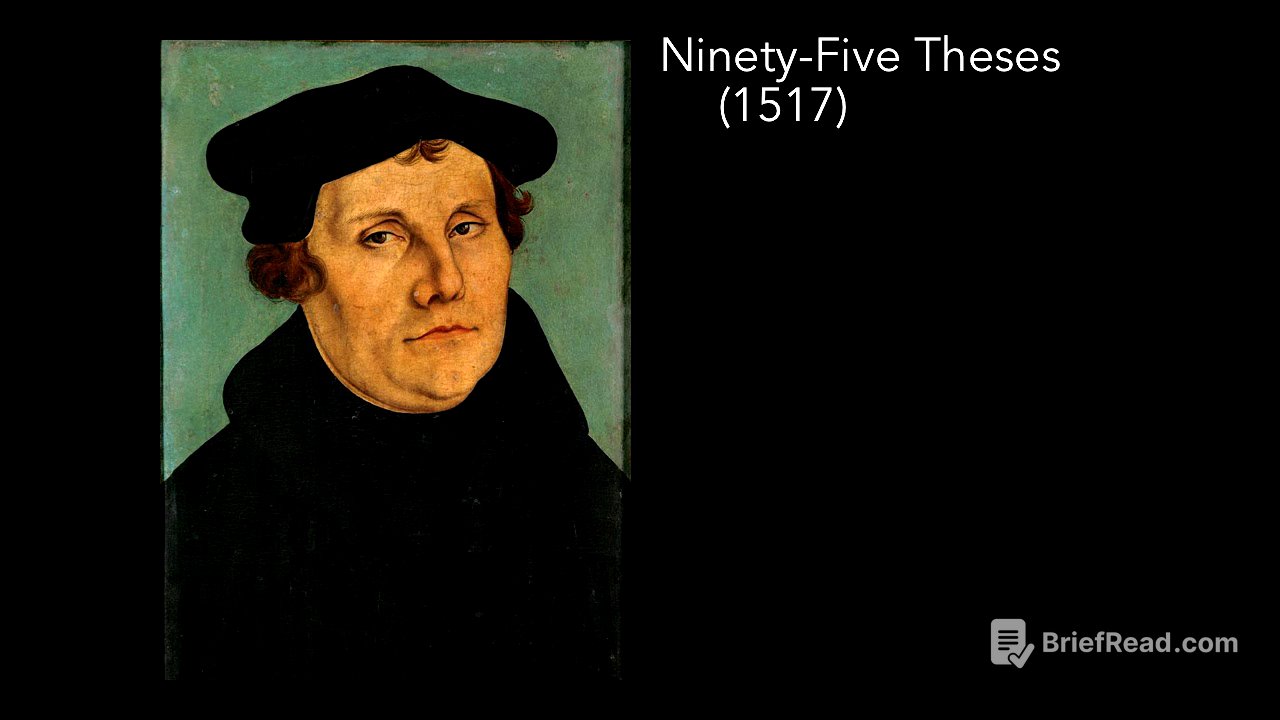
Luther's famous 95 Theses, posted in 1517, criticized indulgences and provoked a significant backlash from the Catholic Church. While Luther sought to reform practices from within, his ideas quickly spread due to the printing press, making him a notorious figure. The Pope denounced him as a heretic, leading to a broader challenge of papal authority and the emergence of various Protestant sects. Luther's theology emphasized scripture as the ultimate authority rather than church traditions or the papacy.
The Anglican Church and Henry VIII [23:00]
The lecture discusses Henry VIII's establishment of the Anglican Church in England, spurred by the need for an annulment from Catherine of Aragon, which the Pope refused. To marry Anne Boleyn, Henry founded a church where he served as the supreme head. This church retained many Catholic practices while eradicating direct papal authority. Henry's reign witnessed the retention of traditional doctrines alongside radical reforms, as he navigated between Catholic and Protestant influences.
Religious Conflict in England [36:00]
After Henry's death, his daughter Mary Tudor reinstated Catholicism as the state religion, resulting in significant persecution of Protestants. Following Mary's reign, Elizabeth I implemented a middle-ground approach, maintaining the Anglican Church while allowing for some Protestant reforms. The lecture highlights how religious minorities, including Catholics and Puritans, responded to these shifts and continued to advocate for their beliefs amidst political turmoil.
Emergence of Religious Minorities [49:00]
The Puritans, influenced by Calvinist theology, sought to reform the Anglican Church further, desiring a more radical purification of its practices. Separatists, believing separation from the Church was necessary, established their congregations. The lecture also introduces the Quakers, known for their radical views and individual conscience in faith. This overview of religious minorities prepares the ground for understanding their influence on the founding of American colonies and their quest for religious freedom.




![Python Tutorial For Data Domain [Advanced Guide - Beyond Basics]](https://wm-img.halpindev.com/p-briefread_c-10_b-10/urlb/aHR0cDovL2ltZy55b3V0dWJlLmNvbS92aS9NLVV0S3hndEthZy9ocWRlZmF1bHQuanBn.jpg)