TLDR;
This lecture focuses on the motivations and early attempts at English colonization in North America, highlighting the political, social, and economic landscapes of England in the late 16th century. Key points include:
- The initial hesitance of England to colonize due to domestic issues and rivalries with Spain.
- The emergence of joint stock companies as a means to finance colonization.
- The socio-political context that drove individuals, particularly the West Country men, to promote colonization as a solution to social problems in England.
- The failed attempts at establishing colonies, notably Roanoke, revealing the challenges of the era.
Introduction to English Settler Colonies [0:00]
The lecture begins by emphasizing that North America was not uninhabited when Columbus arrived. The impact of the Columbian Exchange significantly affected the Native American population, leading to discussions about the motivations for English colonization. The focus shifts to the late 16th century when England, under Queen Elizabeth, began to show interest in colonization, overcoming prior domestic turmoil rooted in the English Reformation.
Political Landscape and Delays in Colonization [1:00]
Initially, England faced obstacles in establishing colonies due to the pressures of domestic issues like the Reformation and conflicts with Spain. Tensions escalated into war in 1585, which made Elizabeth cautious about provoking Spain directly. However, as the mid-Atlantic region became apparent as a neglected territory, the English began to explore colonization, identifying it as a significant opportunity for wealth.
Joint Stock Companies and Economic Motives [3:00]
The English crown opted to rely on private individuals and companies for colonization due to limited resources. This led to the rise of joint stock companies, which allowed investors to share the financial risks of colonization. These companies would hold trade monopolies and operate similarly to modern corporations, allowing for broader investment and risk distribution among shareholders.
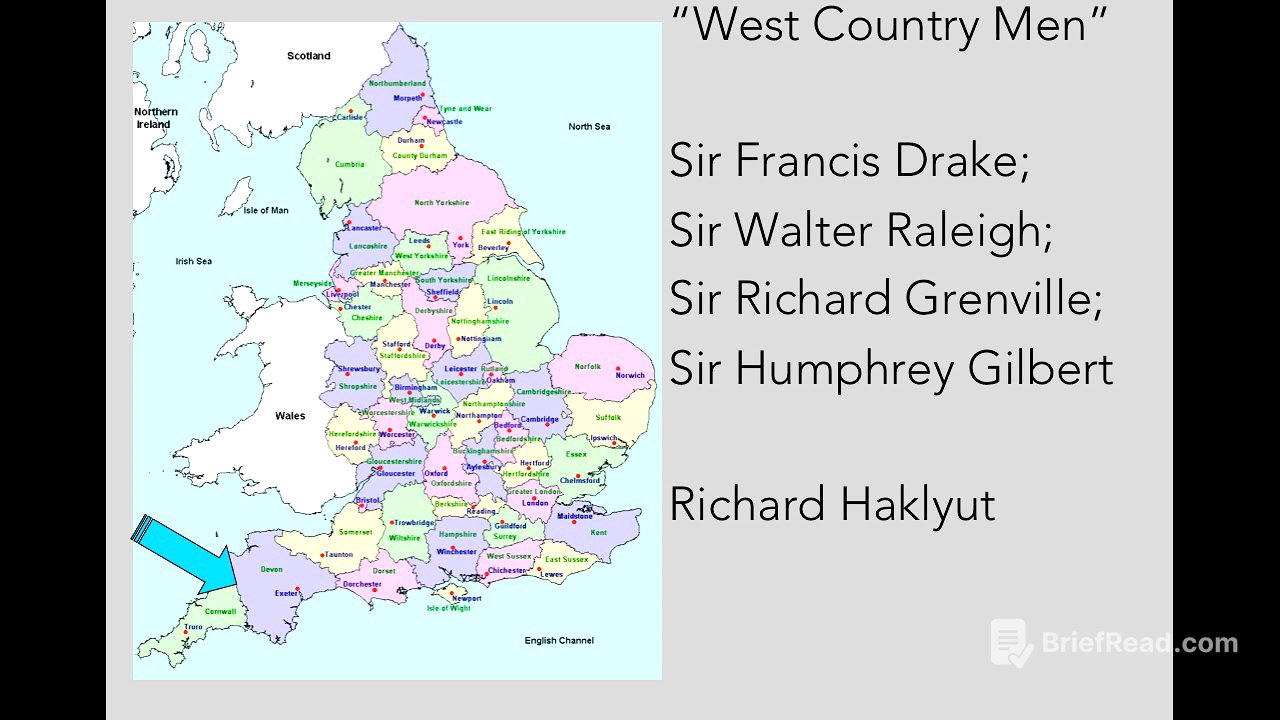
The West Country Men: Early Promoters of Colonization [6:00]
A group of influential aristocrats known as the West Country men emerged as primary advocates for colonization, motivated by anti-Spanish sentiment and mercantilism's promise of profits. Key figures like Sir Walter Raleigh and Sir Francis Drake played significant roles in this movement, aiming to reclaim England's lost glory and challenge Spain's dominance. They believed that established colonies could provide essential raw materials and markets for English goods.
Social Hierarchy and Motivations for Expansion [9:30]
The West Country men sought to preserve England's traditional social hierarchy, which was increasingly threatened by social issues such as poverty and crime. Their promotion of colonization was presented as a solution to these problems, arguing it would restore the social order and provide opportunities for those excluded under primogeniture, particularly younger sons of nobility.
Old England and the Crisis of the Lower Orders [12:40]
The economic struggles of the lower classes, exacerbated by enclosure and a population boom, led to increased poverty and vagrancy in England. The wealthy property classes found these issues burdensome and sought to address them through colonization, suggesting that exporting the idle poor to colonies like Virginia could alleviate their economic pressures while simultaneously building the empire.
Failed Colonization Attempts: Roanoke [16:30]
The first serious English colonization attempt at Roanoke in 1585 failed due to poor relations with Native Americans and inadequate supplies. The settlers faced starvation, leading to their eventual abandonment of the colony. An unsuccessful second attempt in 1587, which included families and women, ended in tragedy when all colonists disappeared after John White's prolonged absence caused by the Spanish conflict.
The Mystery of the Lost Colony of Roanoke [21:30]
Upon returning three years later, John White discovered the colony deserted, with no signs of attack, only the word "Croatoan" carved into a tree. This mystery surrounding the fate of the colonists leads to speculation about whether they integrated with local tribes or fell victim to conflicts with other Native American groups. The Roanoke saga highlights the complexities and difficulties of early colonization efforts.
Conclusion and Next Steps in Colonization [29:10]
The lessons from Roanoke illustrate the unsustainable nature of early private colonization attempts. Future English settlement efforts would need to adapt their strategies, leading to a focus on more permanent colonies, particularly in Virginia and Maryland. These efforts would eventually culminate in the establishment of Jamestown, where the cultivation of tobacco would become a pivotal industry in American colonization.