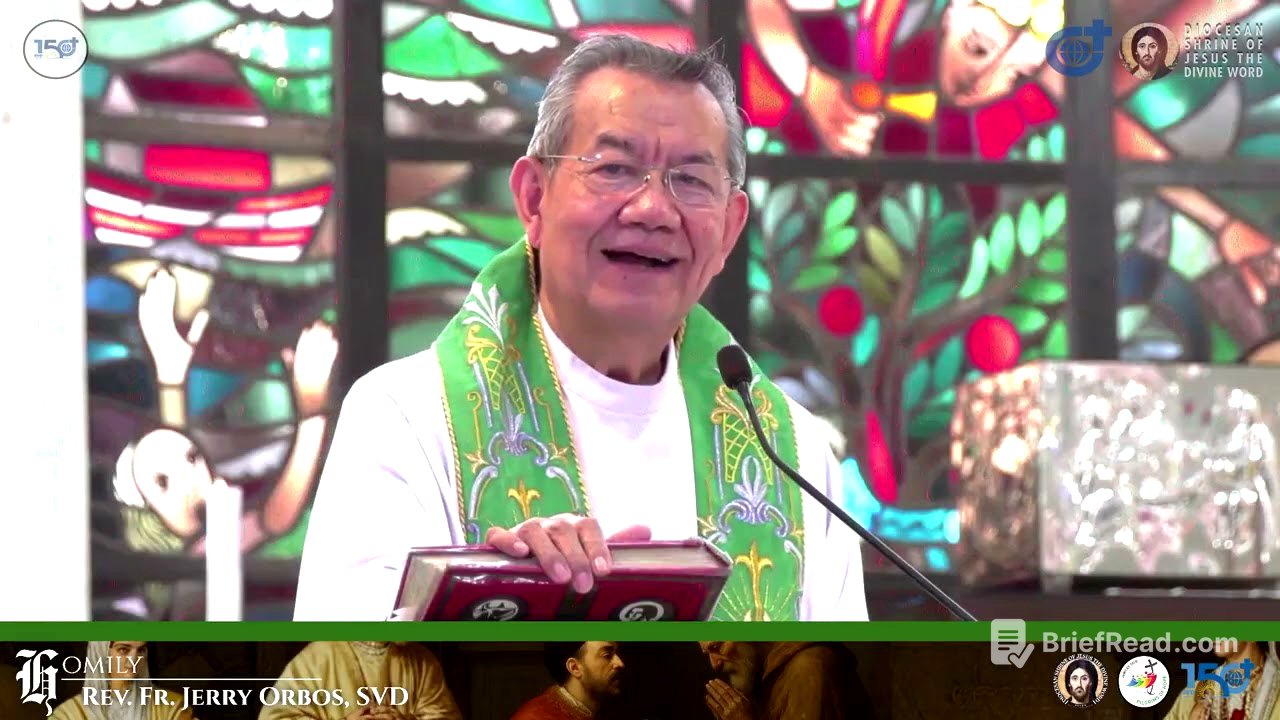
TLDR;
This homily centers on the Gospel of Luke's parable of the Pharisee and the tax collector, emphasizing humility and recognizing one's sinfulness before God. It encourages listeners to avoid self-righteousness and judging others, and to focus on God's grace and forgiveness. The sermon also explores various "prisons" we create for ourselves, such as those of wealth, work, wisdom, and worry, and urges embracing gratitude, true worship, and seeing others through the lens of respect, understanding, compassion, and love.
- Focus on humility and recognizing sinfulness.
- Avoid self-righteousness and judging others.
- Focus on God's grace and forgiveness.
- Embrace gratitude, true worship, and seeing others with respect and love.
Gospel Reading: The Pharisee and the Tax Collector [0:03]
The Gospel reading from Luke presents the parable of the Pharisee and the tax collector who went to the temple to pray. The Pharisee, standing proudly, thanks God that he is not like other men, listing his virtues and religious practices. In contrast, the tax collector humbly beats his breast, asking God for mercy as a sinner. Jesus concludes that the tax collector, not the Pharisee, went home justified, because everyone who exalts himself will be humbled, and he who humbles himself will be exalted.
Introduction: Prayer and Prison Awareness [1:57]
The priest begins by leading the congregation in a prayer, asking for the Holy Spirit to bless and speak to everyone's heart. He reflects on the gospel, emphasizing the prayer "Lord have mercy on me, a sinner," and notes that the one who prays humbly is blessed by God. He then introduces the theme of Prison Awareness Sunday, clarifying that those formerly called "prisoners" are now referred to as "persons deprived of liberty" (PDL), encouraging understanding and prayer for them.
Various Forms of Imprisonment [4:09]
The priest discusses different ways people can become "prisoners." He identifies being a "prisoner of wealth," where one is obsessed with earning money, and a "prisoner of work," where work overshadows everything, including worship. He also speaks of being a "prisoner of wisdom," marked by intellectual pride, and cautions against relying solely on one's own understanding, referencing Proverbs 3:5. Further examples include being a "prisoner of words," "waste," "worry," "wine," and even humorously, "wife" and "Wi-Fi," illustrating how various obsessions and preoccupations can imprison individuals.
The Prison of Worth and Self-Righteousness [6:47]
The priest explains that the Gospel is about people who become prisoners of worth, comparing themselves to others based on face value and perceived spiritual worth. He contrasts this with focusing on the goodness of God. Drawing from the parable, he notes that the self-righteous, like the Pharisee, focus on their own goodness, while the truly righteous acknowledge God's goodness. He shares an anecdote about his priestly anniversary, where he and his classmates, now in their 70s, have learned to accept each other and rejoice in their shared vocation.
Symptoms and Solutions for Self-Righteousness [10:11]
The priest humorously points out physical symptoms of self-righteousness, such as head movements and tilting the head when observing others. He urges the congregation to focus on the Lord rather than judging those around them during worship. He advises against judging others, reminding them that only God is the judge, and against making oneself the standard, as the Lord is the only true standard. He emphasizes that holiness is not a contest and that going to heaven is a group effort, encouraging listeners to bring others with them.
Avoiding Spiritual Accounting and Focusing on Hope and Joy [13:31]
The priest cautions against becoming a "spiritual accountant" or a "protector of the creed, code, and cult," constantly checking for violations. He suggests becoming a "pilgrim of hope" and "pilgrim of joy" instead, focusing on respect, understanding, compassion, and love. He encourages focusing on the positive rather than the negative, sharing his experience with cancer and how he chose to thank God for the grace to endure it rather than feeling entitled to be well.
God's Faithfulness, Mercy, and Forgiveness
The priest reiterates that only God is worthy of all praise, cautioning against feelings of entitlement. He reflects on celebrating God's faithfulness and mercy with his classmates, emphasizing that their worthiness or unworthiness was secondary to their gratitude. He encourages the congregation to recognize God's grace in the little details of life, which is far more significant than any perceived worthiness. He encourages believing in God's love and the goodness of people, rather than dwelling on the negative.
Letting Go and Embracing Gratitude and True Worship [18:30]
The priest encourages seeing people as God sees them and acknowledges everyone's sinfulness, referencing Psalm 130:3. He urges focusing less on what should have been or could have been, and more on what is—God's grace and forgiveness. He encourages letting go of burdens and allowing God to work in their lives, leading the congregation in singing "Let It Go." He concludes by encouraging everyone to become prisoners of gratitude and true worship, asking God for the grace to look at each other with respect, understanding, compassion, and love, and seeking the help of Mama Mary to follow Jesus more humbly and joyfully.