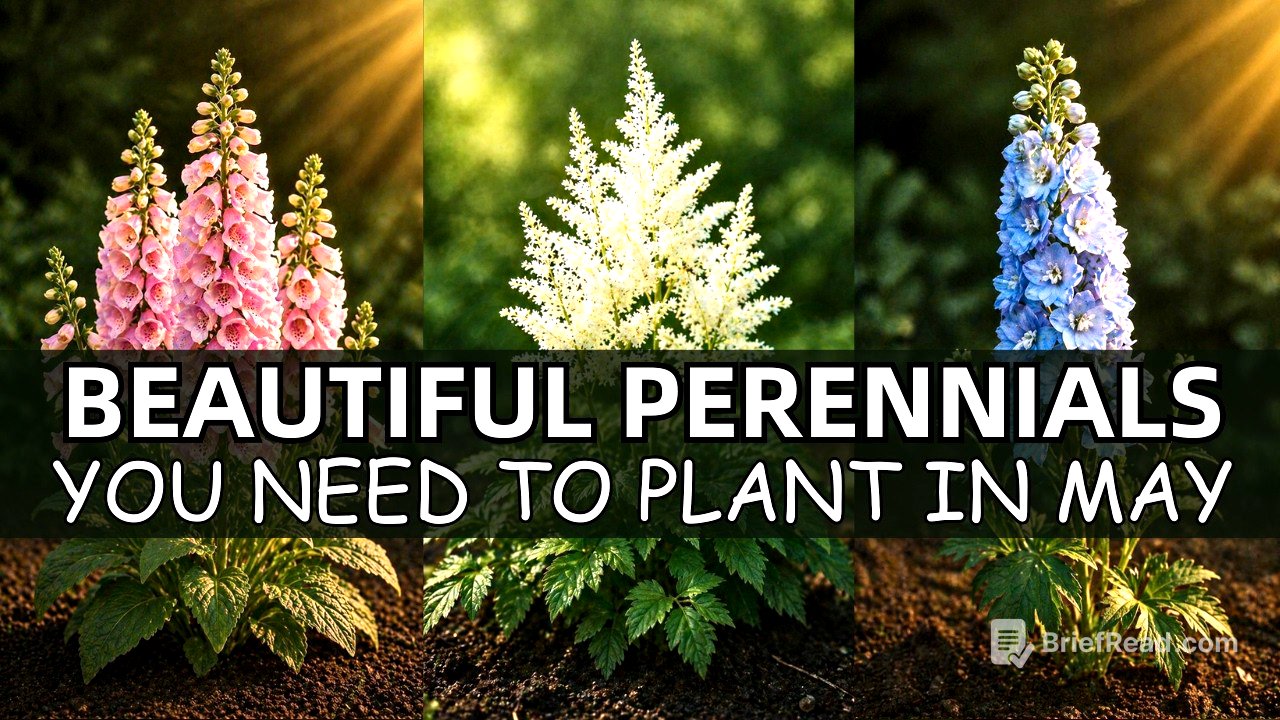
TLDR;
This video presents 20 perennials that can be planted in May to create a stunning, low-maintenance garden that improves year after year. These plants are selected for their beauty, resilience, and ability to attract pollinators, making them ideal for gardeners looking to invest in long-term garden solutions.
- Planting perennials in May leads to a vibrant garden by July, improving each year with minimal effort.
- The list includes a variety of plants suited for different conditions, from sun-loving to shade-tolerant, ensuring options for any garden.
- These perennials not only enhance garden aesthetics but also support local wildlife by providing food and habitat.
Intro [0:00]
The video introduces the idea that a beautiful garden doesn't require extensive experience, a large budget, or innate talent, but rather the smart choice of planting perennials. Unlike annuals that die each year or shrubs that take a long time to mature, perennials come back annually, growing larger and requiring less maintenance while offering more beauty. The best time to plant these perennials is in May when the soil is warm, promising a colorful garden by July and an even more impressive display in subsequent years.
Black-Eyed Susan (Rudbeckia) [1:30]
Black-Eyed Susans are highlighted as a resilient and straightforward perennial, thriving in conditions where others might struggle. These golden-yellow, daisy-like flowers with dark chocolate centers are commonly found growing wild across North America, demonstrating their ability to flourish without intervention. They bloom for an extended period, from midsummer through the first hard frost, and are highly attractive to pollinators like bees and butterflies. Additionally, their seed heads provide food for birds during the winter, making them a valuable addition to any garden ecosystem.
Coneflower (Echinacea) [3:12]
Coneflowers, or Echinacea, are presented as a vital component of a perennial garden, attracting a multitude of pollinators. Native to the North American prairie, Echinacea Purpurea has a history of medicinal use and offers drought, heat, and deer resistance. Leaving the seed heads standing through winter provides a crucial food source for birds like goldfinches and chickadees. Coneflowers spread through self-seeding and clump division, naturally creating variations in color and form each year.
Shasta Daisy [4:31]
Shasta Daisies are celebrated for their enduring appeal and reliability in gardens. These classic white flowers with cheerful yellow centers have been popular since the late 1800s due to their adaptability and prolific blooming in early to midsummer. They are easy to grow, requiring only full sun, decent soil, and reasonable drainage, and can be divided in spring to expand plantings. Shasta Daisies provide a visual contrast to hotter colored flowers and offer a sense of rest in garden design.
Blanket Flower (Gaillardia) [5:48]
Blanket Flowers, or Gaillardia, are known for their non-stop color from summer to frost, thriving in poor soil, full sun, and heat. These fiery, bi-colored flowers in shades of red, orange, and yellow bloom continuously with minimal care. They fill gaps in the garden, bridge transitions between bloom cycles, and keep the garden looking vibrant during late summer. Regular deadheading encourages continuous bloom, and the seed heads can be left for birds in late fall.
Lavender [7:07]
Lavender is highlighted for its sensory appeal, offering fragrance, attracting bees, and maintaining its form even in winter. Grown since ancient times, lavender requires sharp drainage, lean soil, and full sun, and should be left alone to thrive. The spikes can be harvested and dried to fill rooms with fragrance for months. It serves as a cut flower, edging plant, pollinator habitat, and sensory experience all in one.
Hosta [9:10]
Hostas are celebrated as the queen of shade, transforming dim, dappled corners into lush, textural spaces. With enormous leaves in various colors and patterns, hostas are virtually indestructible once established. They thrive in morning sun and afternoon shade, multiplying into impressive clumps over time. Hostas are known for their longevity, with well-sited plants living up to 50 years, providing decades of beauty with minimal maintenance.
Bleeding Heart [10:34]
Bleeding Heart is included for its unique and original appearance, featuring long, arching stems with heart-shaped flowers in rose pink or white. Blooming in spring, it gracefully disappears in summer heat, making way for summer-blooming perennials. It thrives in shaded, moist conditions, making it a natural companion to hostas. The white-flowered variety, Alba, is particularly elegant in woodland settings, attracting hummingbirds and early emerging bumblebees.
Astilbe [11:53]
Astilbe brings dramatic vertical interest to moist, shaded spaces with its feathery plumes in red, pink, white, and lavender. Thriving in wet shade conditions, it is ideal for areas near downspouts or ponds. The dried seed heads remain attractive for weeks after the blooms fade, providing texture and movement in the winter. Combining early, mid, and late-blooming varieties extends the display from June through August.
Heuchera (Coral Bells) [13:06]
Heuchera, or Coral Bells, is valued for its foliage, which provides color throughout the season. Modern cultivars offer leaves in surreal colors like burgundy, copper, caramel, silver, lime green, and black purple, often with contrasting veining or ruffled edges. They anchor border edges, fill container combinations, and provide visual contrast. Coral Bells serve as punctuation marks in the perennial border, creating visual breaks and color continuity.
Delphinium [14:15]
Delphinium is celebrated for producing the rarest color in the garden: true, deep, sky-filling blue. These towering spikes, ranging from pale sky blue to deep indigo, create vertical drama and reshape the garden's scale. They bloom in early summer and benefit from staking and cutting back after the first bloom. Delphiniums are hummingbird favorites, making them a valuable addition to wildlife gardens.
Lupine [15:27]
Lupine blooms in late spring, filling the gap between early spring bulbs and midsummer perennials with dense, upright spikes in various colors. Growing from taproots, they do not transplant well, making May planting essential. Lupines are nitrogen-fixing plants, improving the soil for surrounding plants. They prefer cool climates and may go dormant in summer heat, returning reliably the following spring.
Foxglove [16:43]
Foxglove is a biennial that behaves like a perennial, producing a rosette of leaves in the first year and spectacular spikes of tubular flowers in the second. It self-seeds abundantly, creating self-sustaining colonies that drift and naturalize across the garden. Foxglove is a critical plant for bumblebees and serves as meaningful conservation planting. Note that it is toxic if ingested.
Bellflower (Campanula) [18:05]
Bellflower, or Campanula, is a quiet overachiever in the perennial garden, featuring cup or bell-shaped flowers in blue, violet, and white. These plants are vigorous and adaptable, spreading gently to fill spaces. Campanula Persicifolia sends up tall, slender stems, while Campanula Carpatica stays compact and mounding. The blue shades of Campanula are among the clearest in the garden, offering grace and intimacy.
Salvia [19:16]
Salvia is highlighted as a straightforwardly useful plant with a long bloom season, attracting hummingbirds and pollinators, and offering drought tolerance and deer resistance. The deep blue and purple spikes complement other flower colors. Combining early, mid, and late varieties extends the bloom from May through October. Salvia foliage is aromatic, deterring deer, and the plant maintains an attractive form even when not in bloom.
Catmint (Nepeta) [20:29]
Catmint is a plant that experienced gardeners return to for its performance, featuring soft, silver-green aromatic foliage covered in blue-purple flowers. It edges paths, spills over walls, and fills gaps with effortless grace. Catmint is deer-resistant, drought-tolerant, and pollinator-friendly, with a refreshing fragrance. Its cool blue-purple tones and silver foliage make warm colors around it look richer.
Penstemon (Beard Tongue) [21:47]
Penstemon, or Beard Tongue, transforms the perennial garden into a wildlife corridor with its tubular flowers in various shades that attract hummingbirds. Native species are adapted to challenging conditions, requiring minimal resources once established. Bumblebees and native bees are also important pollinators. Combining Penstemon with Salvia and Catmint creates a pollinator-focused planting that hums with activity.
Yarrow [22:58]
Yarrow has a long history and is known for its hardiness and flat-topped flower clusters in yellow, white, red, and pink. It is virtually indestructible, thriving in poor soil, full sun, and with no water. Yarrow spreads slowly into colonies and attracts beneficial predatory insects. It is ideal for hot, dry, difficult slopes, providing season-long color and feeding beneficial insects.
Peony [24:14]
Peonies can bloom in the same spot for 100 years, outlasting the people who planted them. They produce enormous, lush flowers in white, cream, pink, coral, and red with an intoxicating fragrance. The bloom season is brief but spectacular. Peonies require full sun and rich, well-drained soil, and should not be planted too deep. A well-established peony is breathtaking and provides beauty across generations.
Iris [25:56]
Irises carry a regal simplicity with their unmistakable flowers in unique color combinations. Bearded, beardless, and Siberian varieties all offer extraordinary color ranges. Bearded iris wants full sun, while Siberian iris tolerates moist conditions and partial shade. Iris divides easily, multiplying the planting from the original investment, making it a generous self-multiplying plant.
Columbine (Aquilegia) [27:17]
Columbine, or Aquilegia, is a delicate-looking but tough plant with nodding flowers and backward-projecting spurs. It is cold-hardy, tolerant of poor soil, partial shade, and variable moisture. Columbine blooms in spring, bridging the gap between early bulbs and summer perennials. It self-seeds abundantly, spreading through the garden and producing new color combinations each generation.