TLDR;
The lecture covers the era of exploration and discovery, focusing on the voyages and impact of the Spanish, French, English, and Dutch explorers. Key points include the Treaty of Tordesillas, various expeditions to find a Northwest Passage, early claims of territory by European powers, the impact of conquistadors in the Americas, and the transformation of societies from extraction-based to settler societies.
- Columbus's voyages raised disputes between Spain and Portugal, leading to the Treaty of Tordesillas.
- The Europeans initially viewed the Americas as an obstacle to Asia rather than an opportunity.
- Major explorers like Balboa, Ponce de León, and Magellan made significant discoveries in the Americas.
- The English, French, and Dutch began to challenge the Iberian monopoly on exploration.
- The phenomena of disease played a crucial role in the conquests of native empires, particularly the Aztecs and Incas.
European Rivalries and the Treaty of Tordesillas [0:00]
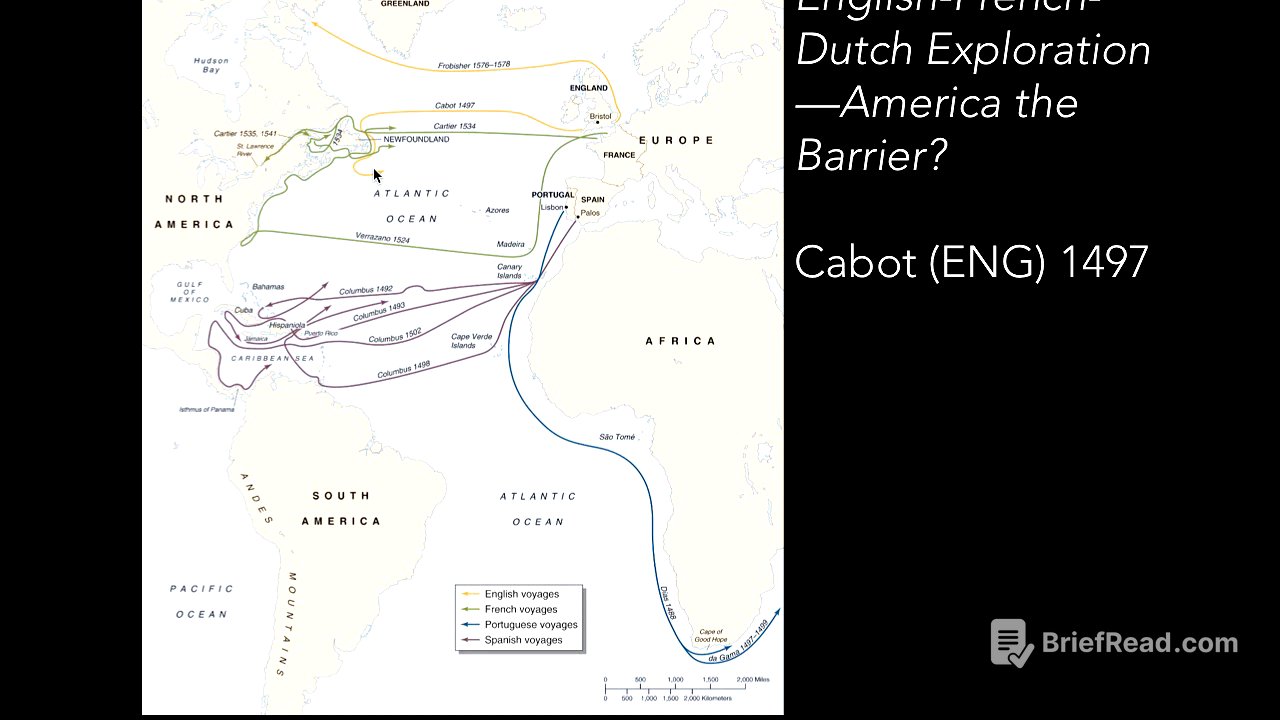
The lecture begins by discussing Columbus's voyages and how they shocked the Portuguese, who had dominated exploration for over a century. The Treaty of Tordesillas was established due to disputes between Spain and Portugal, dividing the new world between the two countries. Spain claimed all non-Christian lands west of an imaginary line 307 leagues west of the Canary Islands, while Portugal controlled territories to the east. This division appeared unfair, especially as the extent of South America was not well understood at the time. Columbus’s discovery became a disappointment as Europeans saw the Americas more as a barrier to Asia rather than an opportunity for colonization.
Pioneering Expeditions: The Northwest Passage [2:45]
The discussion transitions to the pursuit of the Northwest Passage, an all-water route to Asia through North America. Many explorers attempted to find this passage, viewing the Americas as a barrier rather than a place for settlement. The name "America" was given to the new land after Amerigo Vespucci suggested it in a letter, which was later published, popularizing the name across Europe.
Spanish Explorations: Balboa and Ponce de León [5:05]
The lecture then covers key Spanish explorers, beginning with Vasco Núñez de Balboa, who crossed Panama and became the first European to see the Pacific Ocean, claiming it for Spain. His friendly relations with Native Americans helped his expedition, and discovering gold and pearls increased European interest in the new world. Next, Ponce de León sought the Fountain of Youth and explored Florida but returned empty-handed. The establishment of a Spanish military fort in Florida did not occur until years later.
Circumnavigation and the Global Impact of Magellan [7:17]
Ferdinand Magellan's expedition from 1519 to 1522 became notable as the first successful circumnavigation of the globe. Although he died en route, this voyage demonstrated that an all-water route to Asia was possible, albeit lengthy and difficult. His journey faced numerous hardships, including storms and starvation, highlighting the challenges faced by explorers.
Northern European Explorers: England, France, and the Dutch [8:43]
Northern European powers like England, France, and the Dutch started exploring later, challenging the Spanish and Portuguese's claims. In 1497, John Cabot, under King Henry VII of England, sailed westward and landed in Newfoundland, marking England's first claim in North America. The French followed in 1524 with Giovanni da Verrazzano's expedition to find a Northwest Passage but missed it. Jacques Cartier's missions in the 1530s focused on exploring parts of Canada without finding the passage, leading the French to then focus on fish and fur instead of precious metals. The Dutch established their presence through Henry Hudson, who explored up the Hudson River.
The Shift from Extraction Societies to Settler Societies [11:13]
The lecture introduces a conceptual model of societies transitioning from extraction-based to settler-oriented economies. Extraction societies focused solely on obtaining quick wealth through resources and were populated by adventurers with no interest in permanent settlement. In contrast, settler societies, like Jamestown, aimed for sustainable establishments with balanced demographics and motivations beyond mere profit, influenced by cash crops such as tobacco.
Conquistadors: Traits and Impact [16:17]
The notorious role of conquistadors in Spanish exploration is outlined, depicting them as adventurers driven by greed who brutally conquered vast territories in the Americas with minimal supervision from the crown. Exemplifying this model, Hernando Cortés's conquest of the Aztec Empire with only a few hundred men is discussed, highlighting factors like effective diplomacy with the Aztecs' enemies and the devastating impact of disease on the native population.
Hernando Cortés and the Fall of the Aztecs [24:17]
Cortés's expedition is scrutinized, focusing on his effective alliances with Aztec rivals, misleading cultural perceptions, and the devastating smallpox epidemic that crippled the Aztec society during his campaign. The fall of Tenochtitlan, marked by brutality and cunning strategy, culminated in the surrender of the Aztec leader Montezuma II. La Malinche, a vital figure as Cortés's translator, also played a role in the conquest, embodying the complexities of alliances and betrayal during this period.
The Conquest of the Inca Empire: Pizarro's Campaign [44:21]
Francisco Pizarro's conquest of the Inca Empire is addressed, noting similar tactics employed by Cortés. With a small contingent, Pizarro took advantage of the Incas' gifts and their rivalries, ultimately leading to the capture and execution of the last Incan emperor, Atahualpa. The decline of the Inca Empire, facilitated by diseases and the strategic exploitation of internal discord, echoed the events of the Aztec conquest.
Spanish Wealth Extraction from the New World [49:45]
The overall success of Spanish conquests led to tremendous wealth being extracted from their American territories, particularly through silver and gold mining. Spain became the wealthiest country in Europe thanks to this influx, setting the stage for future European interactions and colonization efforts. The lecture ends with a preview of how Native American culture influenced European society in unexpected ways.


![unit-1 to unit-5 ONE SHOT MARATHON] . PHILOSOPHICAL FOUNDATION OF EDUCATION 1ST SEM- BY Arpita mam.](https://wm-img.halpindev.com/p-briefread_c-10_b-10/urlb/aHR0cDovL2ltZy55b3V0dWJlLmNvbS92aS82Y1VJREt3MTduNC9ocWRlZmF1bHQuanBn.jpg)