TLDR;
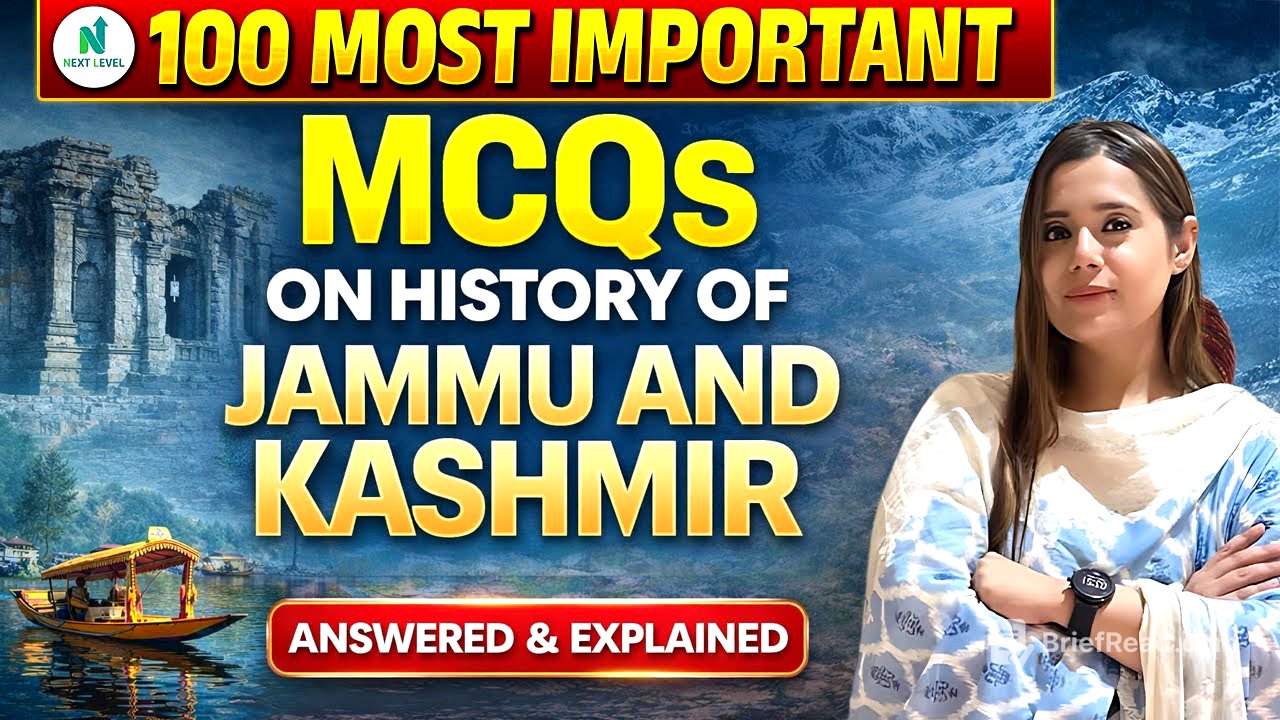
This YouTube video by Next Level India features a comprehensive review of 100 MCQs on the history of Jammu and Kashmir. The session covers ancient, medieval, and modern periods, discussing dynasties, rulers, key events, and their significance. The presenter aims to provide a thorough understanding of the region's history through multiple-choice questions, offering detailed explanations and historical context.
- Covers ancient, medieval, and modern history of Jammu and Kashmir.
- Discusses various dynasties, rulers, and key historical events.
- Aims to provide a comprehensive understanding through MCQs and detailed explanations.
Question 1-5 [3:42]
The session begins with a question about the winter capital of Jammu and Kashmir, which is Jammu. Srinagar is the summer capital. The presenter mentions the Chief Minister's call for the Durbar Move after a long time. The next question identifies the location of the Martand Sun Temple in the Anantnag district of Kashmir, built by Lalitaditya Muktapida of the Karakota dynasty. The temple's architecture shows Greek, Islamic, Chinese, and Roman influences and was demolished by Shahmir. Currently, the Archeological Survey of India protects it.
Question 6-10 [11:28]
The discussion shifts to books mentioning the Jammu region, including Ashtadhyayi by Panini, Rajatarangini by Kalhana, and Tahkik-ul-Hind by Al-Biruni. All of these books contain mentions of the Jammu region. The place with significant archeological finds is Akhnoor, specifically Manda, an Indus Valley Civilization site. The city of Jammu gets its name from Raja Jambulochan, who, upon seeing a lion and goat drinking water together, decided to build his kingdom there, signifying peace and harmony.
Question 11-15 [19:02]
In ancient times, the Pir Panjal range was known as Panchala Deva, linking it to the kingdom of Mahabharata. The Dogri script was invented by Shaktikaran from the Agnigir dynasty. After King Shal's death, Babruvahana, son of Arjuna, ruled Jammu, according to the Mahabharata. Raja Bhau Arjun was the first ruler to establish a strong dynasty in Jammu, founding the Raja Bhau dynasty. Damodar Datta, son of Raja Bhau Arjun, defended his territory against Alexander in 326 BC.
Question 16-20 [29:46]
Adi Rai established the Rai dynasty in Jammu, ruling for 40 years. Suraj Dhar founded the Dhar dynasty, which lasted for 55 years. During the Dhar dynasty, Muslim saint Roshan Shah Wali R.A. entered Jammu from Arab, and his shrine is in Gumat. Ariwa is not an ancient capital around the Jammu region. The Dhar dynasty was taken over by the Dev dynasty in 840 AD, marking the start of the medieval history of Jammu.
Question 21-25 [36:31]
During the Dev dynasty's rule, Muslim states began to appear in Jammu. Avatar Dev, a ruler of the Dev dynasty, defeated Mahmud of Ghazni with the combined strength of Jammu's hill chiefs. The Battle of Peshawar was fought between Avatar Dev and Mahmud of Ghazni. Maldev, of the Dev dynasty, resisted attacks from Timur and is known for the golden period in Jammu's history, establishing Jammu as the Dogra capital.
Question 26-30 [42:23]
The longest-ruling dynasty in Jammu was the Dev dynasty, which ruled for about 200 years. Out of the 12 Sikh Misls, the Sukerchakia Misl, to which Ranjit Singh belonged, started attacks in the Jammu region during the rule of Jeet Singh. The Sikh rule in Jammu was established by Ranjit Singh. Mian Dido, from the Jamwal clan, led local revolts against Sikh rule in Jammu.
Question 31-35 [47:52]
Maharaja Ranjit Singh gave the title of Raja to Gulab Singh in 1820. In 1820, Maharaja Ranjit Singh appointed Gulab Singh as an independent ruler of Jammu. Kashmir was not a part of the Jammu kingdom under Gulab Singh until 1846. The Anglo-Sikh War ended with the Treaty of Lahore. Gulab Singh purchased Kashmir from the East India Company in 1846 for 75 lakh Nanak Shahi under the Treaty of Amritsar.
Question 36-40 [52:59]
Gulab Singh established Dogra rule in Jammu and became the first Maharaja of Jammu and Kashmir. Gulab Singh was the first Maharaja of Jammu and Kashmir. After Maharaja Gulab Singh, Maharaja Ranbir Singh took the throne of Jammu and Kashmir. Maharaja Gulab Singh politically united the three regions of Jammu, Kashmir, and Ladakh into the princely state of Jammu and Kashmir.
Question 41-45 [55:29]
Maharaja Ranbir Singh built the Ranbireshwar Temple in the Jammu region. Ranbir Singh conquered Gilgit and Astor. Maharaja Pratap Singh built the Jhelum Valley Road and completed the Banihal Cart Road in Jammu and Kashmir. Maharaja Pratap Singh built the Ranbir Canal and Pratap Canal in the UT of Jammu and Kashmir.
Question 46-50 [58:48]
During the reign of Maharaja Pratap Singh, Jammu and Kashmir got its first hydroelectric power plant. Maharaja Hari Singh made primary education compulsory in the UT of Jammu and Kashmir. Maharaja Hari Singh established the first legislature, known as the Praja Sabha, in 1934. Srinagar was the summer capital of Jammu and Kashmir during the Dogra rule. Gulab Singh demarcated the boundaries of the princely state of Jammu and Kashmir because he signed the Treaty of Amritsar.
Question 51-55 [1:02:50]
Rajatarangini, written by Kalhana, presents a critical record of the history of Kashmir. The earliest archeological site in Kashmir is Burzahom. Kashyap Mar represented modern-day Kashmir, and the Kashmir Valley was a lake called Satisar.
Question 56-60 [1:10:01]
The earliest literary source of Kashmir is Rajatarangini. Burzahom, a neolithic site in Srinagar, Kashmir, has evidence of agriculture. Major inventions of the Neolithic era found in Kashmir include needles, harpoons, and hunting tools. A neolithic skull with a hole suggests a surgical operation. Gritty redware pottery was found at Akhnoor, an Indus Valley Civilization site.
Question 61-65 [1:15:11]
According to popular belief, Sadimati Nagar got submerged with the creation of Wular Lake. Ashoka appointed a Buddhist missionary to spread Buddhism in Kashmir. Kalhana mentions Kushka, Jushka, and Kanishka as the Turushka kings. Kanishkapura was built by Kanishka.
Question 66-70 [1:22:00]
Kanishka held the Fourth Buddhist Council in Kundalvan, Kashmir, which divided Buddhism into Mahayana and Hinayana. Abhimanyu I, of the Gonanda Empire, shifted his capital from Kashmir to Rajouri during winter. An invader from Central Asia, Mirakula, conquered North India, including Kashmir and Gandhara. Pravarasena II founded the Pravarasenapura city of Srinagar.
Question 71-75 [1:28:30]
Meghavahana, who prohibited the slaughtering of animals, belonged to the Gonanda dynasty. Durlabhvardhana was the founder of the Karakota dynasty. During the reign of Durlabhvardhana, the Chinese traveler Hiuen Tsang visited Kashmir. Lalitaditya Muktapida conquered several states.
Question 76-80 [1:32:26]
Lalitaditya Muktapida built the Martand Sun Temple in Jammu and Kashmir. After the end of the Karakota dynasty, the Utpala dynasty came into power. Avantivarman founded the Utpala dynasty. King Yashaskara ruled Kashmir between 939 to 948 AD. Queen Didda, known as the Catherine of Kashmir, belonged to the Lohara dynasty.
Question 81-85 [1:36:32]
Sangramraj was the founder of the Lohara dynasty. During the reign of Jayasimha, Kalhana completed the writing of Rajatarangini. Kalhana completed his writing of Rajatarangini between 1148 to 1150 AD. Sangram Dev and Suha Dev were the notable kings of the Dev dynasty. The first Muslim ruler of Kashmir was Sultan Sadruddin.
Question 86-90 [1:46:04]
Udayana Deva was the last Hindu ruler of Kashmir. Shah Mir assumed the title of Shams-ud-din and became the first ruler of the Shah Mir dynasty. Ghazi Chak succeeded Sultan Habib Shah. Ghazi Shah Chak founded the Chak dynasty in Kashmir.
Question 91-95 [1:47:17]
Yusuf Chak was imprisoned by Akbar. The Mughal army, under Qasim Khan, defeated Yaqub Shah Chak, the last Chak dynasty ruler, at Haripura. The chronological order of dynasties in Kashmir is Utpalas, Loharas, Deva dynasty, and Shah Mirs. Raja Todar Mal was a great finance/revenue minister during Akbar's period. Akbar built the Hari Parbat Fort, also known as Koh-e-Maran.
Question 96-100 [1:52:33]
Jahangir built Shalimar and Nishat Bagh in Jammu and Kashmir. Chashma Shahi Garden was built in 1632 AD. Ahmed Shah Abdali was invited by two Kashmiri noblemen to capture Kashmir in 1752 AD. The Afghan period is known as the darkest period in the history of Kashmir. The Afghan rule was established in Kashmir approximately in 1752.