TLDR;
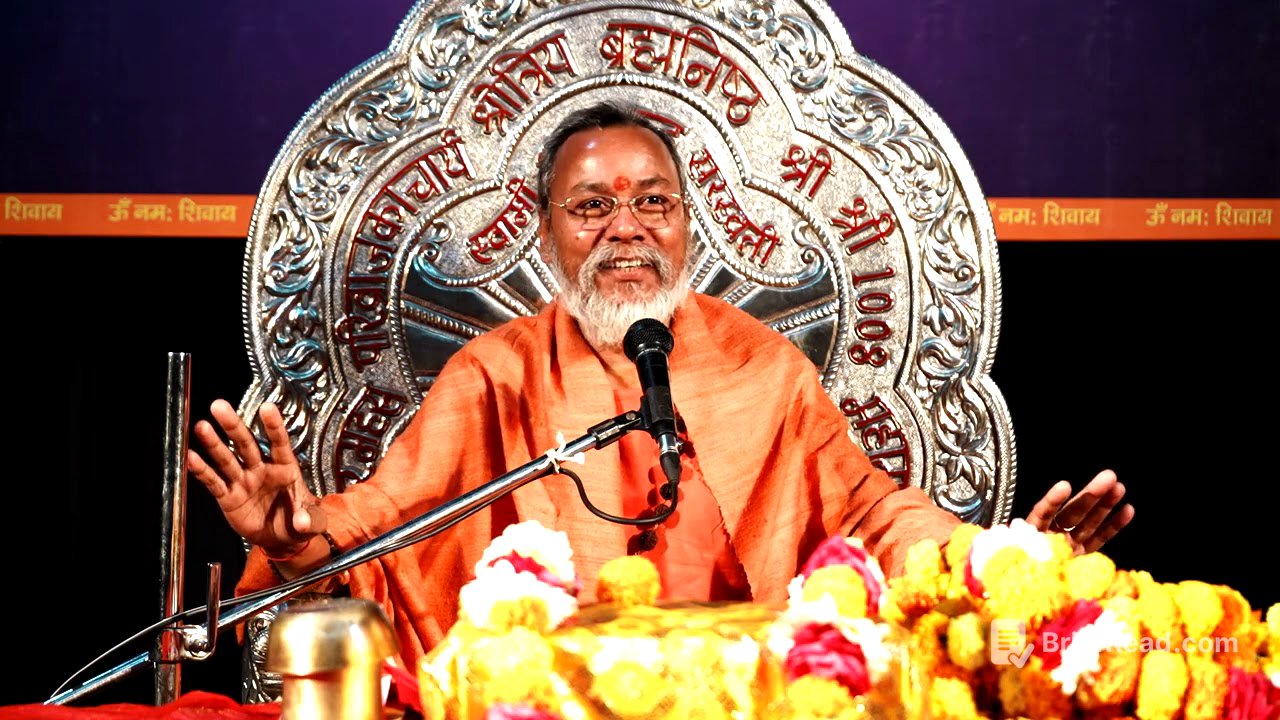
This YouTube video by Mahamandleshwar Swami Abhayanand Saraswati provides a detailed explanation of the seventh chapter of the Bhagavad Gita, titled "Jnana-Vijnana Yoga." The chapter begins with a promise from Krishna to Arjuna, stating that if Arjuna dedicates his mind to Krishna, Krishna will reveal himself in totality. The talk covers the importance of devotion, the nature of the material world, and the distinction between the lower and higher natures of reality.
- Krishna promises to reveal himself fully to Arjuna if Arjuna dedicates his mind to him.
- The material world is described as a combination of lower and higher natures.
- True knowledge involves understanding the relationship between the individual soul, the material world, and the Supreme Being.
Introduction [0:05]
The video starts with traditional Hindu chants and prayers, setting a spiritual tone for the discourse on the Bhagavad Gita. It emphasizes the importance of surrendering to the divine and seeking guidance for one's well-being. The speaker outlines the progression of the Gita, noting that the first chapter describes Arjuna's mental state, the second summarizes essential knowledge, and subsequent chapters focus on purifying the mind.
The Promise of Divine Revelation [3:22]
The seventh chapter, "Jnana-Vijnana Yoga," begins with Krishna's promise to Arjuna: if Arjuna dedicates his mind to Krishna, Krishna will reveal himself in totality. This is framed as a reciprocal relationship, where effort and devotion from the devotee lead to divine grace and knowledge. The speaker stresses that this devotion requires a full-time commitment, not just temporary or half-hearted efforts.
The Nature of "Jnana-Vijnana" [12:48]
Krishna promises to impart both "jnana" (general knowledge) and "vijnana" (specific, experiential knowledge). This knowledge is so complete that nothing else remains to be known. The speaker highlights the rarity of those who truly seek and understand this knowledge, noting that it is not easily accessible or universally grasped.
The Rarity of True Seekers [14:37]
The speaker emphasizes that true spiritual seekers are rare. Drawing from the Bhagavad Gita, he explains that out of thousands of people, only a few strive for spiritual perfection, and among those who strive, only a handful truly know Krishna. He contrasts this with the common pursuit of worldly pleasures and material success, which distract many from the path of self-realization.
The Lower Nature (Aprakriti) [29:58]
Krishna describes his lower nature, "Aprakriti," as being comprised of eight elements: earth, water, fire, air, ether, mind (manas), intellect (buddhi), and ego (ahankara). The speaker uses the analogy of building an ashram to illustrate these elements, starting with the need for land and water, then fire for cooking, and so on. He explains that the mind is both individual (vyashti) and collective (samashti), influencing our actions and perceptions.
The Higher Nature (Para Prakriti) [47:28]
Krishna reveals his higher nature, "Para Prakriti," as the life-element (jiva) that sustains the entire universe. This life-element is the consciousness that animates all beings. The speaker explains that while the lower nature comprises the physical elements and mental faculties, it is the higher nature, the divine spark within, that truly sustains and governs existence.
The Source of All Creation [56:33]
Krishna declares that both the lower and higher natures originate from him, making him the source of all creation and dissolution. He emphasizes that these natures are not independent but are governed by him. The speaker uses the analogy of an organization where different individuals have different roles, but all are under the authority of the leader.
Krishna as the Thread [1:02:08]
Krishna explains that everything in the universe is connected to him like beads on a thread. He is the underlying reality that pervades all existence. The speaker uses the analogy of a sweater with various designs, where the thread is the fundamental element, and the designs are mere appearances. Similarly, Krishna is the underlying reality, and the diverse forms of the universe are manifestations of him.
Dealing with Dukkha (Suffering) [1:11:45]
The speaker discusses how suffering arises from various sources, including one's own past actions (prarabdha), the external environment (prakriti), and the body and mind. He shares a story of a clever jackal to illustrate different strategies for dealing with challenges: appeasement for the powerful, division for those with conflicting interests, strategic alliances for the weak, and direct confrontation for equals. He applies these strategies to dealing with suffering, suggesting acceptance and endurance for unavoidable circumstances, adaptation for environmental challenges, and mental discipline for overcoming mental afflictions.
Conclusion and Preview [1:20:25]
The speaker summarizes the key points of the discourse, emphasizing Krishna's promise, the nature of knowledge, the rarity of true seekers, and the distinction between the lower and higher natures. He concludes by previewing the next session, which will explore how to perceive Krishna in all aspects of creation, and ends with traditional chants and prayers.