TLDR;
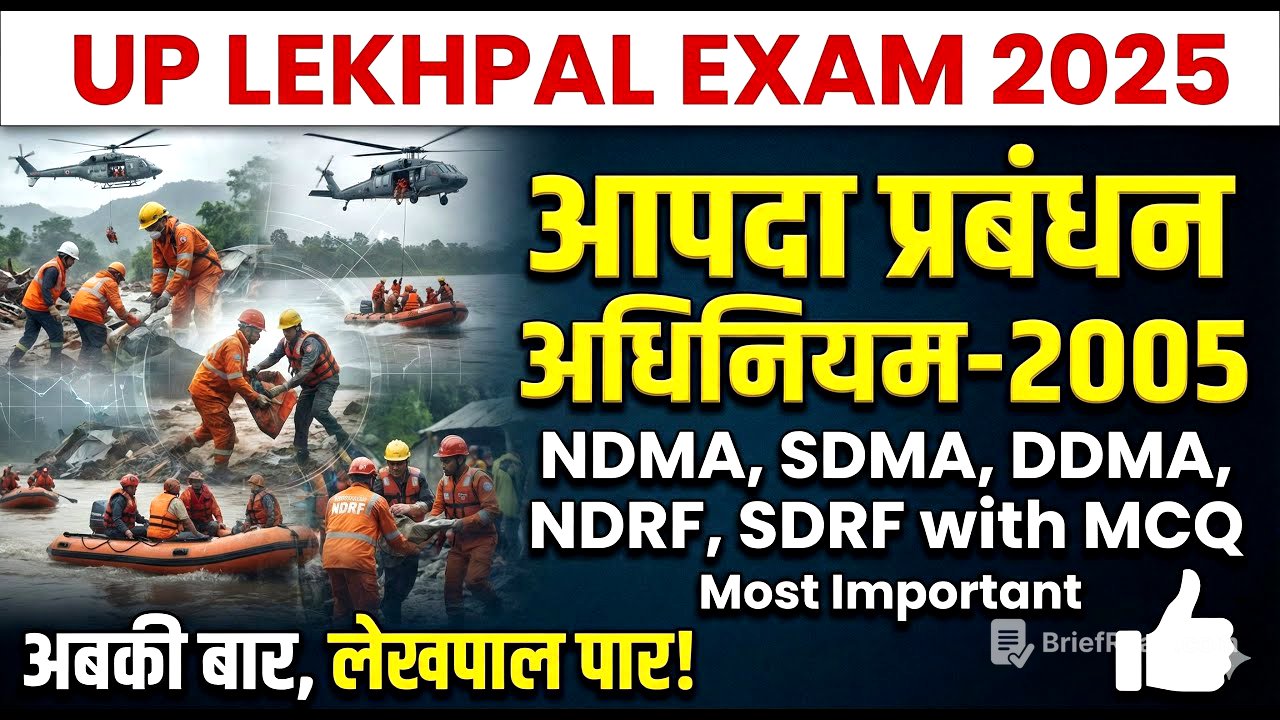
Namaste doston! This video is a comprehensive guide to the Disaster Management Act 2005, crucial for the UP Lekhpal exam 2025. It covers key sections, the structure of disaster management bodies at national, state, and district levels, and important institutions like NDMA and NDRF. The video also includes a set of MCQs to help reinforce the concepts.
- Key sections of Disaster Management Act 2005
- Structure of disaster management bodies
- Functions of NDMA, SDMA, DDMA, NDRF
- Important institutions like NIDM and IMD
Introduction to Disaster Management Act 2005 [0:00]
The video begins with a brief introduction and a mention of an Agarwal Exam Card study book for the UP Lekhpal exam, covering various subjects like history, polity, economics, and গ্রাম সমাজ एवं विकास. The book also includes practice sets and उत्तर प्रदेश जीके. The speaker then introduces the main topic: the Disaster Management Act 2005.
Overview of the Disaster Management Act 2005 [1:38]
The Disaster Management Act 2005 is the primary framework for disaster management in India, enacted on December 23, 2005. It comprises 11 chapters and 79 sections. Section 2D defines "disaster" broadly. The act establishes a three-tiered structure: national, state, and district levels. It also provides for the creation of mitigation and response funds. The Ministry of Home Affairs is designated as the nodal ministry for disaster management.
Key Sections of the Act [2:49]
Section 3 deals with the establishment of the National Disaster Management Authority (NDMA). Section 6 outlines the powers and functions of the NDMA. Section 8 provides for the formation of the National Executive Committee. Section 14 concerns the establishment of State Disaster Management Authorities (SDMA). Section 25 deals with the establishment of District Disaster Management Authorities (DDMA). Section 44 is related to the formation of the National Disaster Response Force (NDRF). Section 46 mentions the National Disaster Response Fund. Sections 51, 52, and 54 specify penalties for obstructing disaster relief efforts, making false claims for relief, and spreading false warnings, respectively.
National Disaster Management Authority (NDMA) [5:07]
The NDMA is the apex statutory body for disaster management in India, headed by the Prime Minister. The Vice-Chairman holds a rank equivalent to a Cabinet Minister. Established on September 27, 2006, under the Disaster Management Act 2005, its headquarters is in New Delhi. The NDMA approves the national plan for disaster management and can have up to nine members besides the chairperson. It ensures coordination among various ministries during disasters.
State and District Disaster Management Authorities (SDMA & DDMA) [6:04]
At the state level, the SDMA is responsible for disaster management, headed by the Chief Minister. The Chief Secretary chairs the State Executive Committee. The Uttar Pradesh SDMA was formed under the 2005 Act. At the district level, the DDMA is headed by the District Magistrate, with an elected representative from the local authority as the co-chairperson. The SDMA approves the state disaster management plan.
National and State Disaster Response Forces (NDRF & SDRF) [7:09]
The NDRF, or National Disaster Response Force, was formed under Section 44 of the Disaster Management Act 2005. Its motto is "आपदा सेवा सदैव" (Aapda Seva Sadaiv). It is a specialized force for relief and rescue operations during severe disasters, comprising personnel from various central armed police forces. The NDRF is headed by a Director General of IPS rank. The SDRF is formed by state governments for deployment in local emergencies.
Other Important Institutions [8:16]
NIDM, or the National Institute of Disaster Management, located in New Delhi, focuses on training and research in disaster management. IMD, the India Meteorological Department, is the nodal agency for weather forecasting and cyclone warnings. CWC, the Central Water Commission, issues flood warnings. The National Executive Committee (NEC) is headed by the Union Home Secretary. The government runs the Aapda Mitra scheme for community-level awareness. India has adopted the Sendai Framework for international disaster risk reduction.
MCQ Practice [9:33]
The video concludes with a series of multiple-choice questions (MCQs) to reinforce learning:
- Who is the ex-officio chairman of NDMA? (Prime Minister)
- Which section of the act defines "disaster"? (Section 2D)
- Who chairs the District Disaster Management Authority? (District Magistrate)
- Under which section was NDRF formed? (Section 44)
- What is the penalty for spreading false warnings about a disaster? (Section 54)
- Who is the ex-officio chairman of the National Executive Committee? (Union Home Secretary)
- Which ministry is the nodal ministry for disaster management in India? (Ministry of Home Affairs)
- How many chapters are there in the Disaster Management Act 2005? (11)
- What is the main function of NIDM? (Training and capacity building)
- Who chairs the State Executive Committee? (Chief Secretary of the State)
Conclusion [13:50]
The video wraps up by encouraging viewers to like, subscribe, and share the video. Viewers are also prompted to leave comments and can obtain the PDF of the session by contacting the number displayed on the screen.