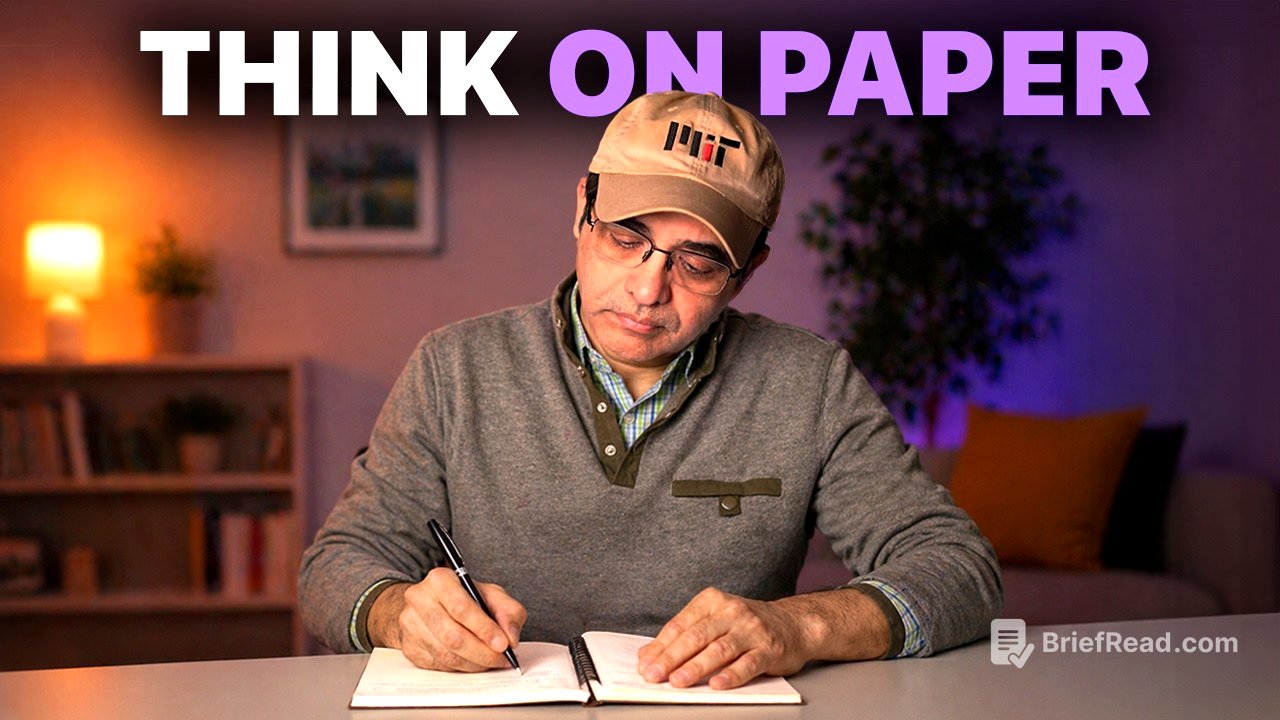
TLDR;
The video emphasizes the importance of the age-old skill of "thinking on paper" to enhance clarity of thought, accelerate learning, and master skills in the era of AI. The presenter shares a comprehensive framework that encourages the use of pen and paper as a powerful tool for generating ideas, introspecting emotions, and developing intuition.
- Pen and paper aid in shaping thoughts more effectively than typing or prompting.
- Three Originals – Invention, Introspection, and Intuition – are key traits that define human creativity and originality.
The Importance of Thinking on Paper [0:00]
The video opens with the assertion that to think more clearly and learn quickly in the age of AI, one must revive the forgotten skill of thinking on paper. The speaker shares insights from decades in high-stakes environments, stating that the best thinkers still use pen and paper as their primary tool for generating ideas, emphasizing that writing on paper activates areas of the brain responsible for creativity and learning.
The Power of Handwriting [1:30]
The presenter explains how writing by hand is distinct from typing, as each letter you write involves a unique physical experience that benefits your cognitive processes. Even research supports that handwritten notes enable deeper understanding compared to typing. The importance of engaging the physical act of writing is noted, as it positively affects emotional processing and cognitive clarity.
The Three Originals: Invention, Introspection, and Intuition [4:00]
The video introduces the framework known as the "three originals," which are invention (generating new ideas), introspection (navigating emotions), and intuition (defining problems). The speaker encourages viewers to use paper for invention by removing self-criticism, labeling thoughts during introspection to articulate emotions, and employing writing to clarify problems intuitively—reinforcing that these processes are distinct to each individual's creative expression.
Confronting the Blank Page [6:24]
The speaker addresses the common fear of facing a blank page, explaining that this challenge often drives people to rely on AI solutions, which only offer a temporary escape. It is suggested that embracing the discomfort of the blank page is essential for achieving clarity and originality in creative work. Essential tips are provided on how to overcome the fear of starting, emphasizing the need to be non-judgmental and spontaneous when writing.
Using Tools Effectively: Paper, Keyboard, and AI [9:49]
The presenter discusses how each tool—paper, keyboard, and AI—serves a different purpose in the creative process. Paper is ideal when ideas need freedom and rawness; keyboards assist with structuring and refining ideas; and AI provides feedback and expansion. The sequence can change based on the evolving needs of the idea, illustrating that creativity should flow between these tools to achieve the best results.
The Human Element in Creation [14:04]
In concluding remarks, the video emphasizes that while AI can enhance and refine ideas, it cannot create them. The essence of human creation lies in personal emotion, intuition, and originality, which paper helps protect and cultivate. The speaker draws analogies to art and sculpture, stressing that the process of shaping ideas in private is crucial for genuine creative expression and personal growth.