TLDR;
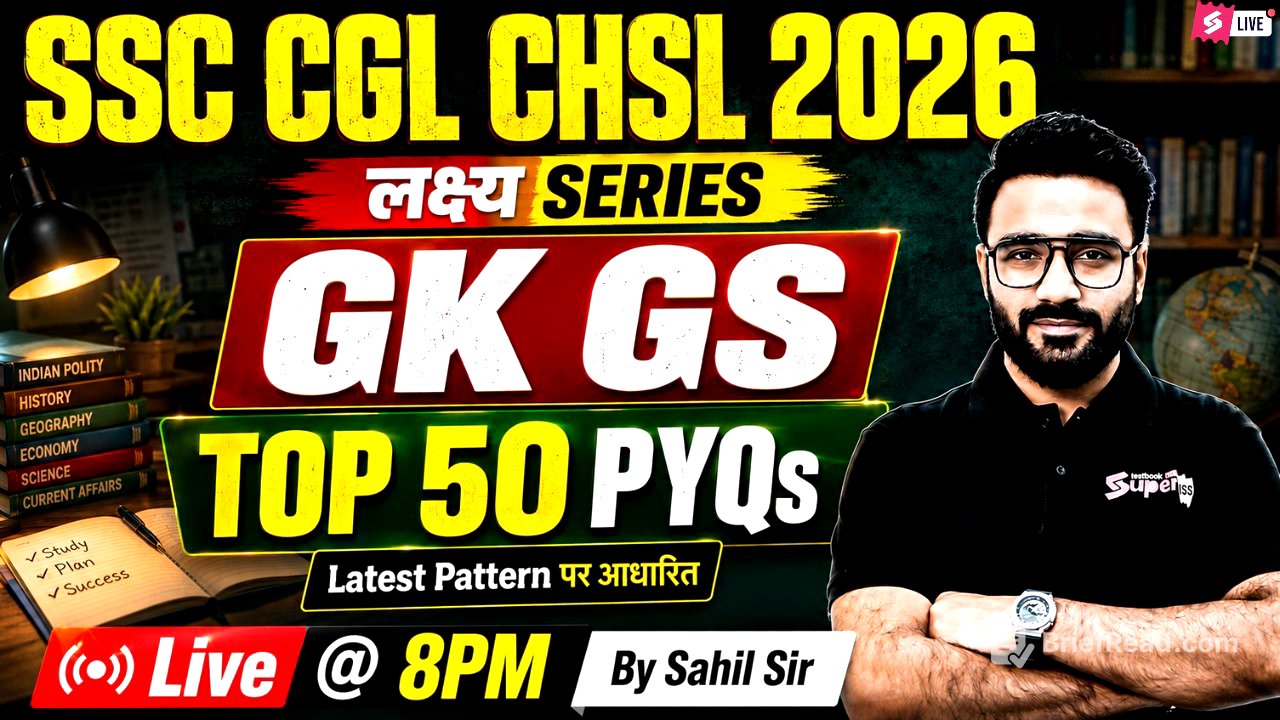
The video is a recording of a live SSC (Staff Selection Commission) exam preparation class. The instructor discusses the importance of syllabus coverage and practice for cracking exams like CGL and CHSL. He also solves previous year questions, explains important facts and concepts, and shares important exam updates. The session includes questions from polity, geography, history and current affairs. The instructor also announces changes to the class schedule, combining current affairs with the existing GK/GS session.
- Syllabus coverage and practice are key to exam success.
- The class will now cover GK/GS, static GK, and current affairs.
- A special offer is available on the SSC CGL 2026 batch with coupon code AVS.
Introduction and Importance of Syllabus Coverage [0:06]
The instructor welcomes students preparing for SSC CGL, CHSL, and other SSC exams. He emphasizes the importance of covering the syllabus and practicing regularly to clear these exams. He insists that without proper syllabus coverage, clearing the exam is impossible. He also mentions that the daily 8 PM class is for practice.
Parliament and State Legislature Composition [1:34]
The instructor explains the composition of the Indian Parliament, which includes the Lok Sabha, Rajya Sabha, and the President. He mentions Article 79 for Parliament, Article 80 for Rajya Sabha, Article 81 for Lok Sabha, and Articles 52-62 for the President. Similarly, he describes the State Legislature, comprising the Vidhan Parishad, Vidhan Sabha, and the Governor, with corresponding articles 168, 169, 170, and 153 respectively.
Election of the Vice President of India [3:08]
The discussion moves to the electoral college for the election of the Vice President of India. Unlike the President's election, which includes only elected members from the Lok Sabha, Rajya Sabha, and State Legislative Assemblies, the Vice President's election involves all members of Parliament, whether elected or nominated.
Town Planning and Municipalities [4:54]
The instructor explains that town planning falls under the purview of municipalities. He references the 74th Amendment of 1992, Part 9A, Schedule 12, and Articles 243P to 243 ZG, which are related to municipalities.
Incorrect Statement about Rajya Sabha [6:01]
The instructor asks students to identify the incorrect statement about the Rajya Sabha. The correct answer is that 1/3 of its members retire every second year, not every year.
Rigidity and Flexibility of the Indian Constitution [7:14]
The instructor discusses the article of the Indian Constitution that indicates it is neither too rigid nor too flexible. He points out that Article 368, which deals with constitutional amendments, implies this balance. He also mentions Article 338 (National Commission for Scheduled Castes), Article 352 (National Emergency), and Article 148 (CAG).
Capital of Nepal [8:22]
A straightforward question about the capital of Nepal is posed, with the correct answer being Kathmandu. Other options like Dhaka (Bangladesh), Naypyidaw (Myanmar), and Islamabad (Pakistan) are also mentioned.
Duties of Devta Adhyaksha in Mauryan Empire [8:53]
The role of the Devta Adhyaksha in the Mauryan Empire is explained as the head of religious institutions or temples. Other administrative posts like Mantriparishad, Amatyas, Rajukkas, and various Adhyakshas for market, toll, agriculture etc. are also mentioned.
Current CAG of India [10:45]
The instructor asks who the current CAG (Comptroller and Auditor General) of India is, with the correct answer being Mr. K. Sanjay Murthy. He explains that the CAG is appointed by the President under Article 148 and audits the expenses of the Central and State Governments.
20th G20 Leaders' Summit Venue [12:04]
The venue for the 20th G20 Leaders' Summit is discussed, with the correct answer being South Africa (2025). The instructor also mentions previous and upcoming venues: Indonesia (2022), India (2023), and Brazil (2024).
Guardian of Fundamental Rights [12:52]
The instructor asks which institution is known as the guardian of fundamental rights, with the correct answer being the Judiciary. He explains that individuals can approach the Supreme Court (Article 32) or High Court (Article 226) if their fundamental rights are violated, and these courts can issue writs.
Climate for Paddy and Jute Cultivation [13:52]
The type of climate suitable for paddy (rice) and jute cultivation is identified as tropical wet climate. West Bengal is mentioned as a major producer of both crops in India. India is now the number one producer of rice, surpassing China.
Eastern Maritime Corridor [14:56]
The Eastern Maritime Corridor, connecting Chennai (India) and Vladivostok (Russia), is discussed. This corridor aims to reduce travel time and dependency on routes through China.
Father of Local Self Government [17:18]
Lord Ripon is identified as the Father of Local Self Government. The instructor also mentions that the 1881 census, conducted during Ripon's tenure, led to the continuation of the 10-year census cycle.
Indra Exercise [18:15]
The Indra exercise is identified as a joint military exercise between India and Russia. The instructor provides a trick to remember it: IND from India and RA from Russia make INDRA. He also lists other joint exercises like Yudh Abhyas and Vajra Prahar (India-US), Sampriti (India-Bangladesh), and Mitra Shakti (India-Sri Lanka).
First Governor-General of Independent India [19:46]
Lord Mountbatten is identified as the first Governor-General of independent India. The instructor clarifies that while Mountbatten was the last Viceroy, the post was changed to Governor-General after independence. C. Rajagopalachari was the first Indian to hold this position.
Sathyamangalam Tiger Reserve [21:06]
The Sathyamangalam Tiger Reserve is located in Tamil Nadu. The instructor also addresses a student's query about starting studies mid-way through the course, advising them to focus on syllabus coverage through online batches and to treat the daily 8 PM class as their first for practice.
Origin of Sabarmati River [23:01]
The Sabarmati River originates from the Aravalli hills in Rajasthan and flows through Gujarat, with cities like Ahmedabad and Gandhinagar situated on its banks. It eventually merges into the Arabian Sea via the Gulf of Khambhat.
Winner Space Program [23:49]
The Winner Space Program is associated with Australia.
Objective of the 15th Census [24:30]
The objective of the 15th census was "Our Census, Our Future." It was the 15th census in total and the 7th after independence. The upcoming 2027 census will be the 16th.
India's First Super Capacitor Manufacturing Facility [25:10]
India's first super capacitor manufacturing facility was inaugurated in Kannur, Kerala (now Keralaam).
Name of Indian National Congress [25:43]
The name "Indian National Congress" was given by Dadabhai Naoroji. The instructor shares details about Dadabhai Naoroji, including his three terms as Congress President (1886, 1893, 1906), his book "Poverty and Un-British Rule in India," his pioneering work in estimating India's national and per capita income, his membership in the British House of Commons, and his newspaper "Raft Goftar". He was also known as the Grand Old Man of India.
Red Revolution [27:55]
The Red Revolution is associated with increasing the production of tomatoes and meat. The instructor also mentions other revolutions like the Silver Revolution (egg production), Silver Fiber Revolution (cotton production), and Golden Fiber Revolution (jute production).
Planet Closest to Earth [29:02]
According to government exams, Venus is the planet closest to Earth. However, NASA research suggests Mercury is closer. The instructor advises students to answer Venus in exams.
Establishment of Sabarmati Ashram [29:50]
Mahatma Gandhi established the Sabarmati Ashram in 1917. The instructor lists several key events in Gandhi's life, including his return to India in 1915, the Lucknow Session in 1916, the Champaran Satyagraha in 1917, and his death in 1948.
Navika Sagar Parikrama Expedition II [32:12]
The Indian Navy sailing vessel used in the Navika Sagar Parikrama was INS Tarini. This expedition was significant as it was undertaken by an all-women crew, promoting women's empowerment.
Changes to Class Schedule [33:41]
The instructor announces that the 1 PM current affairs class is being discontinued due to workload. However, current affairs will now be included in the 8 PM GK/GS class, along with static GK. The 8 PM class will cover previous year questions, a GK/GS topic, and daily current affairs, aiming to cover the last year's current events.
SSC CGL 2026 Batch and Exam Preparation Strategy [37:28]
The instructor reiterates the importance of syllabus coverage for clearing SSC exams and recommends the SSC CGL 2026 batch for comprehensive preparation. He provides instructions on how to access the batch through the video description, apply the coupon code AVS for a discount, and choose between 1-month and 3-month subscription plans. He also mentions that students using the AVS code will get access to the Vardan batch for free.