TLDR;
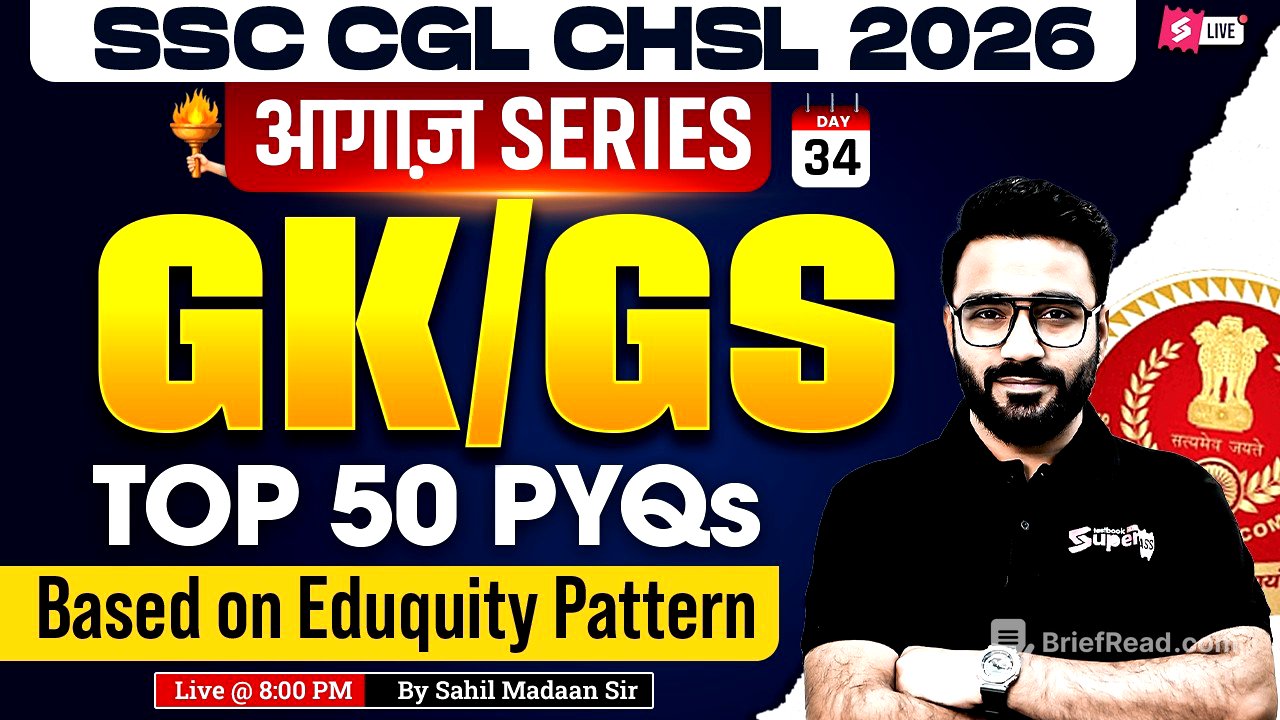
Namaste doston! This video is a GK/GS class for students preparing for SSC CGL and other SSC exams. The speaker shares an update about the SSC GD exam date and anticipates the CGL notification soon. The class covers important topics like fundamental rights, schedules of the Indian Constitution, official languages, historical temples, folk dances, and more. The speaker also shares tips to remember important facts and amendments, and emphasizes focusing on studies rather than stressing about notifications.
- SSC GD exam date announced, CGL notification expected soon.
- Discussion on fundamental rights, schedules, and official languages of the Indian Constitution.
- Tips and tricks to remember important facts and amendments.
Armed Forces and Fundamental Rights [1:27]
The class begins with a question on which article deals with the restriction of fundamental rights in relation to armed forces, paramilitary forces, and police forces. The correct answer is Article 33. Article 34 discusses military law, and Article 35 discusses the power of Parliament in the case of fundamental rights. These articles are often overlooked but are important for exams.
Schedules of the Indian Constitution [2:47]
The speaker discusses the fourth schedule of the Indian Constitution, which deals with the allocation of seats to states in the Rajya Sabha. He introduces a trick to remember all the schedules: "Tears of Old PM." He explains each letter: T for Union and its Territories, E for Emoluments and Salaries, A for Affirmation (Oath), R for Rajya Sabha seats allocation, S for Scheduled Areas, O for Other Scheduled Areas (North East states), F for Federal List (Union, State, and Concurrent List), O for Official Language, L for Land Reforms, D for Anti-Defection Law, P for Panchayat, and M for Municipality.
Official Languages in the Indian Constitution [6:01]
The video discusses the eighth schedule of the Indian Constitution, which deals with official languages. India has 22 official languages. This is mentioned in Part 17 of the Constitution. The speaker shares a trick to remember the amendments related to the addition of languages: First, remember 21 and 71. The 21st amendment added the Sindhi language. The 71st amendment (1992) added Konkani, Manipuri, and Nepali. Adding 21 and 71 gives 92, so the 92nd amendment (2003) added Bodo, Dogri, Maithili, and Santhali (BDMS). Then, 92 + 4 = 96. The 96th amendment (2011) changed the spelling of "Oriya" to "Odia".
Thousand Pillar Temple [9:16]
The speaker asks when the Thousand Pillar Temple was built. It was built in the 12th century by the Kakatiya dynasty. The temple is also known as the Rudreshwara Swami Temple, built by Rudra Deva. It is located in Warangal district, Telangana, and is dedicated to Lord Vishnu and Surya Dev.
Folk Dances of Karnataka [10:44]
The video discusses the folk dance called "Dolu Kunitha," which is from Karnataka. Other folk dances from Karnataka include Yakshagana, Veeragase, Huli Vesha, Kamsale, Bhoota Aradhane, Halakki, Suggi Kunitha, Somana Kunitha, Goravara Kunitha, and Pooja Kunitha. The speaker notes that many dances ending with "Kunitha" are from Karnataka.
Svatantrata Mera Janam Siddh Adhikar Hai [11:47]
The speaker asks who said, "Svatantrata Mera Janam Siddh Adhikar Hai, aur main ise lekar rahunga." The answer is Bal Gangadhar Tilak. Bhagat Singh popularized the slogan "Inquilab Zindabad," and Subhash Chandra Bose said, "Tum mujhe khoon do, main tumhe azadi dunga."
Causes of the 1857 Revolt [12:43]
The speaker discusses the main reasons for the 1857 revolt. These included political, military, social, and religious factors. Religious issues included the use of cow and pig fat in cartridges, which offended Hindus and Muslims. Military issues included discrimination against Indian soldiers. Social issues included interference by the British in Indian customs and rituals.
Chhau Dance [14:13]
The speaker discusses the Chhau dance, which is considered a semi-classical dance. It is found in Odisha, Jharkhand, and West Bengal. The dance includes stories from the Ramayana and Mahabharata.
Trans-Siberian Railway [15:06]
The Trans-Siberian Railway is mentioned in the video. Siberia is where Lake Baikal, the world's largest freshwater lake, is located.
Rivers Flowing into the Arabian Sea [15:39]
The speaker discusses rivers that flow from east to west and eventually meet the Arabian Sea. These are called western flowing rivers. Rivers that flow into the Bay of Bengal form deltas, while rivers that flow into the Arabian Sea form estuaries, which are suitable for ports. Examples of rivers flowing into the Arabian Sea are Narmada, Tapi, Periyar, and Bharatapuzha.
Establishment of an Institution [17:58]
The speaker asks who established an institution. The answer is Pandit Birju Maharaj, who is famous for Kathak, a classical dance from Uttar Pradesh (UP).
100th Constitutional Amendment [19:06]
The 100th Constitutional Amendment, passed in 2015, involved an agreement between India and Bangladesh to exchange territories.
Governor General of Bengal [21:04]
The speaker discusses the first Governor of Bengal, Robert Clive, and the first Governor-General of Bengal, Warren Hastings. The first Governor-General of India was William Bentinck, and the first Viceroy of India was Canning. These changes occurred under the 1773 Regulating Act, the 1833 Charter Act, and the 1858 Government of India Act, respectively.
Article 42 of the Indian Constitution [22:51]
The speaker asks what Article 42 of the Indian Constitution deals with. If you don't know the answer, you can eliminate the other options. Right to life and personal liberty is Article 21, and uniform civil code is Article 44.
Stand-Up India Scheme [23:43]
The government launched the Stand-up India scheme to promote entrepreneurship, especially for women and SC/ST communities. This scheme provides loans from ₹10 lakh to ₹1 crore. The government directly pays the suppliers for machinery and furniture instead of giving the money to the applicant.
Salt Satyagraha in Tamil Nadu [26:29]
The speaker asks who started the Salt Satyagraha in Tamil Nadu. The answer is C. Rajagopalachari. He explains that to get a business loan, you need to prove you have the income to repay it.
C. Rajagopalachari [28:05]
C. Rajagopalachari was the first Indian Governor-General of India after independence, after the post of Viceroy of India was changed to Governor-General of India.
69th Amendment Act, 1991 [29:52]
The 69th Amendment Act of 1991 is related to Delhi being declared the National Capital Territory with a legislative assembly. This amendment gave Delhi a legislative assembly, a council of ministers, the status of Delhi NCR, and its own Chief Minister.
Urban Planning of Indus Valley Civilization [30:50]
The speaker discusses the advanced urban planning of the Indus Valley Civilization. The main feature of their urban planning was the grid system of roads. Roads were built at 90-degree angles, and alleys were connected to the main roads.
Kakori Conspiracy Train Action [32:05]
The speaker asks who the main leaders were in the Kakori Conspiracy train action. The answer is Ram Prasad Bismil and Ashfaqulla Khan. The incident occurred on August 9, 1925. The train was going from Shahjahanpur to Lucknow, and ₹8,000 was stolen.
Largest Glacier of India [34:16]
The speaker asks which is the largest glacier in India. The answer is Siachen Glacier.
Pallava Dynasty Capital [34:33]
The speaker asks about the capital of the Pallava dynasty. The answer is Kanchipuram.
Uniform Civil Code (UCC) [34:52]
The speaker mentions that Uttarakhand has implemented the Uniform Civil Code (UCC), and Gujarat is the second state to do so. UCC falls under the Directive Principles of State Policy (DPSP).
Equal Pay for Equal Work [35:17]
The speaker discusses equal pay for equal work, which is related to Article 49A, which talks about free legal aid.
Vellore Mutiny [35:56]
The Vellore Mutiny in 1806 was the first large-scale revolt by Indian soldiers against the British East India Company. It took place in Tamil Nadu.
Symbolic Leader of the 1857 Revolt [37:00]
The speaker asks who was just a symbolic leader in the 1857 revolt. The answer is Bahadur Shah Zafar II, who was declared the Emperor of India but had no real power.
27% Reservation for OBCs [38:15]
The speaker discusses the amendment that provided 27% reservation for OBCs in government and private institutions. The answer is the 93rd Amendment.
Most Densely Populated Region in the World [38:45]
The speaker asks which is the most densely populated region in the world. The answer is the tropical region. This area has a tolerable climate and abundant resources. The tropical region is between the Tropic of Cancer (23.5 degrees north) and the Tropic of Capricorn (23.5 degrees south).
Closing Remarks and Advice [41:10]
The speaker concludes the class and requests students to like and subscribe to the channel. He advises students to focus on their studies, cover the syllabus, and take mock tests and previous year papers instead of stressing about CGL notifications. He emphasizes that hard work is the key to success and that notifications will come eventually. He encourages students to prepare seriously and not take their preparation lightly.