TLDR;
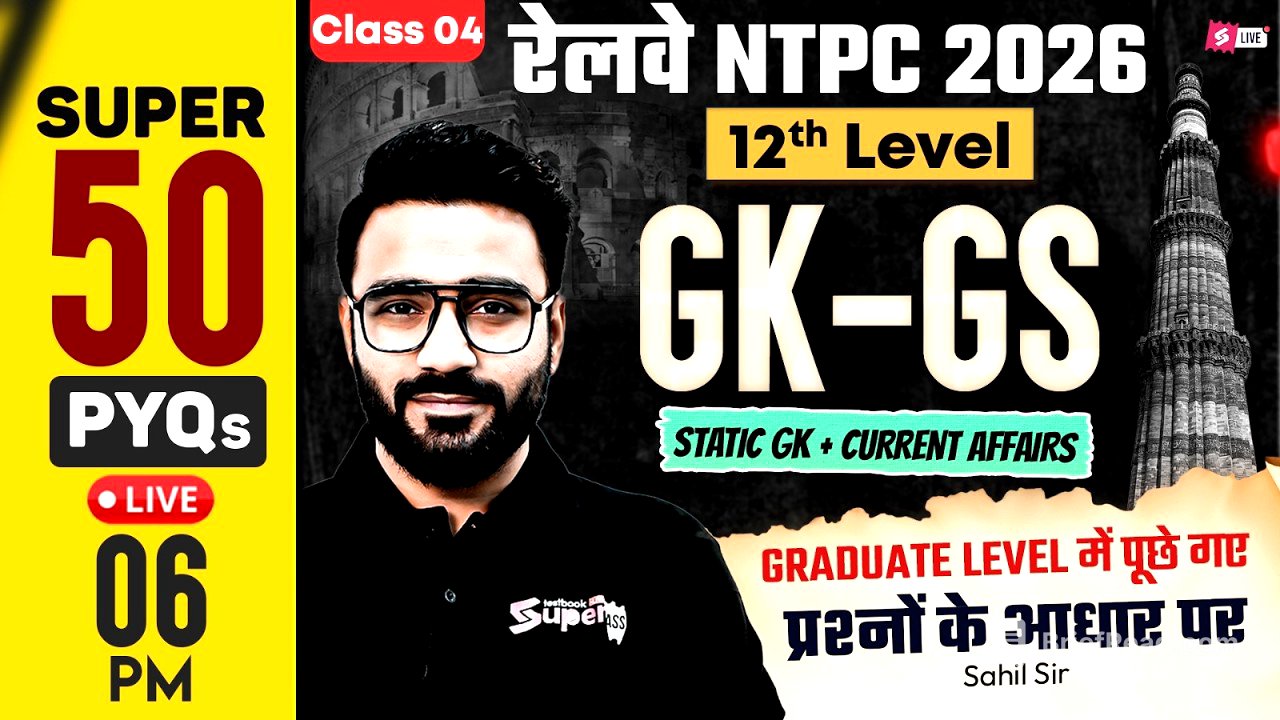
Alright guys, this session is all about prepping for the Railway NTPC exams. We're tackling previous year questions, covering important topics, and generally trying to make sure you're all set for the upcoming exams. Key topics include Indian Polity, Economics, History and Geography. Plus, there's a big surprise and some gifts for the undergraduate exam peeps, so stick around till the end!
- Focus on previous year questions for NTPC Graduate exam.
- Cover GK/GS, reasoning, math, and computer topics.
- Big surprise and 5 gifts for undergraduate exam aspirants.
National Food for Work Program [0:57]
In 2004, the Indian government launched the National Food for Work Program in 150 of the most backward districts. This initiative was spearheaded by the Ministry of Rural Development. The main aim was to provide employment and food security to the rural poor.
Union Territory with Legislative Assembly [2:14]
Among the Union Territories, Puducherry has its own elective legislative assembly. Similar to the 28 states in India, Puducherry, like Jammu & Kashmir, has a Vidhan Sabha. Puducherry got its legislative assembly in 1963 under the Government of Union Territories Act. This happened because Puducherry was under French rule until 1954 and became a Union Territory in 1962 through the 14th Amendment.
Rajya Sabha Nominations [4:32]
The President of India nominates 12 members to the Rajya Sabha. These nominations are made from four specific fields: art, literature, science, and social service. This ensures that people with expertise in these areas contribute to the parliamentary process.
Second Five-Year Plan [6:02]
The Second Five-Year Plan (1956-1961) focused on promoting industrialization in India, based on the Mahalanobis model. In contrast, the First Five-Year Plan (1951-1956), also known as the Harold-Domer model, aimed to boost agriculture and self-sufficiency. The Third Five-Year Plan (1961-1966), or Gadgil Yojana, emphasized both agriculture and industry.
Directive Principles of State Policy (DPSP) [7:46]
The Directive Principles of State Policy (DPSP), outlined in Part 4 (Articles 37-51) of the Indian Constitution, which were borrowed from Ireland, guide the government to ensure social and economic welfare. Any law made should focus on social and economic welfare.
Salaries of Members of Parliament [8:33]
The salaries of Members of Parliament in India are determined by the Parliament itself through legislation. These salaries tend to increase over time. The third schedule of the Indian Constitution deals with salaries and emoluments.
Supreme Court Establishment in Calcutta [9:45]
The Regulating Act of 1773 led to the establishment of a Supreme Court in Calcutta. Sir Elijah Impey was appointed as the first Chief Justice of this Supreme Court.
Mango Showers [10:55]
Mango showers are pre-monsoon showers that occur in Kerala and Karnataka. These early showers are beneficial for mango crops. Other types of early showers include coffee showers in Kerala, which boost coffee production; tea showers in Assam, which help tea, jute, and rice production; Kal Baisakhi in Bengal and Assam; and Bardoli Chilla, which are dust storms in Punjab, Haryana, UP, and Delhi.
Silappatikaram [12:18]
Silappatikaram is a famous Tamil epic written by Ilango around 1800 years ago. It is considered one of the five great epics in Tamil literature.
Arthashastra [13:28]
Arthashastra is associated with the Mauryan Empire and provides detailed insights into its economy, administration, and military organization. Written by Chanakya (also known as Kautilya), the guru of Chandragupta Maurya, this book guided Chandragupta in establishing the Mauryan Empire.
Methane Production and PNG [14:24]
The government should promote the production of methane for Piped Natural Gas (PNG) to reduce India's import dependency. Currently, India imports a significant portion of its methane. Increasing domestic production to 70-80% would greatly benefit the country. The initiative to promote the manufacturing sector in India was launched on December 25, 2014.
Widow Remarriage [16:51]
Baba Padamji wrote a book about the plight of widows. Raja Ram Mohan Roy worked extensively for widow remarriage. He also campaigned against the practice of Sati, which was eventually banned by Governor-General of India, William Bentinck.
Dancing Girl of Mohenjo-daro [18:51]
The "Dancing Girl" is a 4.1-inch bronze statue found in Mohenjo-daro, a city of the Indus Valley Civilization. Mohenjo-daro is also known as the "Mound of the Dead."
Khasi Tribal Revolt [20:14]
In 1829, Tirot Sing led the Khasi tribal revolt against the British. The revolt was triggered by the construction of a road through the Khasi region by the British, which the Khasi people saw as a threat to their sovereignty.
President's Rule [21:35]
President's Rule, when imposed in a state, needs to be approved by the Parliament every six months. The maximum period for which President's Rule can be imposed in a state is three years.
Rathwa ni Gher [23:13]
Rathwa ni Gher is a folk dance performed by the Rathwa community in Gujarat during festivals.
Age for Lok Sabha Membership [23:57]
To become a member of the Lok Sabha, the minimum age required is 25 years, as per Article 84. The voting age in India is 18 years (Article 326). The minimum age to contest Panchayat elections is 21 years, and for Rajya Sabha or Vidhan Parishad, it is 30 years.
Lakes in India [24:56]
Wular Lake in Jammu & Kashmir is the largest freshwater lake in India, while Chilka Lake in Odisha is the largest saltwater lake.
Indo-Aryan Languages [25:15]
Urdu, Bengali, and Assamese belong to the Indo-Aryan language family. Other languages in this group include Hindi, Marathi, Gujarati, Punjabi, Sindhi, Oriya, Nepali and Sinhala.
24th Amendment [26:20]
The 24th Amendment states that if a constitutional amendment bill is presented to the President, the President must sign it. This amendment also allows the Parliament to amend fundamental rights.
Konkan Coast [27:47]
The coastal stretch from Mumbai to Goa is known as the Konkan Coast. Other coastal regions include the Malabar Coast, Coromandel Coast, and Northern Circars.
Blue Water Policy [28:44]
The Blue Water Policy, also known as the Cartazes System, was initiated by Francisco de Almeida, the first Portuguese Viceroy of India (1505-1509). This policy aimed to establish Portuguese naval dominance in the Indian Ocean to control trade routes and coastal regions.
Mansabdari System [30:20]
The Mansabdari system, introduced by Akbar, was a civil and military ranking system. The Iktadari system was started by Iltutmish.
Exam Prep Advice [30:41]
For those preparing for the 2025 exams, it's important to solve previous year's question papers. Also, attend the class at 6 PM to solve the NTPC Graduate exam papers from 2024. Focus on GK/GS, reasoning, math, and computer topics, as many questions are often repeated.
Golden Quadrilateral Project [32:14]
The Golden Quadrilateral project connects India's four major cities—Delhi, Mumbai, Chennai, and Kolkata—through a network of roads.
ASEAN Membership [33:16]
India is not a member of ASEAN (Association of Southeast Asian Nations), which has its headquarters in Jakarta, Indonesia. Member countries include Brunei, Cambodia, Indonesia, Laos, Malaysia, Myanmar, Philippines, Singapore, Thailand and Vietnam. Recently, Timor-Leste joined ASEAN as its 11th member in 2025 during the summit in Kuala Lumpur, Malaysia.
Suez Canal [35:44]
The Suez Canal, controlled by Egypt, connects the Mediterranean Sea and the Red Sea.
Ranji Trophy [36:44]
The first Ranji Trophy tournament was played in 1934. The Ranji Trophy is associated with cricket.
Intensive Farming [37:35]
In areas with high population density, intensive farming is practiced to maximize output from a single field using fertilizers and other inputs.
Alfonso de Albuquerque and Goa [38:18]
In 1510, Alfonso de Albuquerque seized Goa from the Sultan of Bijapur and established it as the capital of the Portuguese.
Surprise Announcement [38:52]
There will be a big surprise and five gifts for students preparing for the NTPC undergraduate exam. Join the live session on the Railway Testbook channel immediately after this class.