TLDR;
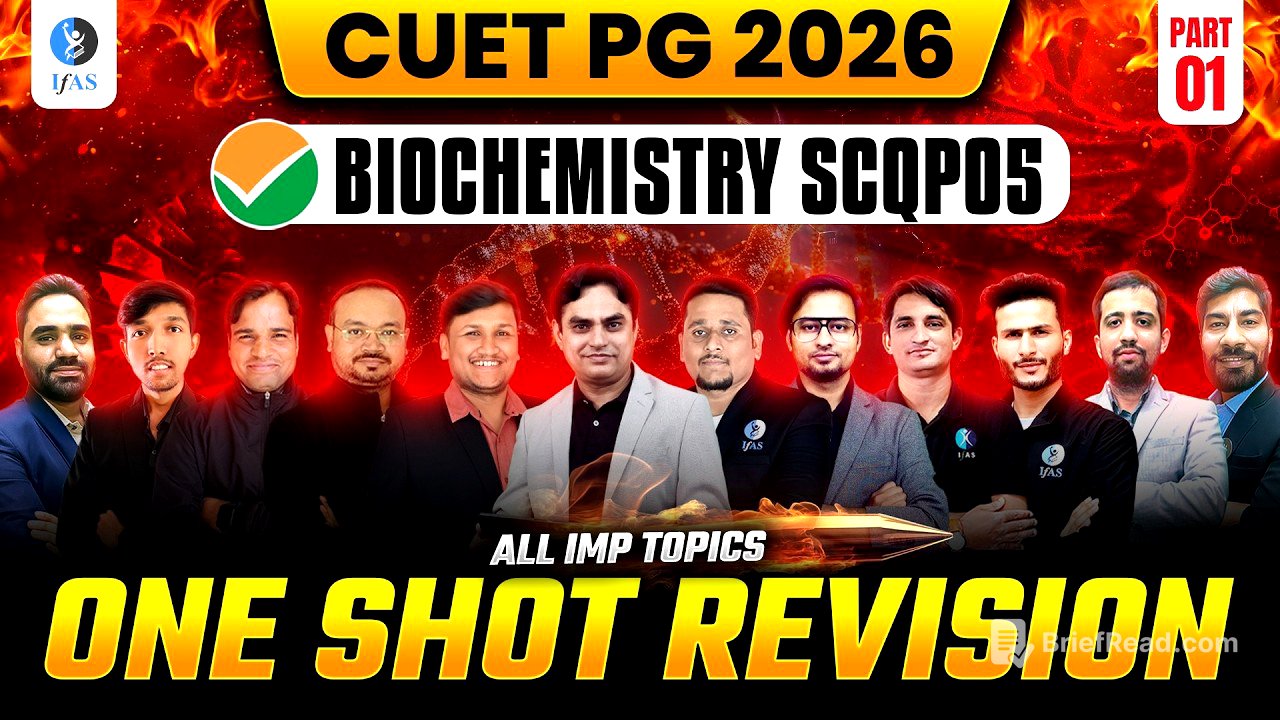
Alright, folks! This session's all about tackling some important questions for your upcoming exams like CUET PG, IIT JAM, and GAT B, focusing on bio-inorganic chemistry and key concepts. The video stresses the importance of practicing questions, using the IFAS app for resources, and grabbing the mock test series for just ₹1. The session covers topics from identifying reactions with carbocation intermediates to understanding aromaticity, EMF, polymer types, bond properties, carbocation stability, chirality, conductivity, and more. Plus, there's a push for those targeting the GAT B exam to join the morning sessions for comprehensive prep.
- Practice questions are key to acing exams.
- The IFAS app offers a ton of free resources.
- Mock tests are a must-do before the exam.
Intro and Testimonials [0:38]
The session kicks off with a shout-out to all the students gearing up for the CUET PG Biochemistry exam. The host encourages sharing the video with friends and classmates who might find it helpful. Before diving into the questions, there's a quick look at the previous year's toppers from IFAS, highlighting how consistent effort in the right direction can lead to great scores. The key message here is that cracking these exams boils down to practicing a lot of questions.
Resources and Mock Tests [1:18]
To help with that, the host recommends the IFAS app, where you can download practice questions, PYQs, exam analysis, and info on exam patterns and cut-offs. For those who haven't already, there's a call to grab the mock test series for just ₹1, especially with the biochemistry exam around the corner on the 25th.
Carbocation Intermediates [3:59]
The first question asks which reaction proceeds via a carbocation intermediate. The answer is SN1 reactions, where carbocations are formed, unlike SN2 reactions that involve a transition state. Specifically, the SN1 reaction of tertiary butyl bromide involves a carbocation intermediate.
Aromaticity and Huckel's Rule [7:44]
Next up is a question about the aromaticity of the cyclopentadienyl anion. The host explains that for a compound to be aromatic, it needs to follow Huckel's rule, which states that a cyclic compound with 4n + 2 pi electrons is aromatic. The cyclopentadienyl anion has six pi electrons, fitting the rule and making it aromatic.
EMF and Gibbs Free Energy [11:22]
The relationship between the EMF of a galvanic cell and Gibbs free energy is discussed. The direct formula is ΔG = -nFE, where ΔG is Gibbs free energy, n is the number of electrons, F is Faraday's constant, and E is the EMF.
Polymer Types [12:59]
A question on polymer types is presented, asking to identify what kind of polymers nylon 66, PVC, Bakelite, and polythene are. Nylon 66 is a condensation polymer, PVC is an addition polymer (polyvinyl chloride), Bakelite is a thermosetting polymer, and polythene is a thermoplastic polymer.
Bond Properties [15:41]
The discussion moves to bond properties, with the host explaining that bond order increases stability and decreases bond length. Hydrogen bonds are weaker than covalent bonds, and sigma bonds are stronger than pi bonds because they form in a plane.
Carbocation Stability [18:28]
The increasing order of carbocation stability is discussed, with the order being primary < secondary < tertiary < allylic. Allylic carbocations are the most stable due to resonance, which allows the positive charge to move and stabilize.
Chirality [23:06]
The concept of chirality is explained, noting that a chiral molecule has a carbon atom with four different groups attached to it. Among the options, CHBrClF is chiral because it has four different substituents.
Conductivity and Dilution [25:12]
The effect of dilution on conductivity is examined. Conductivity decreases with dilution because the number of ions per unit volume decreases. Molar conductivity, however, increases with dilution.
Meta-Directing Groups [28:36]
The host explains that NO2 is a meta-directing group, meaning it directs incoming groups to the meta position on a benzene ring.
Second-Order Kinetics [30:59]
The discussion shifts to reaction kinetics, identifying SN2 reactions as examples of second-order reactions. SN2 reactions involve a nucleophilic substitution and are inhibited by steric hindrance.
Factors Favoring SN2 Reactions [33:17]
The factor that favors SN2 reactions is a strong nucleophile because SN2 reactions involve a nucleophilic attack.
Molecular Geometry and Lone Pairs [36:01]
The effect of lone pairs on molecular geometry is discussed, using H2O as an example. Lone pairs cause greater repulsion, altering the geometry from what it would be based on hybridization alone. The repulsion order is lone pair-lone pair > lone pair-bond pair > bond pair-bond pair.
Calculating Gibbs Free Energy [39:22]
A calculation problem is presented, requiring the use of the formula ΔG = -nFE to find Gibbs free energy, given the number of electrons, Faraday constant, and EMF.
Enantiomers and Diastereomers [43:14]
The properties of enantiomers and diastereomers are compared. Enantiomers have identical physical properties except for optical rotation, while diastereomers are not mirror images. A racemic mixture is optically inactive because it contains equal amounts of D and L forms.
Acidity Trends [45:10]
The increasing order of acidity for CH4, NH3, H2O, and HF is discussed. The acidity increases with the electronegativity of the atom bonded to hydrogen, making HF the most acidic, followed by H2O, NH3, and CH4.
Biodegradable Polymers [49:29]
Among the given polymers, PHBV (Poly beta-hydroxybutyrate-co-beta-hydroxyvalerate) is identified as biodegradable.
Anti-Aromatic Compounds [50:25]
The criteria for anti-aromaticity are explained: a cyclic compound with 4n pi electrons is anti-aromatic. Cyclobutadiene, with four pi electrons, is identified as anti-aromatic.
Free Radical Intermediates [52:29]
Free radical halogenation is identified as a reaction that proceeds through a free radical intermediate.
EMF and Equilibrium [54:48]
If the EMF of a cell is zero, it indicates that the reaction is at equilibrium.
Hybridization and Geometry [56:04]
The relationship between hybridization and geometry is reviewed: sp3 is tetrahedral, sp2 is trigonal planar, sp is linear, and sp3d is trigonal bipyramidal.
Isomers [59:02]
Definitions of isomers are provided: enantiomers are mirror images, diastereomers are not, racemic mixtures are optically inactive due to equal amounts of D and L forms, and meso compounds are optically inactive due to internal symmetry.
Thermoplastics and Thermosetting Polymers [1:00:07]
Thermoplastics can be remolded, while thermosetting polymers cannot. Addition polymers do not release small molecules, but condensation polymers do.
Dipole Moment [1:01:59]
CO2 has a zero dipole moment because the dipoles of the two oxygen atoms cancel each other out.
Strong Electrolytes [1:04:14]
Strong electrolytes show higher conductivity because they completely ionize in solution.
Sigma and Pi Bonds [1:05:07]
Pi bonds are weaker than sigma bonds. Sigma bonds allow free rotation, while pi bonds restrict it. A double bond consists of one sigma and one pi bond.
Stereoisomers [1:06:55]
The number of stereoisomers possible for a compound with n chiral centers is 2^n.
IUPAC Nomenclature [1:07:41]
The session touches on IUPAC nomenclature, emphasizing that the longest chain must include the functional group, which should be given the lowest possible number. Substituents are listed alphabetically.
Nomenclature Rules [1:12:54]
Key rules for nomenclature include that the longest chain must include the functional group, the functional group should have the lowest locant, and substituents are listed alphabetically. Numbering should start from the end that gives the substituents the lowest numbers.
Acid-Base Behavior of Biomolecules [1:18:27]
Amino acids exist as zwitterions in solution. The net charge on a protein varies with pH. Isoelectric point does not have maximum solubility.
Properties of Water [1:20:33]
Water has a high dielectric constant, which weakens electrostatic attractions between ions. It has maximum density at 4°C. Hydrogen bonding contributes to its high specific heat.
Water as a Solvent [1:24:16]
Water's high dielectric constant is directly responsible for its high solvent capacity for ionic compounds.
Adsorption [1:26:41]
Adsorption is generally an exothermic process. During adsorption, unbalanced surface forces are satisfied, leading to a decrease in surface energy.
Aqueous Solutions [1:29:11]
A 1 molal glucose solution contains 1 mole of glucose in 1 liter of solution. Molality changes with temperature, but molality does not. Mole fraction is dimensionless.
Nernst Equation [1:33:07]
The Nernst equation is applicable when a solute exists in the same molecular state in two immiscible solvents.
Mole Fraction [1:34:30]
The mole fraction of a component in a solution is defined as the ratio of the moles of that component to the total moles of all components.
Osmotic Pressure [1:36:48]
A solution will exhibit the highest osmotic pressure at the same temperature, assuming no association or dissociation, if it has a higher concentration of particles. For non-electrolytes, osmotic pressure is similar.
Osmotic Pressure and Properties [1:40:18]
Osmotic pressure is a colligative property that depends on the number of solute particles present. Solutions with the same molarity of non-electrolytes at the same temperature are always isotonic.
Biochemical Elements [1:51:57]
Nitrogen is a common element in biomolecules and participates in hydrogen bonding. Sulfur in certain amino acids contributes to protein structure stabilization. Calcium has a role in biochemical signaling.
Ionic and Covalent Interactions [1:54:47]
Covalent bonds generally define the primary structure of proteins. Salt bridges contribute to protein stability.
Phytochemical Principles [1:57:18]
Only absorbed light is phytochemically effective. One photon activates one molecule in a primary response. The energy of a photon depends on frequency (Planck relation). A decrease in intensity depends on thickness (Beer-Lambert Law).
Osmotic Phenomena [2:00:06]
A hypertonic solution causes water to move out of cells. An isotonic solution prevents net osmotic movement of water across the membrane. Osmosis requires a semi-permeable membrane.
Trace Elements [2:02:57]
Trace elements are required in minute quantities but are essential for enzyme activity. Iron participates in reversible oxidation-reduction reactions. Magnesium is a cofactor for ATP-dependent reactions.
Avogadro Number and Atomic Mass [2:05:54]
Avogadro's number is the number of particles in one mole. Atomic mass is 1/12th of the mass of a carbon-12 atom. Gram molecular mass is the molecular mass expressed in grams.
Hydrogen Bonding in Water [2:08:23]
Each water molecule can form up to four hydrogen bonds under ideal conditions. Hydrogen bonding is responsible for the unusually high boiling point of water compared to H2S. The open lattice of ice contributes to its lower density than liquid water.
Biomolecular Attractions [2:12:42]
Hydrophobic interactions promote clustering. Electrostatic interactions between charged groups are influenced by the dielectric constant of the medium.
Quantum Yield [2:17:18]
Quantum yield is the ratio of molecules reacting to quanta of light absorbed.
Specific Heat of Water [2:20:34]
The high specific heat of water is biologically important because it helps maintain a relatively stable temperature in living systems.
Normality [2:22:12]
Normality is the number of gram equivalents of solute per liter of solution.