TLDR;
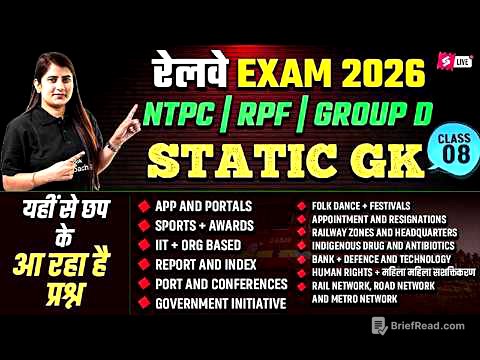
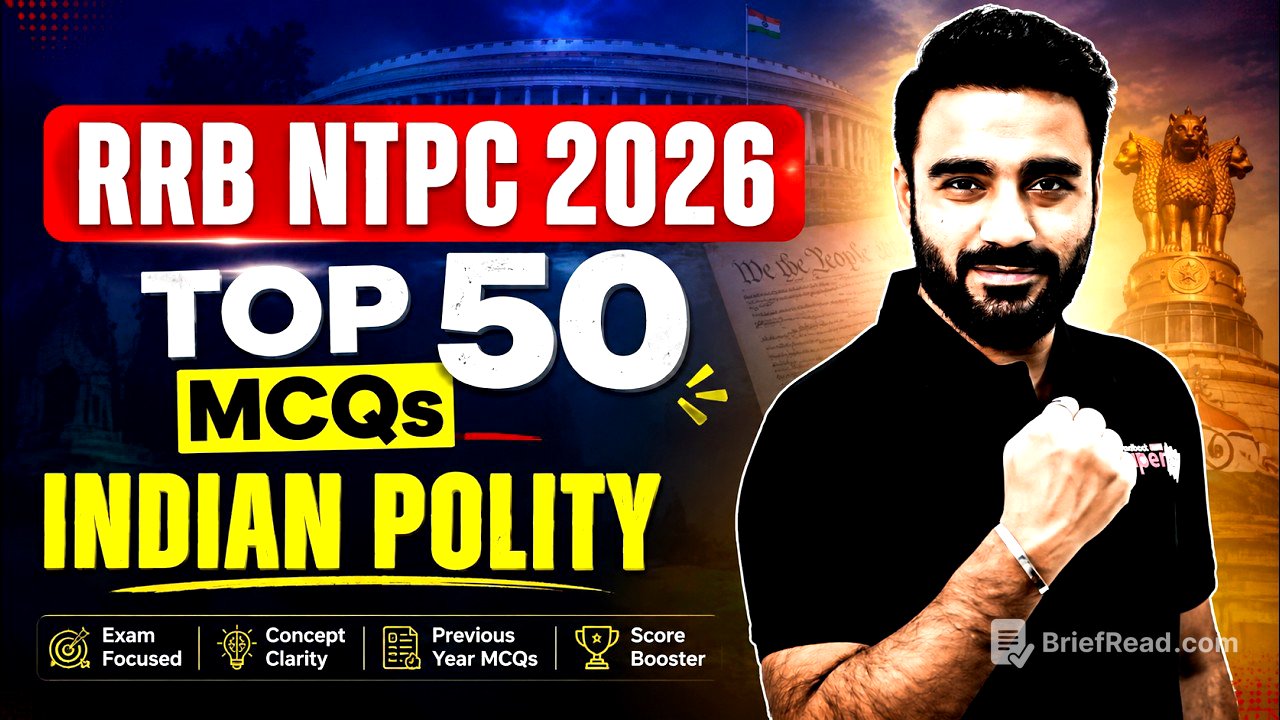
Alright, so this session covers 50 important polity questions useful for various exams like Railway and SSC. The discussion includes fundamental duties, election of the President, powers and functions of the Prime Minister, Attorney General of India, federal system, preamble, fundamental rights, and various articles of the Constitution. Key takeaways include understanding the importance of constitutional articles, amendments, and the structure of Indian governance.
- Fundamental Duties and Amendments
- Election and Powers of President
- Key Constitutional Articles
Fundamental Duties and Amendments [0:08]
The discussion starts with fundamental duties in the Indian Constitution, mentioning that they were added through the 42nd Amendment, which included 10 duties. Later, the 86th Amendment in 2002 added another duty, bringing the total to 11. These duties are part of Part 4A, Article 51A. The speaker also mentions the Swaran Singh Committee (1976) and Justice Verma Committee (1999) related to fundamental duties.
Election of the President [1:44]
The video explains the election process of the President of India, referencing Article 54 (election) and Article 55 (procedure). The election uses a Single Transferable Voting system, which is an indirect election via secret ballot, not a direct one.
Removal of President and Role of Vice President [2:48]
If the Vice President needs to be removed, the resolution starts in the Rajya Sabha, then goes to the Lok Sabha. If both houses pass it, the Vice President is removed. The Rajya Sabha, also known as the Council of States, is key here.
Prime Minister's Role and Government Head [3:52]
India follows a parliamentary system where the Prime Minister is the head of the central government. The Chief Minister is the head of the state government.
First Law Officer of India: Attorney General [4:34]
The Attorney General of India is the first law officer of the Government of India, appointed by the President under Article 76. They act as the central government's lawyer. Similarly, each state has an Advocate General, appointed by the Governor under Article 165.
Assertion and Reason: Democracy and Constitution [6:03]
India is a democratic country with its own constitution. While both statements are correct, the constitution isn't necessarily the reason for democracy. A country can be democratic without having its own constitution.
Federal System: Borrowed from Canada [7:24]
India's federal system, which involves the division of powers between the central, state, and local governments, was borrowed from Canada. This includes a federal government with a strong center.
Book Recommendation: India After Gandhi [9:21]
The book "India After Gandhi" was written by Ramachandra Guha.
Preamble and Key Words [9:48]
The concept of the Preamble was borrowed from the US Constitution. The Preamble was presented as the Objective Resolution by Jawaharlal Nehru on December 13, 1946. The word "Integrity" was not in the original Preamble but was added in 1976 through the 42nd Amendment, along with "Socialist" and "Secular."
Definition of State in Article 12 [11:25]
Article 12 defines "State" to include the Parliament, State Government, and any government authority using tax money. This is different from the common understanding of states forming a country. The concept of a Welfare State is linked to the Directive Principles of State Policy (DPSP), Articles 36-51, Part 4, borrowed from Ireland.
Powers of Rajya Sabha and Lok Sabha [12:58]
While the Lok Sabha generally has more power, the Rajya Sabha and Lok Sabha have equal power in amending the Constitution. The Rajya Sabha has more power regarding All India Services (Article 312).
Altering State Boundaries: Parliament's Power [14:20]
Only the Parliament can change the names, areas, or boundaries of existing states under Article 3, requiring a simple majority. Article 2 also deals with new states, but it concerns areas outside of India. For example, dividing Andhra Pradesh into Andhra Pradesh and Telangana falls under Article 3, while adding Pakistan Occupied Kashmir would fall under Article 2.
Dual Citizenship: A Thing of the Past in India [18:13]
Before 2019, people in Jammu & Kashmir had dual citizenship. Now, India follows single citizenship, unlike the US, where people have citizenship of both the US and their specific state.
Fundamental Rights: Articles 12-35 [20:13]
Fundamental Rights are enshrined in Articles 12-35, Part 3 of the Constitution. Other important sections include DPSP (Articles 36-51, Part 4), Citizenship (Articles 5-11, Part 2), and Fundamental Duties (Article 51A, Part 4A).
Powers of Rajya Sabha: What It Cannot Do [22:46]
The Rajya Sabha cannot approve appointments. It shares powers with the Lok Sabha in impeachment (Article 61) and constitutional amendments (Article 368). It has more power in passing bills related to the State List.
Poona Pact: Gandhi and Ambedkar [24:22]
The Poona Pact, signed between Mahatma Gandhi and Ambedkar in 1932, cancelled the separate electorate and adopted a joint electorate.
Presidential Eligibility: No Exam Required [24:56]
To become President, one must be 35 years old, eligible to be a member of the Lok Sabha, and a citizen of India. Education is not a requirement. Unlike many government jobs, there is no exam for becoming PM, CM, President, or Governor.
India's Female Presidents and Prime Ministers [28:13]
India has had two female Presidents: Pratibha Devi Singh Patil and Droupadi Murmu. Indira Gandhi is the only female Prime Minister to date.
Article 78: Prime Minister's Duties [29:35]
Article 78 outlines the duties of the Prime Minister, acting as a bridge between the President and the Council of Ministers.
Attorney General's Rights in Courts [31:11]
The Attorney General of India has the right to be heard in all courts in India. They can attend Parliament, but cannot vote.
Legislative Council Elections and Age Requirements [36:24]
To contest Legislative Council or Rajya Sabha elections, the minimum age is 30 years. For Lok Sabha or Legislative Assembly, it's 25 years. To become President, Governor, or Vice President, it's 35 years. For Panchayat elections, it's 21 years.
Features of the Indian Constitution [37:03]
The Indian Constitution does not have a Presidential form of government; it follows a Parliamentary system.
National Flag: Dimensions and Spokes [37:56]
The national flag has a 2:3 ratio with saffron at the top, white in the middle, and green at the bottom. The Ashok Chakra in the center has 24 spokes.
Majority for New State Formation [38:46]
A simple majority is required for constitutional amendments to form a new state.
Citizenship Laws: Parliament's Authority [40:30]
Only the Parliament has the power to make laws regarding citizenship, as per Article 11.
Abolition of Untouchability: Article 17 [41:02]
Untouchability is abolished under Article 17, which falls under the Right to Equality (Articles 14-18).
Separation of Judiciary: DPSP [41:47]
The separation of the judiciary from the executive is mentioned in Article 50, which is part of the Directive Principles of State Policy (DPSP).
Constitutional Government: Limited Government [42:23]
A constitutional government is a limited government, bound by the rules and regulations of the constitution.
Welfare State: Part 4 of the Constitution [44:28]
The concept of a Welfare State, aiming for the well-being of the people through policies promoting education, health, and employment, is discussed in Part 4 of the Constitution.
Constitutional Statements: Judicial Review and Basic Structure [45:20]
The Constitution provides for judicial review to safeguard citizens' liberties and preserve its ideals. The basic structure includes federalism, secularism, fundamental rights, and democracy.
State Assembly Seats: Population-Based [48:24]
A state assembly can have a maximum of 500 seats, depending on the population.
State Council Responsibility [48:55]
The State Council of Ministers is responsible to the Legislative Assembly, as per Article 164.
Dissolving the Legislative Assembly [49:44]
The Governor can dissolve the Legislative Assembly, similar to how the President can dissolve the Lok Sabha.
Legislative Council Retirements [51:06]
In the Legislative Council, one-third of the members retire every two years.
Delhi's Special Status [51:53]
Delhi, Puducherry, and Jammu & Kashmir are the only Union Territories with their own Legislative Assembly, Chief Minister, and Council of Ministers. Delhi was declared the National Capital Region (NCR) through the 69th Amendment in 1991, which was implemented in 1992. Delhi has 70 seats in its Legislative Assembly.
State Legislature Article [53:52]
Article 168 deals with the State Legislature. Article 169 discusses the creation or abolition of the Legislative Council. Article 170 concerns the Legislative Assembly, and Article 171 again discusses the Legislative Council.
Constitutional Body: Finance Commission [54:52]
The Finance Commission is a constitutional body with its own article.
Revenue Sharing: Finance Commission [55:52]
The Finance Commission is responsible for sharing taxes between the center and the states.
UPSC Chairman Tenure [56:37]
The Chairman or member of the UPSC holds office for six years or until the age of 65. They are appointed by the President. State Public Service Commission (SPSC) members hold office for six years or until the age of 62.
UPSC in the Constitution [58:16]
The UPSC is discussed in Part 14 of the Constitution. Part 15 deals with elections, Part 18 with emergency provisions, and Part 20 with amendments.
Rapid Revision: Key Articles [1:00:45]
- Article 326: Right to vote
- Article 60: Oath of the President
- Article 17: Abolition of Untouchability
- Articles 23-24: Right against exploitation
- Article 26: Management of religious affairs
- Article 371G: Special provisions for Mizoram
- Article 32: Constitutional remedies
- Article 52: There shall be a President of India
- Article 164: Appointment of Chief Minister by Governor
- Article 315: Establishment of UPSC