TLDR;
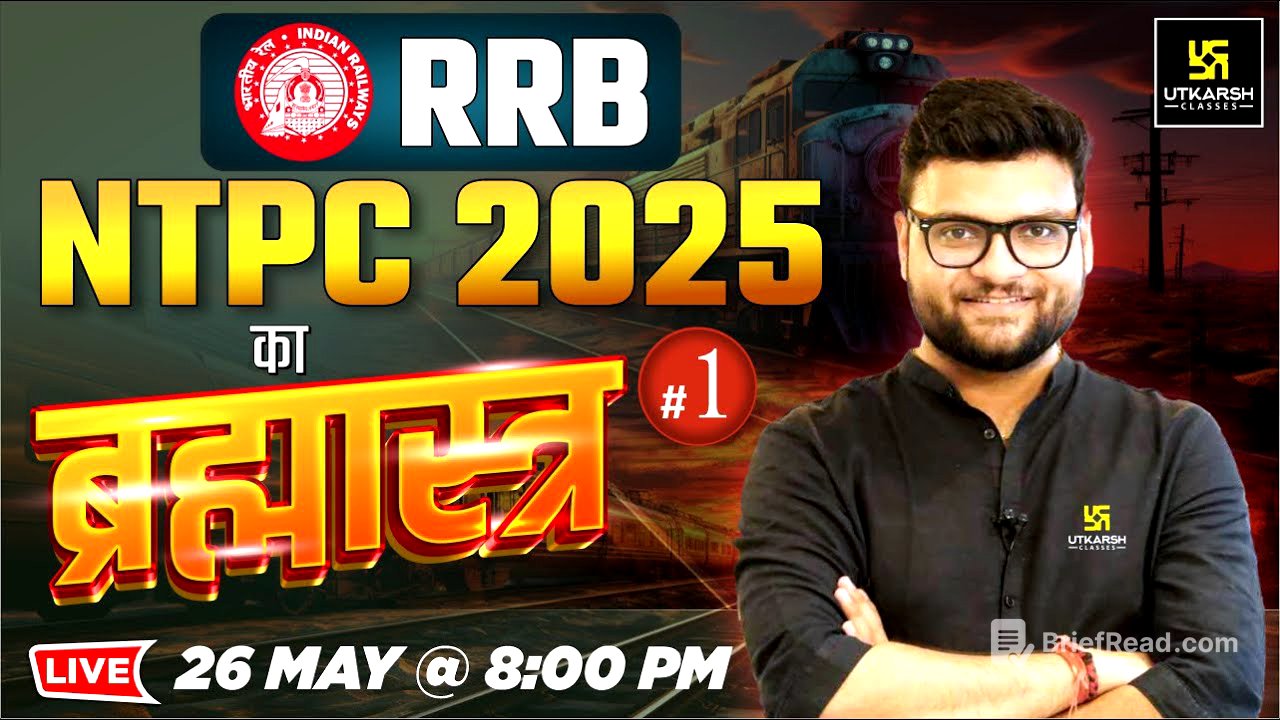
Alright, listen up! Kumar Gaurav Sir is bringing a "Brahmastra" for Railway NTPC exams. Expect a storm of questions and intense prep. The course focuses on GK, GS, and current affairs, covering past 15-20 years papers. Classes start from 26th and will be for seven days.
- Seven classes covering GK, GS, and current affairs.
- Focus on previous year papers and expected questions.
- Current affairs book recommendation for comprehensive preparation.
NTPC Brahmastra Announcement [0:00]
Kumar Gaurav Sir is launching a "Brahmastra" course for Railway NTPC exams starting from the 26th. This course will cover GK, GS, and current affairs, which will have 50 questions in the paper. The course will consist of seven classes, and will cover the previous 15-20 years of NTPC papers. The classes will be held on the 26th, 27th, 28th, 29th, 30th, 2nd and 3rd. The last two classes will focus on current affairs.
Introduction to NTPC Brahmastra [2:11]
Kumar Gaurav Sir welcomes everyone to the Utkarsh family and the start of the NTPC Brahmastra. He emphasizes the need for hard work and dedication for the next 7-8 days. He aims to cover previous year questions from the last 10-15 years and potential new questions. The next seven classes will be very important for the exam. He asks students to focus on each class and listen carefully to the analysis of each question. GK, GS, and current affairs are important for the NTPC exam. The first five classes will cover GK, GS, and static portions, while the last two will cover current affairs. The classes will be fast-paced, so students need to keep up.
Question 1: Rolet Act [5:03]
The Rolet Act was passed in 1919. In 1916, the Congress Lucknow session happened, headed by Ambika Charan Majumdar, where Congress and Muslim League agreed, and so did the गरम and नरम दल. Also in 1916, Annie Besant and Bal Gangadhar Tilak started the Home Rule League Movement. The Rolet Act, also known as "no appeal, no argument, no lawyer" law, came in 1919. The Jallianwala Bagh massacre happened on April 13, 1919, in Amritsar. The Montagu-Chelmsford Act of 1919 was implemented in 1921. In 1929, the Lahore session of Congress, led by Pandit Jawaharlal Nehru, demanded complete independence (पूर्ण स्वराज) and celebrated पूर्ण स्वराज दिवस on January 26, 1930.
Question 2: Penicillin Discovery [9:55]
Alexander Fleming discovered Penicillin. Louis Pasteur created the rabies vaccine, also known as hydrophobia, which is caused by the rabies virus from dog bites. William Harvey discovered the blood circulation system. Edward Jenner discovered the vaccine for smallpox, which is the world's first vaccine. India is free from smallpox since 1980, polio since 2014, and recently, trachoma. Smallpox is caused by the variola virus.
Question 3: Karnam Malleswari's Sport [15:15]
Karnam Malleswari is related to weightlifting. In the 2000 Sydney Olympics, she won a bronze medal, becoming the first Indian woman to win an Olympic medal. She received the Rajiv Gandhi Khel Ratna Award, now known as the Major Dhyan Chand Khel Ratna Award, which includes ₹25 lakh. In 2024, D Gukesh (chess), Manu Bhaker (shooting), Praveen Kumar (high jump, दिव्यांग), and Harmanpreet Singh (hockey) received this award. KD Jadhav won a bronze medal in wrestling at the 1952 Helsinki Olympics, becoming the first Indian to win an Olympic medal. Sharath Kamal, Manika Batra, and Sreeja Akula are important table tennis players. Vishwanath Anand is the first Grandmaster in chess. The 86th Grandmaster is Srihari, and the 85th was P Shyam Nikhil, both from Tamil Nadu.
Question 4: Rivers and Their Nicknames [21:21]
The Damodar River is known as the "Sorrow of Bengal," the Kosi River as the "Sorrow of Bihar," and the Huang He River as the "Sorrow of China" or the Yellow River. The Hirakud Dam is on the Mahanadi River in Sambalpur, Odisha, and is India's longest dam. The Son River originates from the Amarkantak hills, where the Narmada River also originates. Jabalpur is situated on the banks of the Narmada River, which also has the Omkareshwar Dam and Dhuandhar Falls in Madhya Pradesh, and the Sardar Sarovar Dam in Gujarat. The first river valley project in India is the Damodar River Valley Project, which Jawaharlal Nehru called the "modern temples of India."
Question 5: First Amendment of Indian Constitution [25:03]
The first amendment to the Indian Constitution was done in 1951. Constitutional amendments are taken from South Africa, under भाग 20, Article 368. There have been 106 amendments, with the 106th being the Nari Shakti Vandan Adhiniyam. The first amendment added अनुसूची 9, related to land reforms. The 42nd amendment in 1976, known as the "mini-constitution," amended the preamble, adding "समाजवाद," "पंथनिरपेक्षता," and "अखंडता." Education, forests, wildlife, weights and measures, and justice administration were moved from the state list to the concurrent list. भाग 4A was added, including 10 fundamental duties based on the Sardar Swaran Singh Committee. The 11th duty, education, was added in 2002 via the 86th amendment. The 44th amendment in 1978 removed the right to property from fundamental rights, making it a legal right under Article 300A. The 86th amendment in 2002 added Article 21A, the right to education, as a fundamental right.
Question 6: Capital of Ukraine [30:21]
The capital of Ukraine is Kyiv. Ankara is the capital of Turkey. Brussels is the capital of Belgium and the headquarters of the European Union and NATO. The Van Gölü lake, known for its high salinity, is in Turkey. Antwerp, located in Belgium, is known for diamond cutting. Copenhagen is the capital of Denmark, Vienna is the capital of Austria, Baku is the capital of Azerbaijan, Khartoum is the capital of Sudan, and Havana is the capital of Cuba. The currency of Turkey is Lira, and the currency of Israel is New Shekel.
Question 7: Yamini Krishnamurthy's Field [33:54]
Yamini Krishnamurthy, who recently passed away, was related to classical dance, specifically Bharatnatyam and Kuchipudi. In 2016, she received the Padma Vibhushan, and her autobiography is titled "A Passion for Dance." India has eight classical dances, with Bharatnatyam being the oldest, also known as Sadir Attam, performed in Tamil Nadu. The newest is Sattriya dance, started by Srimanta Sankardeva.
Question 8: Right to Information Act Implementation [36:01]
The Right to Information (RTI) Act was implemented in 2005. The GI Tag Act is from 1999 but was implemented in 2003, with the first GI tag given to Darjeeling tea. The Right to Education Act was enacted in 2009 and implemented on April 1, 2010. GST (Goods and Services Tax) was implemented on July 1, 2017, based on the Vijay Kelkar Committee's recommendation, as the 101st Constitutional Amendment of 2016.
Question 9: Adoption of Rupee Symbol [38:37]
The Indian Rupee symbol was adopted in 2010. Udaya Kumar designed the new symbol. Currently, Indian currency notes feature different monuments: ₹10 note has Konark Sun Temple (Black Pagoda, built by the Ganga dynasty, Narasimhadeva I), ₹20 note has Ellora caves (Maharashtra), ₹50 note has Hampi (Karnataka, Vijayanagara capital, founded by Harihar and Bukka, Tuluva dynasty, Krishnadevaraya), ₹100 note has Rani ki Vav (Gujarat), ₹200 note has Sanchi Stupa (Madhya Pradesh), and ₹500 note has Red Fort (Delhi). Krishnadevaraya's book "Amuktamalyada" is in Telugu.
Question 10: Osteoporosis and Affected Organ [42:11]
Osteoporosis affects bones. "Osteo" means bone, and "porosis" means porous or weak. It is caused by Vitamin D deficiency in adults. Vitamin D, also known as calciferol, acts like a hormone. In children, Vitamin D deficiency causes rickets. Vitamin D is also known as the sunshine vitamin. The human body has 206 bones. The axial skeleton has 80 bones. The longest bone is the femur (thigh), and the smallest is the stapes (ear). The jaw bone is called the mandible, and the shoulder bone is called the scapula.
Question 11: First Woman President of INC Before Independence [45:45]
Annie Besant was the first woman president of the Indian National Congress (INC) in 1917 at the Calcutta session. Vijayalakshmi Pandit was the first woman president of the UN General Assembly. The current president of the UN General Assembly's 79th session is Philemon Young from Cameroon. Sarojini Naidu was the first woman governor of Uttar Pradesh and the first Indian woman president of Congress in 1925 at the Kanpur session. Her book is "The Golden Threshold." Sucheta Kriplani was the first woman Chief Minister in India. Annie Besant's magazine was "Common Wheel."
Question 12: India's Longest Border [48:11]
India's longest border is with Bangladesh. States bordering Bangladesh include West Bengal, Meghalaya, Assam, Tripura, and Mizoram. The zero line is between Bangladesh and Tripura. States bordering Pakistan include Gujarat, Rajasthan, Punjab, Jammu and Kashmir, and Ladakh. The Radcliffe Line is between India and Pakistan. China borders Ladakh, Himachal Pradesh, Uttarakhand, Sikkim, and Arunachal Pradesh. The McMahon Line is between India and China. Myanmar borders Arunachal Pradesh, Nagaland, Manipur, and Mizoram. Nepal borders Uttarakhand, Uttar Pradesh, Bihar, West Bengal, and Sikkim. Bhutan borders Sikkim, West Bengal, Assam, and Arunachal Pradesh. Afghanistan borders Ladakh.
Question 13: Bharat Ratna Awardees [52:59]
Zakir Hussain has not been awarded the Bharat Ratna. Bhimsen Joshi received it in 2009. Zakir Hussain received the Padma Shri in 1988, Padma Bhushan in 2002, and Padma Vibhushan in 2023; he is a Tabla player. MS Subbulakshmi received the Bharat Ratna in 1998 and was the first musician to receive it. Lata Mangeshkar received it in 2001. Pandit Ravi Shankar received it in 1999 and was the first Indian to win a Grammy Award. Tanvi Shah was the first Indian woman to win a Grammy Award.
Question 14: DRDO Developed Akash Missile [56:23]
The Akash missile, developed by DRDO, is a surface-to-air missile. The "Patna" missile series includes: Prithvi and Agni (surface-to-surface), Trishul and Akash (surface-to-air), and Nag (anti-tank). DRDO's motto is "Balasya Mulam Vigyanam" (strength originates from science). It was established on January 1, 1958, with Daulat Kothari as its first head, and Sameer Kamat is the current head.
Question 15: India-Pak Kargil War Code Name [58:48]
The code name for the India-Pakistan Kargil War was Operation Vijay. Other operations include: Operation Blue Star (1984, Golden Temple), Operation Meghdoot (1984, Siachen), Operation Polo (1948, Hyderabad), Operation Pawan (Sri Lanka), Operation Trident (1971, Karachi port). Recent operations include: Operation Sindoor (May 7, 2025, Pakistan terror sites) and Operation Brahma (Myanmar earthquake relief).
Question 16: X-Ray Discovery [1:01:59]
Wilhelm Röntgen discovered X-rays and received the first Nobel Prize in Physics. Moseley developed the modern periodic table, which currently has 118 elements. Before Moseley, Mendeleev developed a periodic table based on atomic mass. Thomson discovered the electron. Chadwick discovered the neutron. Goldstein discovered the proton. Rutherford showed that the nucleus has a positive charge. Dalton proposed the atomic theory.
Question 17: India's Oldest High Court [1:04:14]
The oldest High Court in India is the Calcutta High Court, established on July 2, 1862, under the Government of India Act of 1861. The Allahabad High Court, established in 1866, is the largest. India has 25 High Courts, with the latest being the Amravati High Court in Andhra Pradesh. Delhi and Jammu & Kashmir/Ladakh (Srinagar) are the only Union Territories with High Courts. Article 215 states that High Courts are courts of record. The Supreme Court is a court of record under Article 129. The Supreme Court issues five writs under Article 32, while High Courts issue writs under Article 226. The President appoints judges to both the Supreme Court and High Courts, but Parliament has the power to remove them.
Question 18: India's Participation in Commonwealth Games 2022 [1:08:05]
India participated in the 2022 Commonwealth Games held in Birmingham. The first Commonwealth Games were held in Hamilton, Canada, in 1930. In Birmingham, India ranked fourth with 61 medals, while Australia ranked first. The next Commonwealth Games will be held in Glasgow, Scotland, in 2026. The first Asian Games were held in Delhi in 1951, and the ninth Asian Games were also held in Delhi in 1982, featuring Appu (an elephant) as the mascot. The 19th Asian Games were held in Hangzhou, China, and the 20th will be held in Aichi, Japan.
Question 19: Origin of Rivers from Amarkantak [1:10:46]
The Narmada River originates from Amarkantak. The Godavari originates near Nashik, the Krishna originates from Mahabaleshwar, and the Kaveri originates from Brahmagiri hills in Karnataka. The Godavari's tributaries include Indravati, Penganga, and Venganga. The Krishna's tributaries include Ghataprabha, Malaprabha, Tungabhadra, Musi, Bhima, Vardha, and Manjira. The Kaveri's tributaries include Hemavati, Kavini, and Bhavani. The Kaveri receives water from the retreating monsoon. The Polavaram Dam is on the Godavari, the Almatti Dam is on the Krishna in Karnataka, and the Mettur Dam and Krishnarajasagar Dam are on the Kaveri in Tamil Nadu and Karnataka, respectively.
Question 20: First Woman Prime Minister of Sri Lanka [1:14:17]
Sirimavo Bandaranaike was the first woman Prime Minister of Sri Lanka and the world.
Question 21: Chief Justice Acting as President [1:14:48]
Justice M. Hidayatullah has the unique distinction of serving as the Chief Justice of India, Acting President, and Vice President. The Supreme Court of India started functioning on January 28, 1950, with a structure of 1+7 judges (Article 124). Justice H.J. Kania was the first Chief Justice of India. Justice P.N. Bhagwati is known as the father of Public Interest Litigation (PIL). The current Chief Justice is Justice B.R. Gavai (52nd), succeeding Justice Sanjeev Khanna (51st). Dr. Rajendra Prasad was the first President of India. Neelam Sanjiva Reddy was the only President elected unopposed and was also a Lok Sabha Speaker. V.V. Giri won the election based on the "voice of the soul." Pratibha Patil was the first woman President, and Droupadi Murmu is the current woman President.
Question 22: Spring Equinox [1:18:25]
The spring equinox occurs on March 21. On March 21 and September 23, day and night are of equal duration, known as equinoxes. The summer solstice (longest day) is on June 21, which is also celebrated as International Yoga Day. Yoga Day started in 2015, and in 2025, it will be the 11th edition. The theme for 2025 is "Yoga for One Earth One Health." The winter solstice (longest night) is on December 22.
Question 23: Meaning of Ecotone [1:21:25]
An ecotone is the area where two biomes meet. The term "ecosystem" was coined by Tansley, and "ecology" by Ernst Haeckel.
Question 24: International Solar Alliance Launch [1:23:09]
India and France launched the International Solar Alliance (ISA) at the COP21 climate conference in Paris on December 1, 2015. The headquarters of ISA is in Gurugram. COP28 was held in UAE, COP29 will be held in Baku, Azerbaijan, and COP27 was held in Sharm el-Sheikh, Egypt.
Question 25: India's First UNESCO City of Literature [1:24:24]
Kozhikode is India's first UNESCO City of Literature. UNESCO's headquarters are in Paris. The Central Spices Research Institute of India is also in Kozhikode. Gwalior has been declared as the city of music. Udaipur and Indore are the wetland cities.
Question 26: Number of UNESCO World Heritage Sites in India [1:25:47]
India has 43 UNESCO World Heritage Sites: 35 cultural, 7 natural, and 1 mixed. The 39th site is the Ramappa Temple in Telangana, the 40th is Dholavira in Gujarat, the 41st is Shantiniketan in West Bengal, the 42nd is the Hoysala Temples in Karnataka, and the latest, 43rd, is the Moidam in Assam's Charaideo district, which is the Ahom dynasty's cemetery. The Statue of Valour is in Jorhat, Assam. Kangchenjunga in Sikkim is the mixed site. Italy has the most UNESCO sites. India is ranked sixth. The UNESCO meeting in 2024 was in Delhi, and in 2025, it will be in Sofia, Bulgaria.
Question 27: India's First World Heritage City by UNESCO [1:29:22]
Ahmedabad was the first city in India to be declared a World Heritage City by UNESCO in 2017, followed by Jaipur in 2019.
Question 28: UNESCO Recognized Dance Style [1:29:55]
Kalbelia is a dance style from Rajasthan recognized by UNESCO. UNESCO has a list of Intangible Cultural Heritage, which includes 15 items from India. The latest addition is Garba from Gujarat. In 2010, Kalbelia and Chhau dance were added. Chhau dance is performed in West Bengal, Jharkhand, and Odisha. Dal Khai is from Odisha, and Giddha and Bhangra are from Punjab.
Question 29: Classical Language Status in India [1:31:38]
India now has 11 classical languages. The first was Tamil (2004), followed by Sanskrit (2005), Telugu, Kannada, Malayalam (2013), and Odia (2014). Recently, in 2024, five more languages were added: Marathi, Pali, Prakrit, Assamese, and Bengali.
Question 30: Odissi Dance Related Personality [1:33:21]
Mayadhar Raut is related to Odissi dance. Jhaveri sisters are famous for Manipuri dance. Srimanta Sankardeva is related to Sattriya dance. Kumudini Lakhia is related to Kathak dance and recently passed away. Other famous Odissi dancers include Kelucharan Mahapatra, Sanyukta Panigrahi, and Sonal Mansingh.
Question 31: Padma Vibhushan Awardee from Odisha [1:34:47]
Guru Kelucharan Mahapatra was the first dancer from Odisha to be awarded the Padma Vibhushan in 2000. He is related to Odissi dance.
Question 32: Dr. L. Subramaniam's Instrument [1:35:15]
Dr. L. Subramaniam is a violinist who was awarded the Padma Bhushan in 2001 and the Padma Vibhushan in 2025.
Question 33: Shehnai Performance at Red Fort in 1947 [1:36:24]
Bismillah Khan played the Shehnai at the Red Fort during India's independence in 1947. Jawaharlal Nehru's speech, "Tryst with Destiny," mentioned him. In 2001, Bismillah Khan received the Bharat Ratna. Recently, a hall in Tehran, Iran, was named in his honor.
Question 34: Mallika-E-Ghazal Title [1:37:47]
Begum Akhtar is known as Mallika-e-Ghazal.
Question 35: First Musician to Receive Bharat Ratna [1:38:10]
M.S. Subbulakshmi was the first musician to receive the Bharat Ratna in 1998. Pandit Ravi Shankar received it in 1999, Lata Mangeshkar and Bismillah Khan in 2001, and Bhimsen Joshi in 2009. Bhupen Hazarika received it in 2019.
Question 36: Father of Carnatic Music in India [1:39:01]
Purandara Dasa is known as the father of Carnatic music in India.
Question 37: Pandit Ramnarayan's Instrument [1:39:16]
Pandit Ramnarayan, who recently passed away, was a Sarangi player. He received the Padma Vibhushan in 2005 and belonged to the Kirana Gharana, founded by Abdul Karim Khan.
Question 38: Hojagiri Dance State [1:40:26]
Hojagiri dance is mainly performed in Tripura. Other dances include: Himachal Pradesh (Nat, Thoda, Chham, Chhapeli), Tripura (Garia Puja, Khair Puja), Maharashtra (Lavani, Lezim, Tamasha), and Kerala (Theyyam, Kathakali, Mohiniyattam).
Question 39: Gotipua Dance State [1:41:35]
Gotipua is a dance from Odisha. Other dances include: Lai Haroba (Manipur). Ghoomar is from Rajasthan, while Ghoomra is from Odisha.
Class Conclusion and Book Recommendation [1:43:25]
The class concludes with a recommendation for a current affairs book for the year 2024. The current affairs for 2025 will be covered in the last two classes. The book is available at a discounted price of ₹85, with free delivery. The offer is valid until midnight of the 27th. A science class for NTPC students is scheduled for the 28th at 3:00 PM. The next class will be held tomorrow at 8:00 PM.