TLDR;
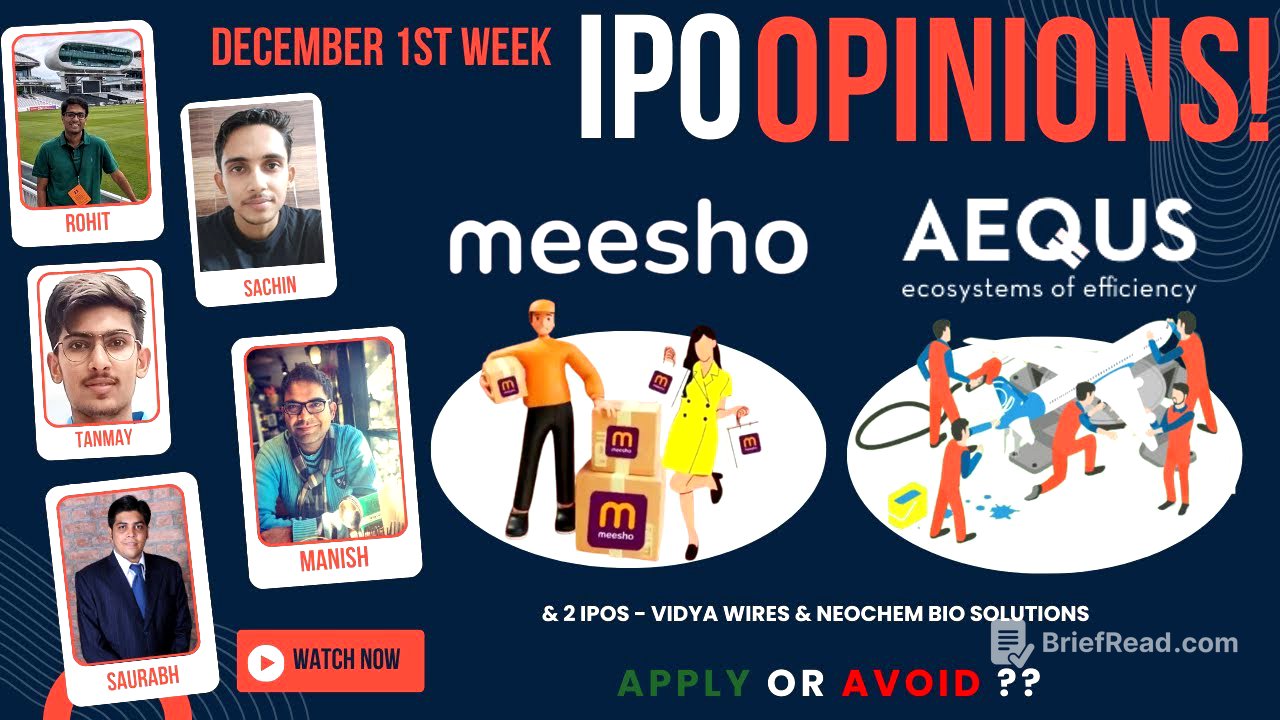
Alright, so this is a breakdown of a few IPOs - Neoam Bio Solutions (SME), Vidya Wires, Meesho, and Aequs. The speakers discuss the fundamentals, potential upsides, and risks associated with each company, giving their personal opinions on whether or not they'd invest.
- Neoam: Specialty chemical company, good legacy, but textile heavy. Valuations look high.
- Vidya Wires: Copper and aluminium wire manufacturer, decent financials, but commodity-driven and pricing is not cheap.
- Meesho: E-commerce platform targeting tier 2/3/4 cities. High growth, but path to profitability is unclear. Strong apply.
- Aequs: Aerospace component manufacturer with solid capabilities. Valuations are a concern, but the sector is hot.
Opening Remarks [0:00]
The host welcomes everyone to the second part of the December first week IPO discussion. They'll be covering four companies: Neoam Bio Solutions (SME), Aequs, Vidya Wires, and Meesho. They clarify that they are not SEBI registered and this is not qualified investment advice, urging viewers to do their own due diligence. They also encourage viewers to follow Sunday Investing on YouTube and Instagram for more content, including promoter interactions.
Neochem Bio Solutions (SME) [2:12]
Neochem Bio Solutions, incorporated in 2006, manufactures specialty performance chemicals for various industries. The IPO is a fresh issue of ₹45 crores, with a market cap of ₹168 crores. The company's revenue is ₹86.75 crores. They have a legacy of four to five decades, operating since 1980, transitioning from a partnership to Neoam Bio Solutions. They provide basic and specialty chemicals for industries like textiles, paints, and mining. They are shifting focus from textiles to non-textile segments. They have four product segments: polymers, surfactants, silicons, and high-margin esters and bio-based solutions. They export to 12-13 countries, with 9-10% of revenue from exports. They specialize in custom formulations, with 350-400 formulations and 40-50 trademarks. Their facility has a capacity of 22,000 metric tons, with utilization at 40-45% in FY25, targeting 55-60% in FY26. They have in-house R&D and a zero liquid discharge facility. They have mandatory licenses for premium-priced export products and eco-friendly products. They use a distributor-led business model with 50-60 distributors across India and 200-300 customers. They are shifting from white-labeling to their own brands, which now account for 70-75% of revenue. They have some backward integration in silicons, reducing imports from China. In FY23, they had ₹48 crores revenue with 9% EBITDA. In FY24, revenue jumped to ₹62 crores with 10-11% EBITDA. In FY25, they did ₹86 crores revenue with near 15% EBITDA and 9% PAT. In H1 FY26, they have done ₹47 crores revenue with over 10-11% PAT. The IPO usage includes ₹23 crores for working capital and ₹10 crores for repayment of loans. They did a pre-IPO in June-July at ₹108 crores valuation. The IPO is near 20 times FY25 and projected 14-15 times FY26. Peers include Rosari Biotech and Indian Emulsifier. Custom formulation provides customer loyalty. Textile heavy currently, but pivoting to other segments. Valuations look high due to recent drawdowns.
Vidya Wires Ltd (Mainboard) [17:51]
Vidya Wires, incorporated in 1981, manufactures copper and aluminium wires for various industries. The IPO is ₹301 crores, with ₹274 crores fresh issue. The market cap is ₹1106 crores. In FY25, financials show ₹1500 crores top line and ₹41 crores bottom line, with just 3% margin. It is coming at 30 times FY25. The company is India's fourth largest manufacturer with 5.7% market share. Current capacity is 19,680 metric tons per annum, adding another 18,000. Products are used in energy generation, transmission, motors, clean energy systems, mobility, railways, etc. Clients include Adani Wilmar, Atlanta Electricals, Schneider Electrical Transformers, and Lubby. They supply products in 20 states and union territories, with approximately 15% revenue from exports. Revenue breakup: power and transmission (48%), power generation (10%), electrical, renewable energy, and EVs (9.8%), consumer durables (3%), and auto (9.7%). In FY23, revenue was ₹111 crores with a PAT of ₹21.5 crores. In FY24, revenue grew by 17.3% to ₹1186 crores with a PAT of ₹25.7 crores. In FY25, revenue jumped by 25% to ₹1486 crores and the PAT was ₹40.9 crores. The IPO is coming at ₹1106 crores market cap, which is 27 times FY25 and 20 times TTM basis. Peers like Precision Wires trade at 51 times FY25, Ramatana Wires at 41 times FY25, and Apar at 45 times. Trade receivables jumped from ₹87 crores in FY23 and ₹88 crores in FY24 to ₹148 crores in FY25. There was an IT department notice and tax proceeding of ₹3.6 crores. The segment is evergreen, with demand always there and industry growing at 10-11%. Commodity-driven business, with copper trading at all-time high. Promoters are experienced, with Mr. Shamssung having 43 years of experience. 100% promoter-owned company. IPO proceeds are used for debt repayment and capex. OFS is 9% of the issue. Valuations have come down due to market demand and supply.
Meesho Ltd (Mainboard) [28:19]
Meesho, incorporated in 2015, operates an e-commerce marketplace. The IPO is ₹5,400 crores, with ₹4,200 crores fresh issue. The market cap is ₹50,000 crores, with 10% dilution. In FY25, revenue is ₹9,900 crores, but PAT is minus ₹4,000 crores. It is the first horizontal e-commerce company listing in India. Started as a reseller platform on WhatsApp, targeting tier 2/3 towns. In 2021, they transitioned to a marketplace model. Focus is entirely on value commerce, with an ASP of around ₹200. Operates on a no-commission model, charging only for logistics. Largest e-commerce company by shipments and number of customers. Focus is on apparel, footwear, and home products. They are trying to decrease the order value. Fully asset-light, pure platform business. They make money from logistics, charging sellers a logistics fee. About a third of their business comes from third-party logistics, and two-thirds from their own logistics platform called Valmo. Valmo connects sellers with fragmented tier three/four logistics players. Focus is on price, not speed or quality. They do 1.2 billion transactions a year. They also make money from ads. They have 230 million unique customers. People order 10 times a year on average. GMV is about $6 billion a year. They did about ₹5500 cr revenue in H1. They grew about 40-45% year-on-year. Still negative EBITDA, with 5-6% negative EBITDA on revenue. The negative PAT is inflated due to a one-time ₹2,500-3,000 cr tax outgo. Monetization is still new, with ads being a natural way to increase revenue. They are doing things around content commerce and looking at fintech. They have their own in-house AI shop. The company is coming at 5.5 times sales. There is no real competition in the space. Very strong anchor book.
Aequs Limited (Mainboard) [58:34]
Aequs, incorporated in 2006, manufactures components for engine systems, landing systems, cargo and interiors, structures, assemblies, and turning for aerospace clients. The IPO is ₹922 crores, with ₹670 crores fresh issue and ₹300 crores OFS. The market cap is ₹8300 crores, with 12% dilution. Aerospace contributes around 89% to the revenue, and consumer contributes 10.8%. In consumer, they have three small verticals: consumer electrical components, plastics, and cookware. They raised ₹144 crores pre-IPO. They are repaying ₹433 crores debt. Capacity utilization in aerospace is around 75%, and in consumer electrical segment is around 22%. New capex is happening in the aerospace and not in the consumer electrical. In FY23, they did a revenue of ₹812 crores, ₹63 crores EBITDA, and a net loss of ₹109 crores. In FY24, they did ₹965 crores topline, ₹145 crores EBITDA, and ₹14.2 crores net loss. In FY25, the revenue degrew by 4% to ₹925 crores, ₹108 crores EBITDA, and ₹102 crores net loss. In H1, they did ₹537 crores top line, ₹84 crores EBITDA, and ₹10 crores loss. Management said they intend to grow their aerospace segment at a standalone level by 20% for at least the next 5 to 10 years. Aerospace has grown by 17% in H1. Consumer had degrowth by 60% in FY25. Aerospace is a 25% EBITDA business, while consumer electric is in losses. They have their own SEZ and multiple JVs. They have revenue visibility of 10 years.
Closing Remarks [1:15:02]
The hosts summarize their investment decisions: apply to Aequs and Meesho, and are doubtful about Neoam. They remind viewers that this is not a recommendation and to do their own research. They mention that next week's space is uncertain due to travel plans. They thank everyone for joining and remind them to follow Sunday Investing on Twitter.