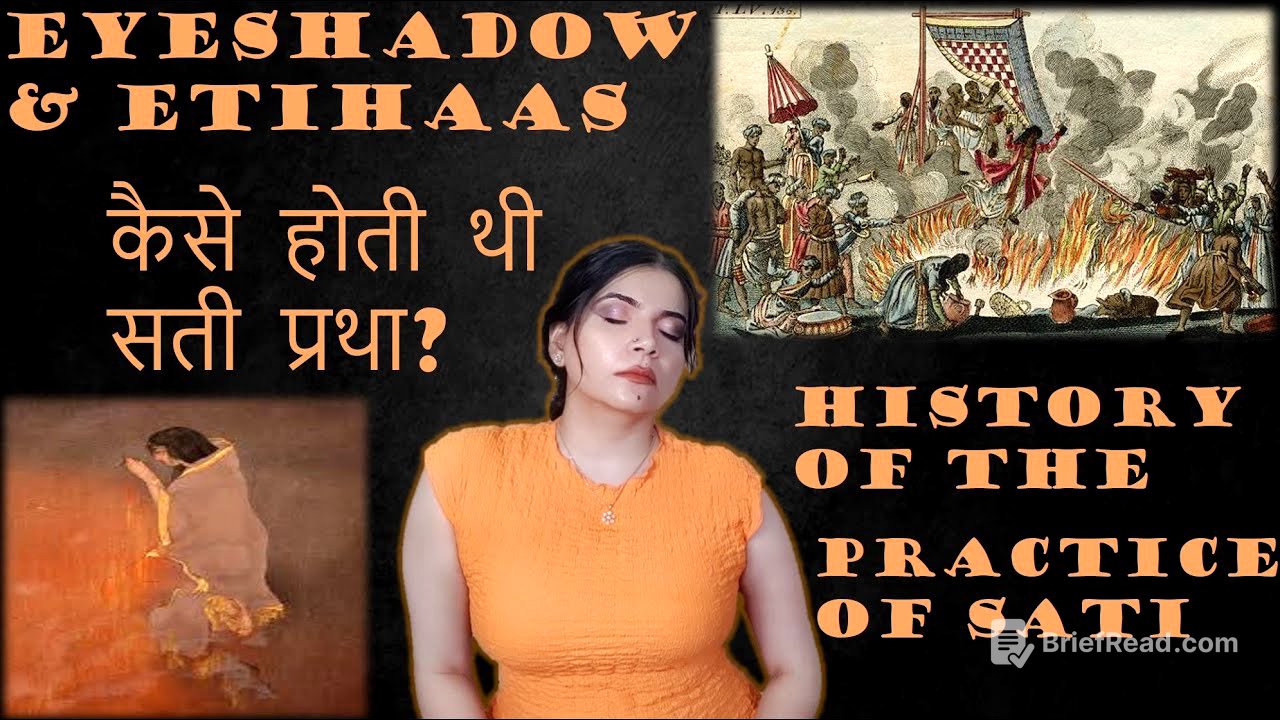
TLDR;
In this video, Dr. Ruchika Sharma discusses the practice of Sati, where a widow sacrifices herself on her husband’s funeral pyre. The video addresses common myths surrounding Sati, its historical context, the question of consent, and the involvement of various castes beyond the upper classes. Key takeaways include discussions on how Sati was seen as both an act of devotion and a coercive practice, evidence of its presence across different castes, and critiques against the tradition by historical figures.
- Sati is the act of a widow self-immolating on her husband's pyre, often considered noble.
- The practice was entrenched in social norms, and historical texts reveal it was not limited to upper castes.
- Instances of forced Sati highlight serious human rights violations.
Preview [3:14]
Dr. Ruchika Sharma introduces the topic of Sati in her 30th episode, linking it to a poll on the topic of historical widow burning. She plans to answer five main questions related to Sati, including its definition, religious texts that mention it, how it was done, and issues of consent across castes.
Sati kya hai? [9:32]
Sati is detailed as a practice where a widow voluntarily or forcibly burns herself on her husband's funeral pyre. The glorification of this act led to the elevation of the term "Sati" to the status of a goddess. It is revealed that this practice was woven into the fabric of Hindu society, wherein the act of committing Sati was often seen as a noble deed, related to a woman's duty (stri dharma). Temples dedicated to Sati Mata have been built at sites of such acts, reinforcing the perception of Sati as divinely sanctioned.
Kaise hoti thi aur kahan mentioned hai [24:35]
The methods of committing Sati and its mention in religious texts are examined. Historical texts like the Brahma Purana describe two forms of Sati: Sahamarna (performing Sati at the same time as the husband’s cremation) and Anumarana (committing Sati at a later time). The origins of Sati are debated, with evidence suggesting that it was not merely a practice that originated with the arrival of Turkic influences but existed prior to that period.
Bana's critique of Sati [26:08]
Banabhatta, a 7th-century poet, critiques Sati, calling it a misguided act associated with illiteracy and childishness. He argues that Sati does not benefit either the deceased or the widow, instead highlighting the emotional misery it causes. His observations illustrate that alternatives existed, yet societal norms prevailed, leading to tragic outcomes for many women under pressure to commit Sati.
Ibn Battuta's account [30:02]
Ibn Battuta, a 14th-century traveler, provides insights into Sati practices during his time, noting that permission was needed from local rulers to perform Sati. He observed the social importance placed on Sati, which was viewed as an honorable act for widows, influencing their family’s status. His accounts confirm that while Sati was significant, it was not an enforced practice, raising questions about the autonomy of widows.
Mass sati [32:06]
The video discusses instances of mass Sati, particularly among nobles where multiple wives might self-immolate upon their husband's death. It mentions Portuguese accounts from the 16th century that detail large-scale Sati ceremonies, where the culture emphasized honor and prestige, often forcing women into the act under societal pressure. The brutal nature and the high numbers of women involved raise significant ethical concerns.
Kya Sati forced thi? [40:09]
Dr. Sharma highlights evidence suggesting that many cases of Sati were forced, particularly among young widows, who were coerced into the practice by family and societal pressure. Historical accounts reveal that some widows attempted to escape their fate only to be violently returned to the pyres, contradicting claims that Sati was voluntarily embraced by women as a means of honor.
Kya Sati sirf upper caste women karti thi? [44:13]
Finally, it is clarified that Sati was practiced across various castes, not just among the upper classes. Various accounts and research confirm that women from lower castes also committed Sati, challenging the notion that it was exclusive to a few social stratas. Historical instances demonstrate that Sati transcended caste boundaries, reflecting broader societal issues regarding women's rights and autonomy.