TLDR;
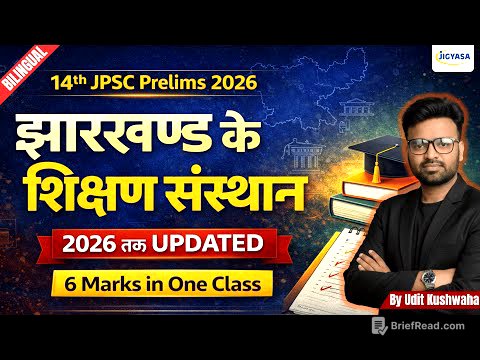
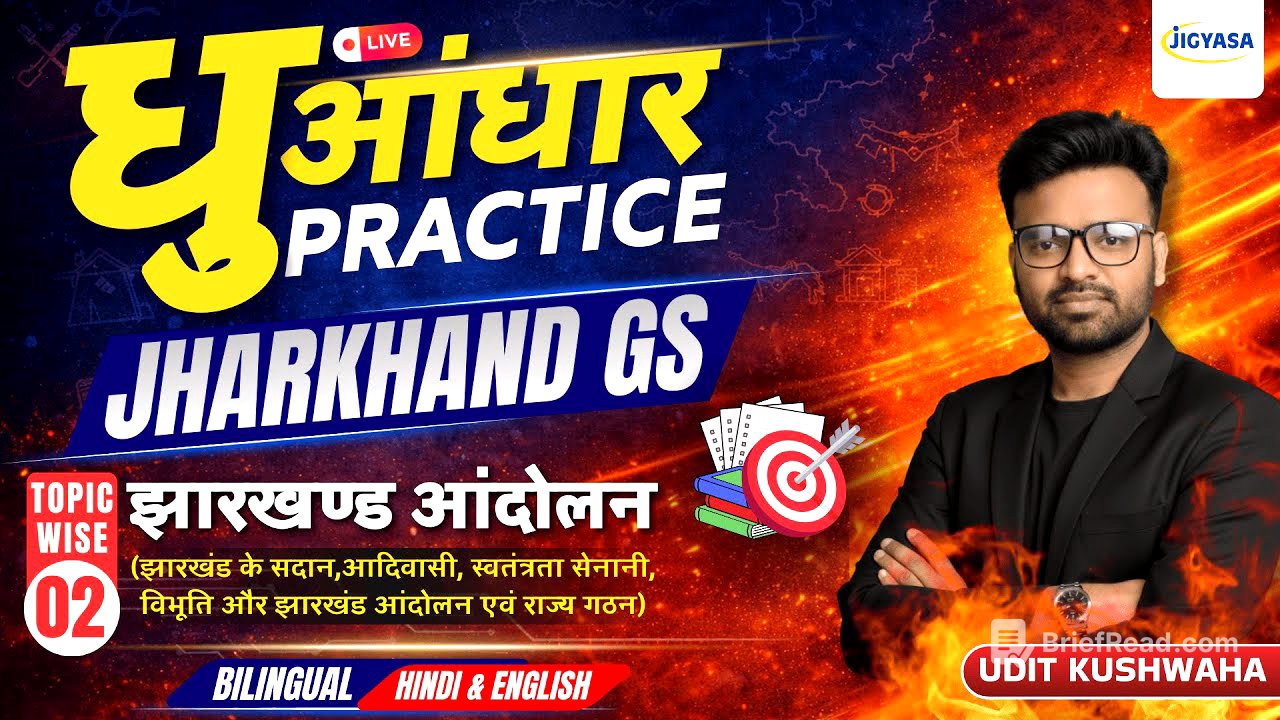
Alright, so this video is basically about Jharkhand movement and some of its prominent freedom fighters and personalities. The speaker talks about Baba Tilka Manjhi's death anniversary and pays tribute to him. He then discusses the structure of the Jharkhand movement topic in JPSC exams, focusing on the importance of freedom fighters and personalities. The video includes a series of multiple-choice questions related to these figures, with detailed explanations and additional info. Also, there is discussion about exam updates and paid courses.
- Tilka Manjhi's death anniversary and his contributions
- Exam structure and important topics
- MCQs on freedom fighters and personalities with detailed explanations
- Discussion on exam updates and paid courses
Introduction and Tilka Manjhi Tribute [0:19]
The video starts with the speaker greeting everyone and addressing some technical issues with the live classes. He mentions that today's topic is the Jharkhand movement, but due to time constraints, he will focus on freedom fighters and personalities. The speaker notes that today is a somber day in Jharkhand's history as it marks the death anniversary of Baba Tilka Manjhi, who was hanged in Bhagalpur. Tilka Manjhi killed Augustus Cleveland on January 13, 1784, because Cleveland implemented a divide and rule policy. A year later, on the same date, Tilka Manjhi was hanged. The speaker and the team pay tribute to Tilka Manjhi and start the class.
Exam Structure and Important Topics [3:54]
The speaker discusses the Jharkhand movement topic, which will have seven questions in the exam. He expresses confusion about the topic's structure, which includes sections like Sadan, Adivasi, freedom fighters, personalities, and state formation. The speaker clarifies that today's class will cover freedom fighters and personalities, which will account for three questions. He also announces that there will be an Indian Geography class for Paper 1 tomorrow at 8 PM, which will help students score 10 marks.
MCQ 1: Tilka Manjhi - Correct or Incorrect [5:49]
The first question asks which statement about Tilka Manjhi is incorrect. The options cover his leadership in the tribal revolt, his hanging in Bhagalpur, his guerrilla warfare in Ramgarh hills, and the renaming of Bhagalpur University after him. The speaker explains that Tilka Manjhi was born on February 11, 1750, and was also known as Jabra Paharia. He initiated a revolt against the British due to the famine in 1770 and their suppressive policies. Tilka Manjhi opposed Augustus Cleveland's divide policy and killed him on January 13, 1784. He was hanged on January 13, 1785. The speaker points out that the incorrect statement is that Tilka Manjhi led guerrilla warfare in the Ramgarh hills; he actually led it in Vancharjore, making option C the right answer.
MCQ 2: Tribal Revolt Leader [12:04]
The next question asks who led the tribal revolt and managed to injure a British Army Chief before independence. The options are Birsa Munda, Tilanga Khadia, Tilka Manjhi, and Sidhu and Kanhu. The speaker explains that the tribal revolt, led by Tilka Manjhi from 1773 to 1785, had Vancharjore as its central point. Sal leaves were used to spread messages during the movement. The person who suppressed the revolt was Ayarkut, and Jaura Paharia betrayed Tilka Manjhi, leading to his arrest. Birsa Munda started his movement in 1895, Tilanga Khadia is known for starting the Juri Panchayat, and Sidhu and Kanhu are related to the Santhal Revolt. Therefore, the correct answer is Tilka Manjhi.
MCQ 3: Attacker of Augustus Cleveland [14:49]
This question asks who attacked and fatally injured Augustus Cleveland. The options are Tilka Manjhi, Veer Surendra Sahay, Nilambar Pitambar, and Telanga Khadia. The speaker confirms that Tilka Manjhi is the correct answer. He adds that Nilambar and Pitambar were from Madgarhi in Garhwa district and were known as Bhokta Bandhu, who created trouble for the British during the 1857 revolt. Telanga Khadia, from 1949 to 1960, established the Juri Panchayat and was killed by Bodhan Singh.
MCQ 4: First Martyr from Jharkhand [16:30]
The question is about who was the first martyr among the freedom fighters of Jharkhand. The options are Birsa Munda, Telanga Khadia, Tilka Manjhi, and Sidho and Kano. The speaker reiterates that Tilka Manjhi is the first martyr. He also mentions that Birsa Munda led the Ulgulan movement, Telanga Khadia worked to unite tribals in the Gumla area, and Sidho and Kano were active in the Santhal Pargana region.
MCQ 5: First Rebel Martyr of Indian Freedom Struggle [17:40]
The question asks who was the first rebel martyr of the Indian Freedom Struggle. The options are Budhu Bhagat, Tana Bhagat, Tilka Manjhi, and Sidho. The speaker confirms that Tilka Manjhi is known as the "Adi Vidrohi" because he was the first to revolt. Budhu Bhagat was the first to die in battle. Tana Bhagat started the Tana Bhagat Movement, which was influenced by Gandhian ideology and was the first non-violent movement in Jharkhand.
Clarification on Exam Dates and Website Information [19:12]
The speaker addresses a question about the Jharkhand TGT PGT exam in 2026. He clarifies that no one can definitively say when the government will conduct these exams. He advises students to check the official websites of JSSC (jssc.nic.in) and JPSC (jpsc.gov.in) for accurate information. He emphasizes that he doesn't want to mislead anyone with false information and encourages students to rely on official sources.
MCQ 6: First Revolutionary from Chota Nagpur [21:46]
The question asks who was the first revolutionary from the Chota Nagpur area to be martyred during the struggle against the British. The options are Kunwar Singh, Budhu Bhagat, Ramnarayan Singh, and Birsa Munda. The speaker clarifies that Kunwar Singh was from Jagdishpur in Ara, Bihar. Budhu Bhagat was martyred on February 13, 1832, during the Kol Revolt, shot by Captain Impey. Ramnarayan Singh was involved in the Indian National Movement and was known as Chota Nagpur Kesari, a title given by Mahatma Gandhi. Birsa Munda died on June 9, 1900, due to cholera. The correct answer is Budhu Bhagat, associated with the Kol विद्रोह.
MCQ 7: Birthplace of Birsa Munda [24:02]
The question asks where Birsa Munda was born. The options are Ulihatu, Bagodar, Jarigaon, and Kasmar. The speaker mentions that Birsa Munda was known as Daud Munda in his childhood. After adopting Christianity, he was called Birsa David. He started a new sect and became known as Birsa Munda. He was called Bhagwan Birsa Munda by Mrityunjay Nath Lal and was also known as Dharti Aba (Father of the Earth). Birsa Munda was born on November 15, 1875, in Ulihatu village in the Khunti district. Ulihatu has recently been declared a state tourist place.
MCQ 8: Date of Birth of Birsa Munda [27:07]
The question asks for Birsa Munda's date of birth. The options include various dates. The speaker confirms that Birsa Munda was born on November 15, 1875. He explains that November 15 is significant because it is Jharkhand Foundation Day, celebrated as Tribal Pride Day, and is Birsa Munda's date of birth. The war cry of the Bihar Regiment is "Birsa Munda ki Jai."
MCQ 9: Other Names of Birsa Munda [29:41]
The question asks what other names Birsa Munda was known by. The options are Jharkhand ka Janak, Bhupita (Dharti Aba), Rashtrapita, and Vidroh Janak. The speaker confirms that Birsa Munda was known as Bhupita or Dharti Aba (Father of the Earth). Mrityunjay Nath Lal first called him Bhagwan.
MCQ 10: Incorrect Statement about Birsa Munda [31:06]
The question asks which statement about Birsa Munda is incorrect. The options include his establishment of the Sonot Santhal Samaj, his fight for tribal rights on forests and land, his leadership against exploitation by landlords and moneylenders, and his capture and death in jail. The speaker clarifies that the Sonot Santhal Samaj was established by Disom Guru Shibu Soren in 1969, making the first statement incorrect. Birsa Munda fought for tribal rights on forests and land, opposing the 1894 Chota Nagpur Forest Security Act and advocating for the Khutkatti system. He was captured on February 3 or March 3, 1900, by a British officer named Ross and died in Ranchi jail on June 9, 1900. He led the Great Tumult against exploitation.
MCQ 11: Leader Who Died in Ranchi Jail Due to Cholera [35:58]
The question asks which leader was captured by British forces and died in Ranchi jail due to cholera on June 9, according to British records. The options are Birsa Munda, Ganga Narayan, Tana Bhagat, and Bhagirath Manjhi. The speaker confirms that Birsa Munda was arrested on February 3 or March 3 by Ross and kept in Barrack No. 4. The symbol of the Birsa movement was a white flag. Ganga Narayan led the Ganga Narayan's Hungama or Bhumij Revolt in 1832-33. Jatra Bhagat is associated with the Tana Bhagat Movement, which started on April 21, 1914. Bhagirath Manjhi led the Kharwar Movement in 1870.
MCQ 12: Identify the Personality - Birsa Munda [38:32]
The question asks to identify the personality whose followers considered him a god and who brought significant changes in religious beliefs. The speaker confirms that this is Birsa Munda, who started the Birsai Panth in 1895, based on monotheism. He advocated for the worship of Singbonga and renunciation of other deities and vices. Albert Ekka was the first person from Jharkhand to receive the Paramveer Chakra. Joel Lakra led the separate Jharkhand movement and was the first tribal leader to receive the Padma Shri award in 1963. Haran Thakur is related to painting and promoted the art of Chota Nagpur.
MCQ 13: Tribal Leader in Central Hall of Parliament [41:38]
The question asks which tribal leader from Jharkhand has a portrait in the Central Hall of Parliament. The options are Sidhu Murmu, Tilka Manjhi, Birsa Munda, and Dhananjay Mahato. The speaker confirms that Birsa Munda is the only tribal leader with a portrait in the Central Hall of Parliament. Sidhu Murmu is related to the Santhal Revolt, which started on June 30, 1855.
Personal Anecdote and Condolences [43:19]
The speaker shares a personal anecdote about the sudden death of his uncle's younger brother in an accident. He expresses his sadness and mentions that despite the personal loss, he decided to continue with the scheduled class.
MCQ 14: Freedom Fighter from Jamshedpur [44:49]
The question asks which of the following was a freedom fighter from Jamshedpur, Jharkhand. The options are Jawaharlal Nehru, Sardar Vallabhbhai Patel, Dhananjay Mahato, and Ram Prasad Bismil. The speaker explains that Dhananjay Mahato was a revolutionary during the Quit India Movement in 1942. Although originally from Bihar, he worked in the Jamshedpur area, which was a hub for revolutionaries working in Tata Steel.
MCQ 15: Poto Sardar's Tribe [47:06]
The question asks which tribe the freedom fighter Poto Sardar belonged to. The options are Uraon, Gond, Munda, and Nagvanshi. The speaker explains that Poto Sardar was from Raja Basa village in the Singhbhum area and led the Battle of Serengesia. He was neither Uraon, Gond, Munda, nor Nagvanshi but belonged to the Ho community. He was later hanged.
MCQ 16: Nilambar and Pitambar's Tribe [48:57]
The question asks which tribe Nilambar and Pitambar, who created trouble for the British during the freedom movement, belonged to. The options are Santhal, Kharwar, Sabar, and None of the above. The speaker explains that the 1857 revolt started in the Palamu area on September 26, 1857, led by the Bhokta brothers, Nilambar and Pitambar Shahi, from Madgarhi in Garhwa district. The Bhokta brothers belonged to the Kharwar tribe, which calls itself "18 Hazari" and is known for speaking the truth and sacrificing everything for it.
MCQ 17: Albert Ekka's Death in Which War [51:11]
The question asks in which war Lance Naik Albert Ekka died. The options are Indo-Pak War 1971, Indo-Pak War 1965, Kargil War, and Indo-China War. The speaker explains that Albert Ekka, a recipient of the Param Veer Chakra, died on December 3, 1971, during the Battle of Hill in Gangasagar.
Albert Ekka and Equal Respect for All [52:20]
The speaker expresses disappointment that there were no posts from the Governor or CMO on Lance Naik Albert Ekka's martyrdom day or birthday. He emphasizes that all the brave sons of the state should receive equal respect, without any discrimination.
MCQ 18: Marang Gomke [54:17]
The question asks who is known as Marang Gomke. The options are Rajkumar Shukla, Kunwar Singh, and Jaipal Singh. The speaker explains that Marang Gomke means "Great Leader" or "Bade Guruji." Jaipal Singh Munda, born on January 3, 1903, in Takra village in Khunti, was a famous hockey player. He led the Indian hockey team to a gold medal in the 1928 Amsterdam Olympics. He qualified for the ICS but left it for hockey. He entered Indian politics and became the president of the Adivasi Mahasabha in 1939. He was elected to the Constituent Assembly in 1946. He led the Jharkhand Party, which performed well in the 1952 and 1957 elections. He is also known as Munda Raja.
MCQ 19: Tribal Leader in Constituent Assembly [58:40]
The question asks which tribal leader from Chota Nagpur was a member of the Constituent Assembly. The options are Ani Horo, Jaipal Singh, Sushil Kumar Bage, and Kartik Uraon. The speaker explains that Ani Horo gave the slogan "Kaise Lenge Jharkhand? Ladke Lenge Jharkhand." Jaipal Singh Munda gave the slogan "Jharkhand Abua, Daku Diku Senua." Sushil Kumar Bage was the leader of the opposition in the Bihar Legislative Assembly in 1952 and 1957. Kartik Uraon was known as Baba Kartik Uraon and was one of the key designers of a nuclear power plant in London. The correct answer is Jaipal Singh Munda.
MCQ 20: Opposed Conversion to Christianity [1:03:10]
The question asks which personality from Jharkhand opposed the conversion of tribals to Christianity. The options are Jaipal Munda, Kartik Uraon, Albert Ekka, and Mukund Nayak. The speaker confirms that Baba Kartik Uraon opposed the conversion.
MCQ 21: Coal Minister Who Resigned After Arrest Warrant [1:05:05]
The question asks to identify the central coal minister in Manmohan Singh's government who had to resign after an arrest warrant was issued against him. The options are Raghuvar Das, Shibu Soren, Hemant Soren, and Draupadi Murmu. The speaker explains that Shibu Soren had an arrest warrant issued against him in connection with the Chirudih incident in Jamtara, leading to his resignation.
MCQ 22: Iron Lady of Jharkhand [1:07:29]
The question asks who is known as the Iron Lady of Jharkhand for her fearless work against the violation of tribal rights. The options are Ashuta Lakra, Irom Chanu Sharmila, Gauri Sharma, and Dayamani Barla. The speaker confirms that Dayamani Barla, an activist, journalist, and social worker, is known as the Iron Lady of Jharkhand for fighting against Arcelor Mittal in the Khunti area.
MCQ 23: Mahendra Singh Dhoni's Ancestral District [1:09:43]
The question asks what is the ancestral district of Mahendra Singh Dhoni. The options are Ranchi, Dumka, Allahabad, and Almora. The speaker confirms that it is Almora in Uttarakhand. He also mentions that Dhoni was inducted into the Hall of Fame in 2024.
MCQ 24: Myang Chang's Birthplace [1:10:56]
The question asks where Myang Chang, an Indian actor, television host, and singer from Jharkhand, was born. The options are Ranchi, Hazaribagh, Dhanbad, and Deoghar. The speaker confirms that Myang Chang is from Dhanbad.
MCQ 25: Actress Simone Singh's Birthplace [1:12:22]
The question asks where actress Simone Singh, who acted in "Kal Ho Naa Ho" and played the lead role in "Heena," was born. The speaker confirms that she was born in Jamshedpur.
Paid Courses Promotion [1:13:51]
The speaker promotes paid courses available on the Jigyasa Learning App, including courses for JPSC exams and test series.
MCQ 26: Actress in Balika Vadhu [1:14:53]
The question asks which actress, born in Jamshedpur, became famous for her role as Anandi in the TV serial "Balika Vadhu." The options are Shilpa Rao, Komal Jha, and Pratyusha Banerjee. The speaker confirms that it is Pratyusha Banerjee.
MCQ 27: Bachendri Pal's Workplace [1:16:10]
The question asks in which company Bachendri Pal works. The options are Tata Iron and Steel Company Limited, Bokaro Steel Limited, Chandrapura Thermal Power Plant, and Tata Engineering and Locomotive Company. The speaker confirms that Bachendri Pal works at Tata Iron and Steel Company Limited.
MCQ 28: Bollywood Personality Not Born in Jamshedpur [1:18:50]
The question asks which Bollywood personality was not born in Jamshedpur. The options are Imtiaz Ali, Priyanka Chopra, Imran Zahid, and R. Madhavan. The speaker confirms that Imran Zahid is from Bokaro.
MCQ 29: Miss World from Jharkhand [1:20:34]
The question asks which film star from Jharkhand was awarded the Miss World title. The options are Meenakshi Seshadri, Tanushree Dutta, Munmun Sen, and Priyanka Chopra. The speaker confirms that Priyanka Chopra was crowned Miss World in 2000.
MCQ 30: First Indian Woman to Climb Seven Summits [1:21:16]
The question asks who was the first Indian woman to climb the highest peaks in seven continents. The options are Tashi Malik, Naganshi Malik, Malavath Purna, and Premlata Agarwal. The speaker confirms that Premlata Agarwal completed the Seventh Summit Challenge in 2011 and received the Padma Shri award in 2013.
MCQ 31: Director of Socha Na Tha [1:22:38]
The question asks who is the famous director, producer, and writer born in Jamshedpur who made his directorial debut with "Socha Na Tha." The speaker confirms that it is Imtiaz Ali.
MCQ 32: Lalit Mohan Rai's Field [1:22:55]
The question asks which field Lalit Mohan Rai from Jharkhand is associated with. The options are music, sports, painting, and acting. The speaker confirms that Lalit Mohan Rai is associated with painting.
MCQ 33: Mukund Nayak's Dance Style [1:24:02]
The question asks which dance style Mukund Nayak is popular for. The options are Kali, Anganai, Mardani Jhumar, and Natua Nach. The speaker confirms that it is Mardani Jhumar.
MCQ 34: Social Worker and Secretary of Vikas Bharti [1:24:21]
The question asks who is a famous social worker from Jharkhand who worked as the secretary of Vikas Bharti. The speaker confirms that it is Ashok Bhagat.
MCQ 35: Anthropologist Who Classified Jharkhand Tribes [1:24:57]
The question asks which Indian anthropologist classified the tribes of Jharkhand based on their cultural types. The speaker confirms that it is Lalita Prasad Vidyarthi.
MCQ 36: Indian Tibetologist Born in Ranchi [1:25:34]
The question asks which Indian Tibetologist, born in Ranchi, is a writer and the founder director of the Sikkim Research Institute of Tibetology. The speaker confirms that it is Nirmal Chandra Sinha.
MCQ 37: Minister of Forest and Environment in Vajpayee Government [1:26:00]
The question asks who was the Minister of Forest and Environment in the Atal Bihari Vajpayee government. The options are Babulal Marandi, Karia Munda, CP Singh, and Jayaprakash Narayan Singh. The speaker confirms that it was Babulal Marandi.
MCQ 38: First Woman Cabinet Minister of Jharkhand [1:27:17]
The question asks who was the first woman cabinet minister of Jharkhand. The speaker confirms that it was Joba Manjhi.
MCQ 39: Promoted Chota Nagpur Style of Art [1:27:35]
The question asks which famous artist promoted the Chota Nagpur style of art. The options are Haran Thakur, Mukund Nayak, Lalit Mohan Rai, and Sudhendu Narayan Singh. The speaker confirms that it was Haran Thakur.
MCQ 40: Chhau Dancer and Choreographer [1:28:01]
The question asks who is the Chhau dancer and choreographer from Jharkhand. The options are Pandit Gopal Prasad Dubey, Pandit Ravil Prasad Dubey, Pandit Aditya Prasad Dubey, and Pandit Akshay Prasad Dubey. The speaker confirms that it was Pandit Gopal Prasad Dubey.
MCQ 41: Indian Journalist and News Presenter from Jharkhand [1:28:27]
The question asks who is an Indian journalist and news presenter from Jharkhand. The options are Ton Sinhal, Khagendra Thakur, Ramkrishna Singh, and Anjana Om Kashyap. The speaker confirms that it is Anjana Om Kashyap.
MCQ 42: First from Santhal Village with Master's and Doctorate [1:28:51]
The question asks who was the first person from the Santhal village of Vishnu Pati to earn a master's and doctorate degree. The options are Borobaski, Lakhobadra, Bulu Imam, and Sona Murmu. The speaker confirms that it was Borobaski.
MCQ 43: Christian Priest Known for Work on Ramayana [1:29:27]
The question asks which Christian priest is known for his notable work on the Ramayana. The options are Father J. Hoffman, Father Camille Bulcke, and Father F. Hopen. The speaker confirms that it was Father Camille Bulcke.
MCQ 44: Telanga Khadia Known For [1:30:10]
The question asks what Telanga Khadia, a freedom fighter from Chota Nagpur, is known for. The options include organizing the Swadeshi movement, being a close associate of Gandhiji, forming the Juri Panchayat, and being a governor under British rule. The speaker confirms that he is known for forming the Juri Panchayat.
MCQ 45: Founder President of Palamu Hindi Sahitya Sammelan [1:30:41]
The question asks who was the founder president of the Palamu Hindi Sahitya Sammelan. The options are Atal Bihari Vajpayee, Hawaldhari Ramgupta Haldhar, V. D. Savarkar, and Mukutdhari Singh. The speaker confirms that it was Hawaldhari Ramgupta Haldhar.
MCQ 46: Sangeet Natak Akademi Award Winner for Tribal Music and Dance [1:30:59]
The question asks which personality received the Sangeet Natak Akademi Award in 2007 for their contribution to tribal music and dance in Jharkhand. The options are Ramdayal Munda, Himnish Goswami, Manoranjan Vyapari, and Shivaji Samant. The speaker confirms that it was Dr. Ramdayal Munda.
MCQ 47: Shaurya Chakra Winner Randhir Prasad Verma's Profession [1:31:27]
The question asks what was the profession of Shaurya Chakra winner Randhir Prasad Verma. The options are DGP, DIG, IG, and Superintendent of Police. The speaker confirms that he was a Superintendent of Police.
MCQ 48: First Director General of Police of Jharkhand [1:32:21]
The question asks who was the first Director General of Police (DGP) of Jharkhand. The options are Ramchandra Singh, Vinay Kumar Yadav, Anil Kumar Sinha, and Shivaji Mahan Kere. The speaker confirms that it was Shivaji Mahan Kere.
MCQ 49: First Minister of Science and Technology of Jharkhand [1:32:51]
The question asks to identify the late first Minister of Science and Technology of Jharkhand. The options are Vilasrao Deshmukh, Brij Bihari Prasad, Samaresh Singh, and Meghnath Singh. The speaker confirms that it was Samaresh Singh.
MCQ 50: Mukund Nayak's Awards [1:33:16]
The question asks which awards Mukund Nayak has received. The options are only Padma Shri, only Sangeet Natak Akademi Award, both Padma Shri and Sangeet Natak Akademi Award, and Bharat Ratna. The speaker confirms that he has received both Padma Shri and Sangeet Natak Akademi Award.
Conclusion and Announcement of Next Class [1:34:08]
The speaker concludes the session and announces that the next class will be on Indian Geography on January 14 at 8 PM. He also promotes the paid courses available on the Jigyasa Learning App. He provides a strategy for preparing for the JPSC exam, focusing on key areas to score well. He encourages students to reach out with any doubts and ends the session with greetings and well wishes.