TLDR;
Yo, so this video talks about the Indus Valley Civilization (IVC), one of the oldest and most advanced civilizations in the world. It covers the discovery of the civilization, its social structure, culture, trade, the mystery behind its language, and its eventual decline. Key takeaways include:
- The IVC was discovered in the 1920s, challenging British claims of civilizing India.
- The civilization had advanced urban planning, drainage systems, and trade networks.
- The Indus script remains undeciphered, making it difficult to fully understand the civilization.
- The decline of the IVC is attributed to various factors like environmental changes, natural disasters, and possibly invasions.
Intro [0:00]
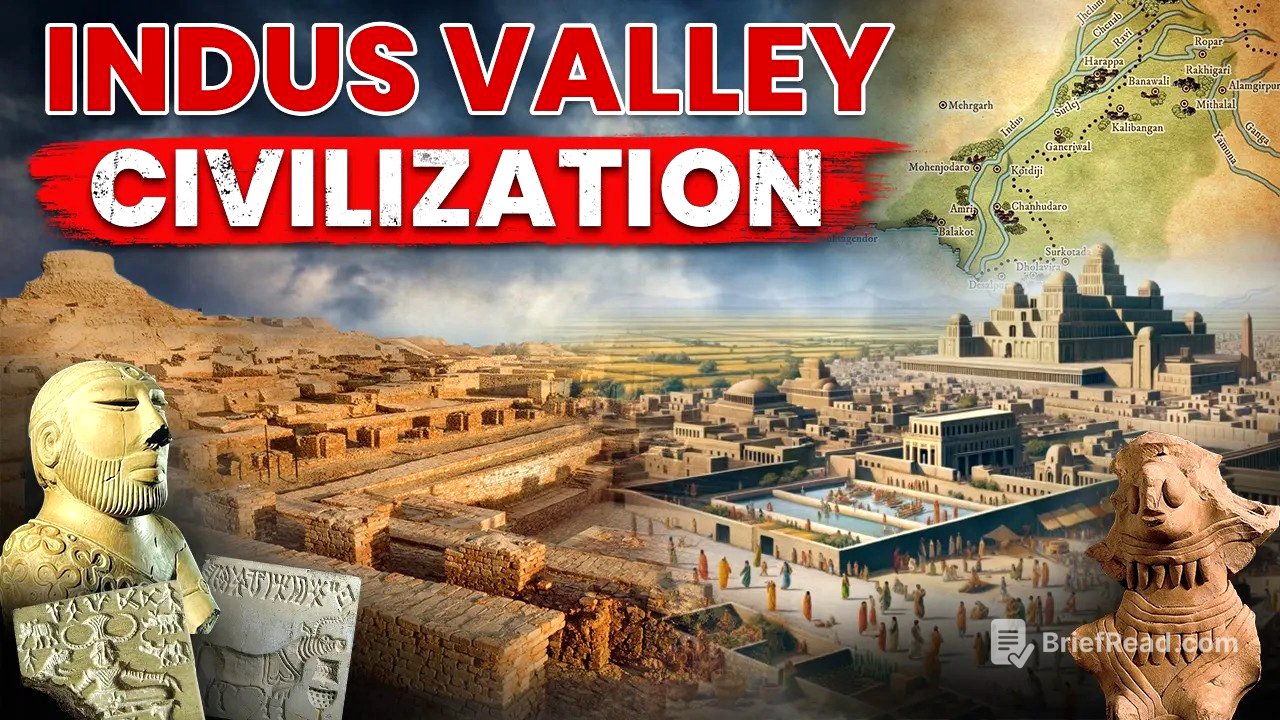
The video starts by setting the stage, explaining how the British used to justify their rule in India by claiming they were civilizing the country. This narrative was shattered in 1921 with the discovery of the Indus Valley Civilization (IVC), proving that India had a highly cultured and civilized society thousands of years ago. The unearthing of Harappa and Mohenjo-daro revealed organized cities with roads, buildings, and advanced drainage systems. Artefacts like terracotta pots, jewelry, and statues showcased the culture and lifestyle of the time. The civilization's advancements in agriculture, trade, technology, and architecture were remarkable, especially its water management. Despite decades of excavation, the Indus script remains a mystery, unlike the languages of other ancient civilizations. The video then poses questions about the unique aspects of the IVC, its discovery, the undeciphered language, and the reasons for its decline.
Discovery of the Indus Valley Civilization [2:04]
The discovery of the Indus Valley Civilization can be traced back to Charles Masson, who in 1829, while traveling through Punjab, noticed ancient ruins and remnants. He documented his observations, unaware that he had stumbled upon an ancient city of a long-lost civilization. Later, British travelers and officers like Sir Alexander Burnes and Sir Alexander Cunningham visited the site. Cunningham, fascinated by the area, conducted small excavations in the 1870s and published a report mentioning a unique seal with an inscription. The real breakthrough came in 1902 when Sir John Marshall became the Director of the Archaeological Survey of India (ASI) and initiated large-scale excavations at Harappa, led by Daya Ram Sahni. In 1921, Sahni found ancient remains near the Ravi River, confirming the existence of a city dating back thousands of years. This city was named Harappa. In 1922, Rakhaldas Banerjee discovered similar remains near the Indus River, about 590 km from Harappa, leading to the discovery of Mohenjo-daro. In 1924, John Marshall officially announced the discovery of an ancient civilization in British India, which came to be known as the Indus Valley Civilization or Harappan Civilization.
Social Structure of the Civilization [7:16]
The Indus Valley Civilization was spread over a vast area of 1.26 million square kilometers, encompassing parts of modern-day India, Pakistan, and Afghanistan. Prominent sites include Harappa, Mohenjo-daro, Amri, Kalibangan, Lothal, Surkotada, Banawali, and Dholavira. The civilization is estimated to have had a population of around 5 million people and is divided into three phases: the Early Harappan phase, the Mature Harappan phase, and the Late Harappan phase. The Mature Harappan phase, from 2600 BCE to 1900 BCE, is considered its golden era, during which cities like Harappa, Mohenjo-daro, and Lothal transformed into major urban centers. These cities were designed with a distinct pattern, featuring a lower mount for residential areas and an upper mount for important buildings like marketplaces, workshops, and granaries. The upper and lower mounts were surrounded by boundary walls to protect against floods and wild animals. Houses were constructed with uniformly sized bricks and had bathrooms with drainage systems connected to the city's main drainage network. The civilization also had advanced water resource management, with wells for clean water and large reservoirs like the Great Bath in Mohenjo-daro, which was used for religious and social activities.
Culture and trade of the Civilization [11:10]
Despite its organized structure, there's no evidence of a ruling class or governing system in the Harappan Civilization. People seemed to live harmoniously without an army or weapons, and there's no sign of warfare. While no temples have been found, seals suggest religious beliefs, including the Pashupati Seal, which depicts a figure in a yogic posture surrounded by animals. Other seals feature trees and unicorns, indicating a reverence for nature. The people were skilled in arts, as evidenced by a bronze statue of a dancing girl found in Mohenjo-daro. They used clay, stone, and metals to create jewelry, toys, and utensils. Agriculture and trade were the main sources of livelihood, with crops like wheat, barley, lentils, and cotton being cultivated. The Indus Valley people were the first to use cotton for spinning and weaving. They also practiced animal husbandry, raising animals like camels, buffaloes, goats, dogs, and cats. Trade was extensive, both internally and with contemporary civilizations like Mesopotamia, where the Indus Valley was known as Meluha. The Mesopotamians imported cotton, timber, and luxury items from the Indus Valley. Seals with unique symbols were used for trade, and accurate weights and measures were employed.
Mysteries behind its Language & Script [14:48]
Despite the archaeological discoveries, the Indus Valley Civilization remains shrouded in mystery because its language, evidenced by inscriptions on seals, terracotta tablets, and metal objects, remains undeciphered. Unlike other ancient civilizations like Mesopotamia and Egypt, where languages have been decoded, the Indus script has defied all attempts at decipherment for over a century. The Rosetta Stone, which helped decode Egyptian hieroglyphs, has no equivalent for the Indus script. Historians have made some observations, such as the script being written from right to left and the presence of animal symbols alongside the text. The script contains around 400 signs, some resembling fish, turtles, and insects, leading historians to believe it is a logo-syllabic script, where signs represent words or sounds. Most inscriptions are short, with only a few signs, but some contain up to 26 symbols. Indus script seals have been found in Persia and Mesopotamia, initially leading some to believe it was related to Mesopotamian script, but this theory was later rejected. The script's origins and relationship to other languages like Sanskrit or Dravidian languages remain debated, with some even suggesting that the signs are not a language at all but merely symbols. The undeciphered script continues to intrigue researchers, with recent announcements of rewards for anyone who can decode it.
Decline of the Civilization [19:53]
The decline of the Indus Valley Civilization occurred rapidly between 1900 BCE and 1300 BCE, known as the Late Harappan phase. While cities had been rebuilt after previous floods, the situation worsened over time. City planning declined, roads were not maintained, drainage systems deteriorated, and trade with Mesopotamia ceased. By 1700 BCE, most cities were abandoned, and standardized weights and building ratios were no longer used. The reasons for this decline are debated, with several theories proposed. One theory suggests environmental changes led to decreased monsoon rains, causing droughts and making agriculture difficult. The drying up of rivers also impacted trade. Another theory points to natural disasters like earthquakes or floods. Epidemics may have also contributed to the decline. Some researchers suggest an Aryan invasion from the west, leading to conflict and displacement. However, these are just theories, and the true cause remains unknown. Despite the mysteries, the Indus Valley Civilization continues to fascinate, and further research and excavation may one day reveal more about this great civilization.