TLDR;
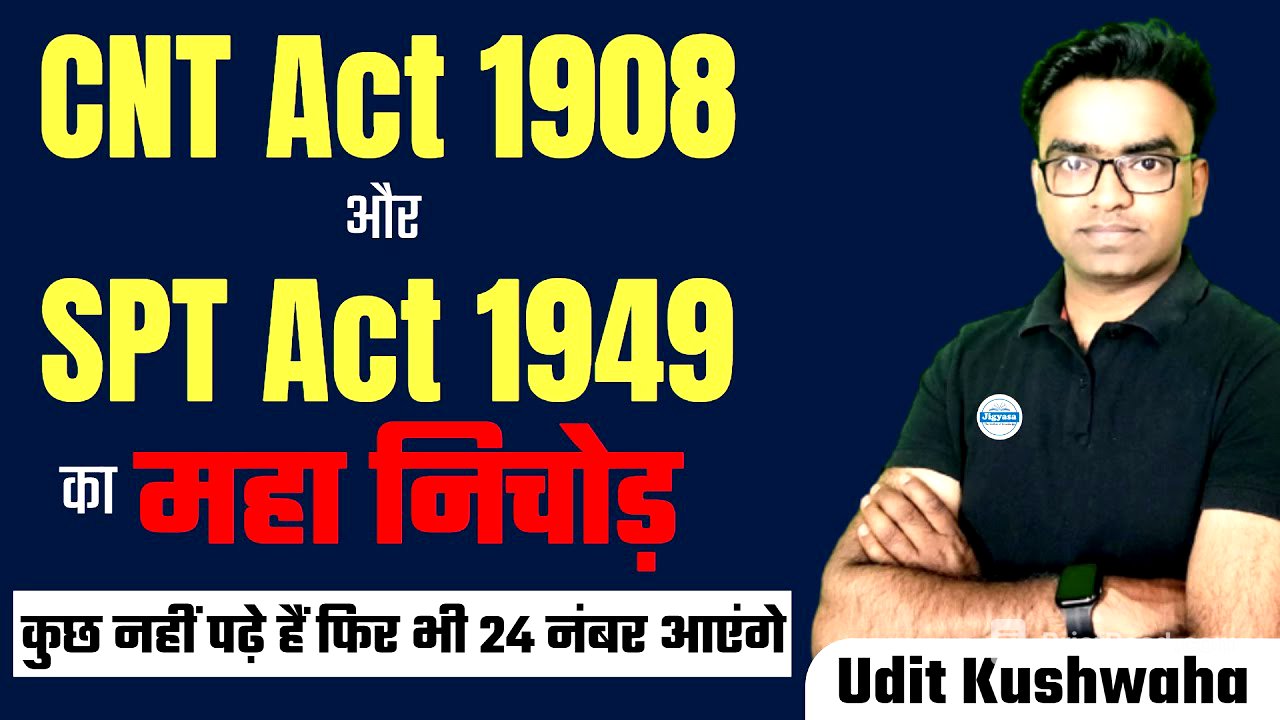
Alright, so this video is basically a crash course on the Chotanagpur Tenancy Act (CNT Act) of 1908 and the Santhal Pargana Tenancy Act (SPT Act) of 1949. The instructor aims to cover the important aspects of both acts, which are crucial for cracking exams like JPSC and JSSC. He goes through a series of multiple-choice questions, explaining the concepts, sections, and historical context behind each one.
- Wilkins Law and its implementation
- Hill Assembly Plan and its relevance to tribal development
- Yule Rule and its impact on the traditional governance system
- Chotanagpur Tenancy Act and its key provisions
- Santhal Pargana Tenancy Act and its key provisions
Introduction [0:48]
The instructor starts off by greeting everyone and checking if the audio and video are clear. He mentions that he's been a bit occupied with JPSC syllabus completion, which is why he couldn't take as many classes as he wanted to. He then announces that he'll be covering the CNT and SPT Acts together, as many students requested.
Wilkins Law and Hill Assembly Plan [3:29]
The first question is about when Wilkins Law was implemented in Chotanagpur. The instructor explains that it was framed in 1834 by Captain Thomas Wilkins but implemented in 1837. This law was specifically for the Kolhan area and had 31 rules. The next question is about the Hill Assembly Plan, which was implemented in the Santhal Pargana area for the Paharia tribe. This plan was launched by August Cleveland, who became the commissioner of Bhagalpur in 1778.
Yule Rule and Chotanagpur Tenures Act [5:48]
The discussion moves to the Yule Rule of 1856, which was actually called the Santhal Police Regulations. It recognized the Manjhi Pargana system and was implemented in the Santhal Pargana area. George Yule, the commissioner of Bhagalpur at the time, is the namesake of this rule. The instructor then asks about the Chotanagpur Tenures Act, which was implemented on April 1, 1869. Rakhal Das Haldhar conducted a survey of 2,482 villages between 1862 and 1876. This survey focused on Uraon land and land belonging to zamindars, but it didn't include Khurk land.
Bhumi Survey and Santhal Pargana Tenancy Act [9:11]
The instructor asks who started the Bhuihari survey to identify Bhuihari land and Majhas land in 1862. The answer is Babu Rakhal Das Haldhar. The survey ran until 1869, leading to the implementation of the Chotanagpur Tenures Act. Before Haldhar, Lal Loknath Shahdev started the survey, but he passed away, and Haldhar took over. The next question is about when the Santhal Pargana Tenancy Act was passed. The instructor clarifies that it was enacted in 1949. This act was a provisional measure following a report on illegal land transfers between 1855 and 1885, which was prepared by GF Gager.
Malguzari System and Permanent Settlement Act [12:02]
The discussion shifts to when the Malguzari system was first implemented in Jharkhand. The instructor says it was in 1765, following the Treaty of Allahabad between Robert Clive and Shah Alam II. In 1775, S.J. Wittel became the first civil collector of Chotanagpur, but he failed to collect taxes effectively. Later, in 1793, Lord Cornwallis implemented the Permanent Settlement Act. The instructor advises students to focus on revision, as the JPSC exam is unlikely to be canceled.
Malguzari System under Mughal Rule and Permanent Settlement in Hilly Areas [14:58]
The instructor asks under which Mughal ruler the Malguzari system was first implemented in Jharkhand. The answer is Akbar, who made Jharkhand a tax-paying state. To collect this tax, the Nagvanshis appointed Mankis. Later, Bhuihars, Jagirdars, and Zamindars took over. Darpan Sahi became the first Jagirdar of the East India Company in 1771. The next question is about when the Permanent Settlement Regulation Act was implemented in the hilly areas of Ramgarh. The instructor says it was in 1793.
Rights of Ryots and Bhuihari Survey [18:20]
The instructor asks in which year the rights of the ryots were first defined and protected in Jharkhand. The answer is 1824. Around this time, the Damin-i-Koh area was created in the Santhal Pargana. A ryot is someone who holds land under a landowner and pays rent. The instructor then asks about the number of villages surveyed under the Bhuihari survey around 1869. The answer is 2,482 villages. The survey covered Bhuihari land, which is associated with the Oraon tribe, and Majhas land, which belonged to zamindars.
Leadership of Bhuihari Survey and Chotanagpur Tenancy Process Act [20:39]
The instructor asks who led the Bhuihari survey in the Ranchi area between 1862 and 1869. The answer is Rakhal Das. The instructor emphasizes remembering things in a way that helps answer exam questions. He then asks in which year the Chotanagpur Tenancy Process Act was implemented in the Chutia Nagpur area. He explains that J.H. Habbit used the term "Chutia Nagpur" for the Chotanagpur region. The answer is 1879.
Mundari Khuntkatti System and Bihar Land Reforms Act [22:41]
The instructor asks when the Mundari Khuntkatti system was recognized. The answer is 1903. In the same year, the draft of the CNT Act was prepared by Father John Bapstist Hoffman. Between 1902 and 1910, the Ranchi district was surveyed by John Reed and Mr. Lister. The next question is about when the Bihar Land Reforms Act was implemented. The answer is 1950. This act aimed to abolish the zamindari system.
Scientific Land Survey and Appointment of Zamindars [25:05]
The instructor asks in which year land was allotted to ryots and zamindars after a scientific survey. The answer is 1902. The instructor explains the difference between ryots and zamindars. The next question is about who had the right to appoint and remove zamindars during the British period. The answer is the District Collector.
Hearing of Tax Disputes and Chotanagpur Landlord and Tenancy Procedure Act [26:52]
The instructor asks which act transferred the right to hear tax-related disputes from the District Collector to civil courts. The answer is the Chotanagpur Land Tenures Act of 1869. The next question is about when the Chotanagpur Landlord and Tenancy Procedure Act was implemented. The answer is 1879.
Land Surveys and Chotanagpur Tenancy Act Implementation [28:29]
The instructor asks which land survey is related to land. The answer is all of the above. The next question is about which land survey was conducted two years before the Chotanagpur Tenancy Act. The answer is Cadastral Survey. The instructor then asks when the Chotanagpur Tenancy Act was implemented. The answer is 1908. The act applies to four divisions and 18 districts of Jharkhand.
Chotanagpur Tenancy Act: Key Sections and Provisions [30:38]
The instructor asks when the British government introduced the Chotanagpur Tenancy Act. The answer is 1908. He then asks which law restored the rights of Scheduled Tribes in illegally transferred land under Section 71A of the CNT Act. The answer is the Bihar Scheduled Areas Regulation Act of 1969. The next question is about the rights of a Khutkattidar girl under the CNT Act. The instructor explains that rights of succession to ancestral property are excluded for female Khutkattidars.
Bhuihari Ryots and Restrictions on Land Transfer [33:33]
The instructor asks about the meaning of Bhuihari Ryot. The answer is Oraon. He explains the difference between Bhuihari land, Bhoot Kheta land, and Khutkatti land. The next question is about the section of the CNT Act that restricts the transfer of land belonging to Scheduled Tribes, Backward Classes, and Scheduled Castes. The answer is Section 46.
Eviction Time and CNT Act Implementation Date [36:58]
The instructor asks about the eviction time under Section 46. The answer is 12 years. The next question is about the exact date when the Chotanagpur Tenancy Act was implemented. The answer is November 11, 1908. The instructor shares additional information about the CNT Act, such as its cost of formation (₹1 lakh) and its origin as a copy of the Bengal Tenancy Act of 1885.
Drafting of CNT Act and Influences [39:26]
The instructor asks who prepared the draft of the Chotanagpur Tenancy Act. The answer is Father John Bapstist Hoffman. He explains that the act was created to protect the land rights of tribals. The next question is about which act influenced the Chotanagpur Tenancy Act. The answer is the Bengal Tenancy Act.
Divisions and Chapters of CNT Act [41:45]
The instructor asks in which division the Chotanagpur Tenancy Act is implemented. The answer is all of the above. The next question is about the number of chapters in the Chotanagpur Tenancy Act. The answer is 19. The instructor highlights some important chapters, such as Chapter 2 (classes of tenants), Chapter 3 (tenure holders), Chapter 8 (transfer of land), Chapter 9 (rent), Chapter 12 (record of rights), and Chapter 18 (Mundari Khutkatti).
Sections and Amendments of CNT Act [45:41]
The instructor asks about the total number of sections in the Chotanagpur Tenancy Act. The answer is 271. The next question is about the year of the first amendment to the Chotanagpur Tenancy Act. The answer is 1920. The instructor mentions that there have been a total of 26 amendments, with the last one in 1995 and a proposed amendment in 2016.
Objectives of CNT Act and Wild Land [46:56]
The instructor asks which of the following is not an objective of the Chotanagpur Tenancy Act. The answer is to evict tribes from their land. The instructor explains that the act aims to protect the land rights of tribals and is considered the Magna Carta of tribes. The next question is about what is called wild land prepared by a farmer other than the landowner under the CNT Act. The answer is Korkar.
Land Tenures and Permanent Settlements [50:39]
The instructor asks about the land tenure that is returned to the landowner after the death of the ryot if there is no male heir. The answer is resumable land tenure. The next question is about when the British government implemented the permanent settlement in Bengal, Bihar, and Orissa. The answer is 1793.
Agricultural Year and Land Holding [52:20]
The instructor asks about the meaning of agricultural year under the Chotanagpur Tenancy Act. The answer is the year prevalent for agricultural work in a local area. The next question is about the meaning of Jot. The answer is land held by the ryot.
Land Owner and Tenant [55:00]
The instructor asks about the meaning of land owner. The answer is a person who has given his land to a tenant. The next question is about the meaning of tenant. The answer is a person who holds land under another person and pays rent.
Rent and Resumable Land [58:04]
The instructor asks about the meaning of rent. The answer is the consideration given by the ryot to his land owner in exchange for the enjoyment of the land. The next question is about the meaning of resumable land. The answer is land that reverts to the land owner if there is no male heir in the family.
Tenants and Land Holders [1:01:14]
The instructor asks who is included under the tenant. The answer is all of the above. The next question is about the meaning of land holder. The answer is a person who holds land from another person and pays rent.
Ryots and Mundari Khuntkattidar [1:04:19]
The instructor asks what a person who holds land for cultivation and pays rent is called. The answer is Ryot. The next question is what a Mundari who has acquired land rights by bringing a part of the wild land under cultivation is called. The answer is Mundari Khuntkattidar.
Degrees and Bhuihari Land [1:09:02]
The instructor asks about the meaning of degree. The answer is an order of the civil court. The next question is about when Bhuihari land will be considered a permanent settlement. The answer is 12 years.
Enhancement of Rent and Definition of Settled Ryot [1:11:49]
The instructor asks under which section of the Chotanagpur Tenancy Act there is a provision for increasing the rent of a Bhuihar or village headman. The answer is Section 9A. The next question is about the section in which the settled ryot is defined. The answer is Section 17.
Exemptions from Rent and Eviction of Ryots [1:16:13]
The instructor asks under which section of the CNT Act there is no rent to be paid for orchards, threshing floors, and compost pits in the Saraikela and Kharsawan subdivisions of Singhbhum district. The answer is Section 24. The next question is about the section of the CNT Act that deals with the eviction of a ryot from his holding. The answer is Section 22.
Reduction in Rent and Khutkatti Rights [1:18:30]
The instructor asks about the section of the CNT Act that deals with the reduction in rent of a ryot's holding. The answer is Section 33A. The next question is about the number of years for which the rent of a Khutkatti rights holder cannot be increased if the tenancy has been created for more than that number of years. The answer is 20 years.
Eviction of Non-Occupancy Ryots and Transfer of Land [1:21:46]
The instructor asks under which circumstances a non-occupancy ryot can be evicted under Section 41 of the CNT Act. The answer is all of the above. The next question is about the maximum period for which a ryot can transfer his holding or any part of it under Section 46 of the CNT Act. The answer is 5 years.
Mortgaging of Land and Registered Societies [1:26:21]
The instructor asks about the minimum period for which a ryot can mortgage his holding under Section 46 of the CNT Act. The answer is 5 years. The next question is about the type of society to which a ryot can mortgage his holding under Section 46 of the CNT Act. The answer is a society registered under the Bihar Orissa Cooperative Societies Act 1935.
Scheduled Tribes and Deputy Commissioners [1:28:46]
The instructor asks under Section 463A of the CNT Act, if one party is a Scheduled Tribe and the other party is not, who must necessarily be a party in such a case. The answer is the Deputy Commissioner.
Sale of Ryoti Land and Illegal Recovery of Rent [1:29:32]
The instructor asks under which section of the CNT Act no order can be passed by any court for the sale of a ryot's holding. The answer is Section 47. The next question is about the section of the CNT Act under which there is a provision for punishment if a land owner illegally recovers an amount in addition to the rent from the tenant. The answer is Section 63.
Barren Land and Korkar Land [1:37:09]
The instructor asks under which section of the CNT Act the state government can settle any barren land. The answer is Section 63A. The next question is about the meaning of Korkar under the Chotanagpur Tenancy Act 1908. The answer is land prepared by the ryot by digging up the fallow land.
Conversion of Land and Rent-Free Period [1:40:49]
The instructor asks under which section of the Chotanagpur Tenancy Act land can be converted into Korkar with the order of the Deputy Commissioner. The answer is Section 64. The next question is about the number of years for which no rent is to be paid on land converted to Korkar under Section 67A of the Chotanagpur Tenancy Act 1908. The answer is 4 years.
Water Usage and Privileged Land [1:43:08]
The instructor asks under which section of the CNT Act the state government can order a revenue officer to resolve and survey water usage or flow-related issues from land owners, tenants, or other individuals. The answer is Section 82. The next question is about the section of the CNT Act in which the definition of privileged land is given. The answer is Section 118.
Inclusions in Privileged Land and Restrictions on Transfer [1:46:54]
The instructor asks which of the following is included in the privileged land of a land owner under Section 118 of the Chotanagpur Tenancy Act 1908. The answer is all of the above. The next question is about the section of the CNT Act under which the transfer of a Mundari Khuntkatti tenancy is restricted. The answer is Section 240.
Authorized Personnel and Payment of Rent [1:50:00]
The instructor asks who is authorized to change the rent of land under the Chotanagpur Tenancy Act. The answer is the District Deputy Commissioner. The next question is about when the rent is to be paid under the Chotanagpur Tenancy Act. The answer is at the end of the quarter of the agricultural year.
Appeals and Barren Land [1:50:43]
The instructor asks where an appeal can be made against the decisions of the Commissioner's Court under the Chotanagpur Tenancy Act. The answer is in the High Court. The next question is about how barren land can be settled according to the provisions of the Chotanagpur Tenancy Act. The answer is by settlement lease.
Authorized Personnel and Malguzari [1:51:54]
The instructor asks who is authorized to make laws regarding the procedure of the Chotanagpur Tenancy Act. The answer is the State Government. The next question is about the number of years for which Malguzari will not be levied on Korkar land according to the Chotanagpur Tenancy Act. The answer is 4 years.
Land Records and Rent [1:52:38]
The instructor asks under which section of the Santhal Pargana Act 1949, land that has not been recorded in any form will be considered the Jot or private Jot of the original Ryot. The answer is Section 10. The next question is about the number of years for which a settlement of barren land can be canceled under Section 33 of the Santhal Pargana Act 1949 if it has not been cultivated. The answer is 5 years.
Temporary Transfer and Special Villages [1:54:15]
The instructor asks under Section 22 of the Santhal Pargana Act 1949, a Ryot can temporarily place his Jot land in trust for agriculture after informing the SDO and Mukhiya or original Ryot in which circumstances. The answer is all of the above. The next question is about the meaning of a Khas village under the Santhal Pargana Act 1949. The answer is a village where there is no original Ryot and no headman.
Headman and Non-Transferable Posts [1:55:46]
The instructor asks under the Santhal Pargana Act 1949, what is the position of the village headman. The answer is non-transferable. The next question is about the district in which the Santhal Pargana Act 1949 does not apply. The answer is Ranchi.
Agricultural Year and Appointment of Headman [1:56:56]
The instructor asks about the definition of agricultural year under the Santhal Pargana Act 1949. The answer is all of the above. The next question is about who appoints the headman of a Khas village under Section 5 of the Santhal Pargana Act 1949. The answer is the Deputy Commissioner of the district.
Consent of Ryots and Classes of Ryots
The instructor asks about the number of Ryots whose consent is required for the appointment of a headman of a Khas village under Section 5 of the Santhal Pargana Act 1949. The answer is two-thirds. The next question is about the section of the Santhal Pargana Act 1949 under which the classes of Ryots are provided. The answer is Section 12.
Domestic and Agricultural Purposes [2:00:59]
The instructor asks under which section of the Santhal Pargana Act 1949, a Ryot can use bricks and tiles in his holding for his domestic or agricultural purposes without any charge. The answer is Section 15.
Planting Trees and Exchange of Land [2:01:32]
The instructor asks under which section of the Santhal Pargana Act 1949, a Ryot has the right to plant trees on his private holding, cut them, and use them. The answer is Section 23. The next question is about the section of the Santhal Pargana Act 1949 under which the land of a Ryot can be exchanged. The answer is Section 23.
Barren Land and Pahariya Villages [2:02:41]
The instructor asks under which section of the Santhal Pargana Act 1949, there is a provision for the settlement of barren land. The answer is Section 27. The next question is about the section of the Santhal Pargana Act 1949 under which the settlement of barren land of a Pahariya village cannot be done with a non-Pahariya village. The answer is Section 41.
PESA Act and Gram Sabha [2:08:10]
The instructor asks when the Panchayat Extension to Scheduled Areas (PESA) Act 1996 was passed. The answer is 1996. The next question is about which of the following the PESA Act aims to empower. The answer is the Gram Sabha.
Powers of Gram Sabha and Control [2:10:59]
The instructor asks which of the following powers is granted to the Gram Sabha under the PESA Act. The answer is both of the above. The next question is about the activity over which the Gram Sabha has control under the PESA Act. The answer is on all of the above.
Conclusion [2:11:55]
The instructor concludes the session, hoping it will help students with their exams. He asks for feedback and encourages students to download the Jigyasa Learning app for paid classes.