TLDR;
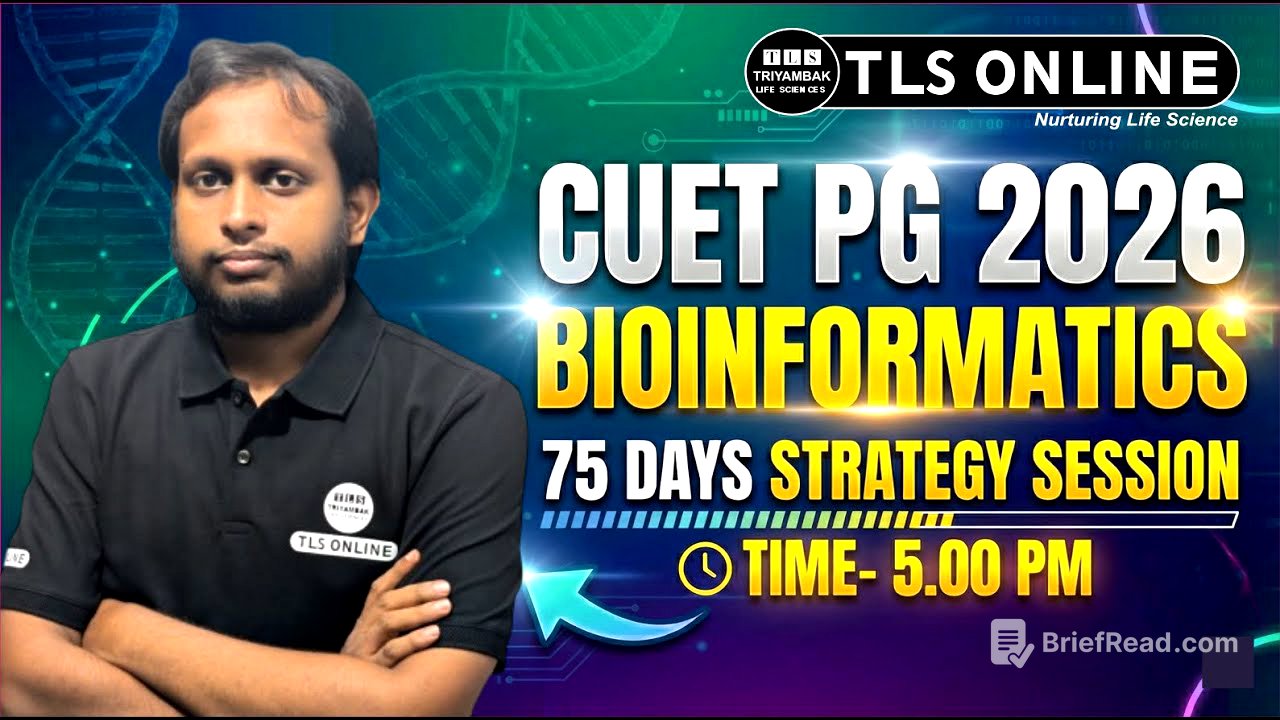
Alright, folks, this video is all about cracking the CUET PG Bioinformatics exam. It gives you a roadmap for the next 11-12 weeks, focusing on understanding the exam pattern, syllabus, and how to prioritize topics. The main takeaways are:
- Know your syllabus inside and out, dividing it into Chemical Science, Techniques & Stats, and Core Bioinformatics.
- Prioritize high-weightage topics like Biochemistry, Molecular Biology, and Core Bioinformatics.
- Practice PYQs (Previous Year Questions) and mock tests religiously.
- Strengthen your weaker areas, especially Math and Computer Science, as they can boost your rank.
Introduction [0:21]
The video kicks off with New Year wishes and sets the stage for CUET PG exam prep. It acknowledges that with about 75 days left, a solid strategy is needed to ace the Bioinformatics exam and get into a good central university for your MSc. The video promises a roadmap to guide you through this.
Exam Pattern [1:38]
The CUET PG exam is a computer-based test conducted by NTA. It consists of 75 MCQs focused on your chosen domain (like Bioinformatics). You get 90 minutes to solve it. The marking scheme is +4 for each correct answer and -1 for each wrong one. The exam is bilingual, available in both English and Hindi.
Syllabus Breakdown [2:57]
To nail any exam, knowing the syllabus is key. The Bioinformatics syllabus is vast, covering:
- Life and Chemical Signs: This is basically your biochemistry, covering DNA, RNA, proteins, enzymes, and metabolic pathways (carbohydrate, fatty acid, lipid, protein, and nucleic acid metabolism).
- Techniques: PCR methods, DNA sequencing, gene therapy, etc.
- Virology, Immunology, Vaccines, and Microbes: Classifications of viruses, viral infections, diseases, adaptive immunity, cellular immunity, complement system, hypersensitivity, B cells, T cells, vaccines, and microbes.
- Math and Statistics: Calculus, probability distributions, and algebra.
- Thermodynamics, NMR, X-rays, and Spectroscopy:
- Computational Toolkits: C++, L programming, bioefficacy databases, sequence alignment (BLAST and FASTA), gene expression analysis, local and global alignment algorithms, and protein/nucleic acid structure prediction methods.
The syllabus can be divided into three units: Chemical Science (biochemistry, immunology, biology), Techniques, Math & Statistics, and Core Bioefficacies in Computer Science.
12-Week Study Plan [6:44]
With 11-12 weeks in hand, the video suggests a three-phase approach:
- Phase 1 (5 weeks): Cover foundational science, including math (calculus, algebra, probability, geometry), chemistry, and thermodynamics.
- Phase 2: Focus on core biology, including biomolecules, metabolism, immunology, viruses, and technical portions. Math is prioritized first because it is often a weaker area for biology students.
- Phase 3: Cover core biophysics, including computer science, language, and core biophysics concepts.
Weightage Analysis [8:58]
Knowing the weightage of each unit is crucial.
- Unit 1 (Math & Stats): Medium weightage, but high scoring if you're good at it.
- Unit 2 (Chemistry): Low weightage, with only 4-6 questions from the biomaterials portion.
- Unit 7 (Programming): Fewer questions (around 10), but can boost your rank.
- Units 4 & 6 (Microbiology & Immunology, Spectroscopy & Chromatography): Medium weightage, compulsory to know.
- Unit 8 (Core Bioefficacies): High weightage, with around 15 questions.
- Biochemistry & Molecular Biology: Basic, with 20-12 questions each.
- Techniques (Recombinant DNA Technology): Around 12 questions.
Focus on high-weightage portions first, and remember that math and computer portions can set you apart.
Exam Strategy [12:22]
To prepare effectively:
- Complete the syllabus.
- Practice PYQs.
- Take mock tests.
Math and computer-based questions are high-scoring and can improve your rank.
Question Types [17:43]
- Match the Column: Easiest and highest scoring (12-15 questions).
- Multi-Selection/MCQs: Most accurate and commonly asked (20-25 questions).
- Numerical Questions: Target at least 5 out of 10.
- Direct Theoretical Questions: Around 20 marks, so have good knowledge.
- Sequencing and Order Questions: Knowledge-based.
- Statement Evaluation: Tricky questions requiring both concept and knowledge.
Avoid negative marking by only attempting questions you're sure of.
Weekly Study Plan [21:19]
- Weeks 1-2: Focus on biochemistry and biophotics basics, targeting high-weighted portions.
- Phase 2: Cover computational portions, computer language, microbiology, immunology, biophysics, and chemistry. Strengthen your analytical skills.
- Week 8: Focus on high weightage portions.
- Weeks 8-10: Practice analytical and calculative questions, strengthening math and computer portions.
- Week 11: Revise the full syllabus and take full-length mock tests.
PYQs are compulsory every week after studying a topic.
TLS Online Courses [24:43]
If you need guidance, TLS Online offers recorded CUET PG courses in various subjects like biochemistry, botany, zoology, bioinformatics, life science, and more. These courses have a six-month validity and are available at a discounted price of ₹1,470. You can purchase them on their website or by calling the provided number.