TLDR;
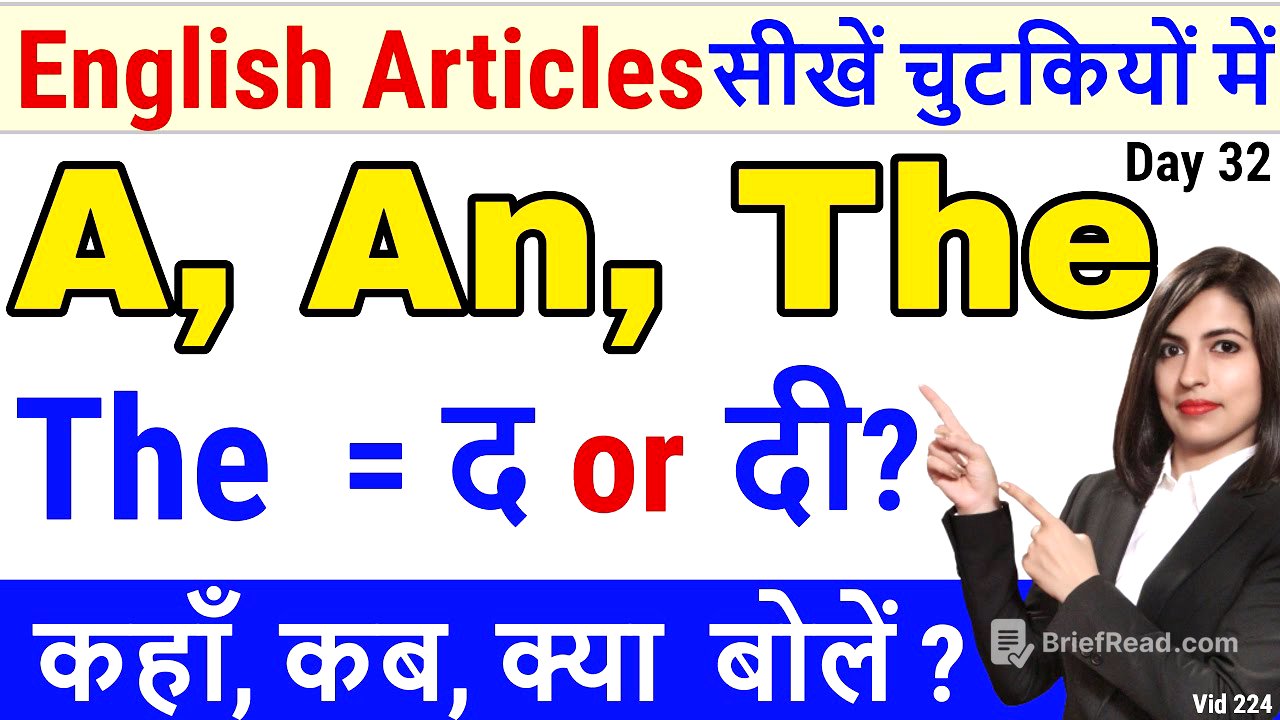
This video is about clearing up confusion around the use of articles 'a', 'an', and 'the' in English. It explains the rules for using 'a' and 'an' based on the sound of the word that follows, not just the first letter. It also covers the different pronunciations of 'the' (thee vs. thuh) and when to use 'the' for specific or already-mentioned nouns.
- Use 'a' or 'an' based on sound, not just the first letter.
- 'The' is used for specific nouns or those already mentioned.
- 'Thee' is used when the next word starts with a vowel sound.
Introduction: Clearing Confusion about Articles [0:00]
The video starts by acknowledging the confusion many people face with English articles: a, an, and the. The speaker emphasizes that clearing this confusion is crucial for speaking and understanding English well. She encourages viewers to share their specific confusions in the comments so she can address them in future videos.
Understanding 'A' and 'An': The Basics [1:42]
'A' and 'an' both mean 'one'. The choice between them depends on the sound of the word that follows. Traditionally, it's taught that 'an' is used before words starting with vowels (A, E, I, O, U). However, the speaker points out that it's about the sound, not just the letter. For example, 'university' starts with 'U' but sounds like 'yu', so we use 'a university'. If the word starts with vowel sound then use 'an' like 'an umbrella'.
The Sound Rule: Hindi Vowels and Consonants [3:12]
For Hindi speakers, a simple trick is explained. If the word starts with the sound of a Hindi vowel (अ, आ, इ, ई, उ, ऊ, ए, ऐ, ओ, औ), use 'an'. If it starts with a consonant sound (क, ख, ग, etc.), use 'a'. This is why we say 'a university' (य sound) but 'an umbrella' (अ sound).
Examples and Exceptions for 'A' and 'An' [5:28]
More examples are given to solidify the concept. 'A European country' uses 'a' because 'European' sounds like 'yoo-ru-pean'. Similarly, 'an hour' uses 'an' because the 'h' is silent, and the word starts with an 'ow' sound. The focus is always on the initial sound, not the spelling.
Pronunciation of 'The': 'Thee' vs. 'Thuh' [7:34]
The speaker addresses the confusion around the pronunciation of 'the' as 'thee' or 'thuh'. Both pronunciations are correct, but 'thee' is used when the following word starts with a vowel sound. For example, 'thee end' sounds better than 'thuh end'.
Understanding 'The': Specific vs. Non-Specific [9:18]
The main use of 'the' is to refer to something specific or something that has already been mentioned. If you say "I saw a man," you're talking about any man. But if you then say "The man was crying," you're talking about the specific man you just mentioned. 'A' or 'an' is used when introducing something new or non-specific.
Examples of 'The' in Use [11:25]
The speaker provides examples to illustrate the difference. "I ate an apple" means any apple. "The apple I ate yesterday was sour" refers to a specific apple. 'The' is used when the listener knows which specific thing you're talking about, either because you've already mentioned it or because it's clear from the context.
Recap of 'A', 'An', and 'The' Rules [13:28]
The video summarizes the key points: Use 'a' or 'an' when introducing a general, non-specific noun. Use 'the' when referring to a specific noun that has already been identified or is known to the listener.
Additional Notes on Articles [14:04]
'A' and 'an' can only be used with singular nouns because they mean 'one'. 'The' can be used with both singular and plural nouns. Articles are determiners, specifying which noun is being referred to.
Conclusion and Call to Action [15:14]
The speaker encourages viewers to re-watch the video if they still have doubts. She reiterates that articles are determiners that come before nouns and specify whether the noun is general or specific. She asks viewers to subscribe to the channel and press the bell icon for more videos.