TLDR;
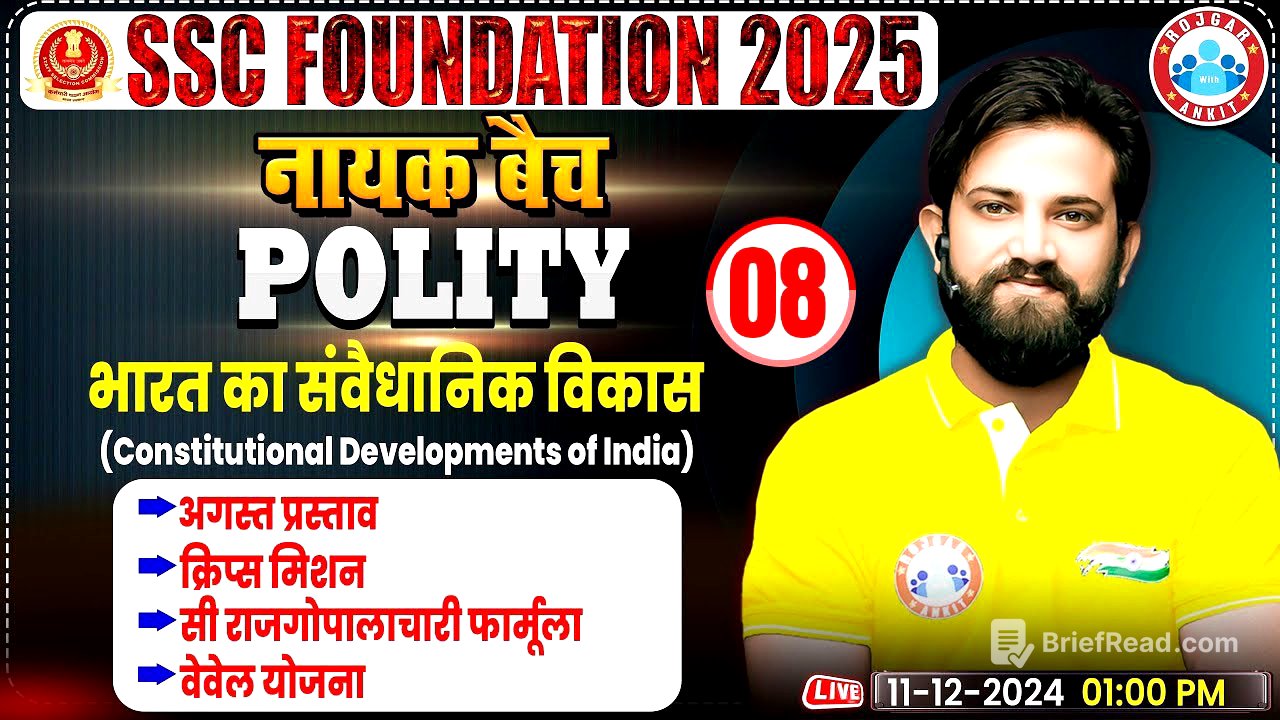
In this video by RWA SSC Exams, the instructor discusses the constitutional development of India, including significant events like the August Offer, Cripps Mission, the Quit India Movement, the role of various political leaders, and the challenges faced during this turbulent period. The discussion encapsulates the key events and responses of the Indian political landscape during World War II, with an emphasis on the demands for Indian independence.
- Overview of the August Offer and its implications.
- Details about the Cripps Mission and its failure.
- Highlighting the impact of the Quit India Movement and reactions from different political groups.
Introduction and Welcome [0:12]
Naveen Sharma welcomes the audience and sets the stage for today's class on India's constitutional development. He requests cooperation from students and apologizes for any potential disruptions during the session.
August Offer and Historical Context [1:17]
The class dives into the August Offer, introduced by the Viceroy, Lord Linlithgow, in response to the demands of Indians during World War II. This offer included discussions around the participation of India in the war without consulting Indian leaders. Key dates and events leading up to the announcement are also highlighted.
World War II and India [1:55]
The instructor explains the context of World War II and the stance of various nations including Britain, Japan, and the involvement of Indian leaders. This section covers the importance of 3rd September 1939 when India was drawn into the war without consultation.
Political Dynamics and Collaboration [3:20]
He elaborates on the two blocs formed during the war - Allied Powers and Axis Powers, identifying significant countries involved, including Japan and Germany. The impact of the war on India's political landscape and the support for British leadership from the Communist Party of India (CPI) is also analyzed.
Reactions to the August Offer [7:35]
Discussion about the Congress party’s response to the August Offer which was rejected due to lack of true representation of Indian aspirations for complete freedom, as demanded at the Lahore session in 1929.
Cripps Mission Details [15:15]
The instructor explains the Cripps Mission introduced in March 1942 aimed at securing Indian cooperation in the war. However, its proposals were rejected by Indian leaders, especially Gandhi, due to perceived ineffectiveness and lack of serious commitment to Indian independence.
Quit India Movement Initiation [22:50]
The Quit India Movement is highlighted as a response to the failure of the Cripps Mission. Gandhi's call for "Do or Die" is discussed, along with the objectives of the movement to demand immediate independence from British rule.
Impact and Response [31:20]
The section covers the widespread support and actions from the populace in response to the Quit India Movement, including the establishment of parallel governments in various regions. The different reactions of political entities like the Hindu Mahasabha and the Muslim League to the movement are also compared.
Political Negotiations and Proposals [37:30]
Discourse about the proposals for communal representation, particularly the C.R. Rajagopalachari Formula, aimed at bridging differences between the Congress and the Muslim League, and its ultimate rejection by key figures like Jinnah.
Wevel Plan and Historical Developments [55:10]
Discussion on the Wavell Plan presented in 1945, which aimed at creating a more inclusive governmental body in India, but faced challenges from the differing demands of Hindu and Muslim leadership.
Conclusion and Lesson Summary [1:36:00]
The instructor wraps up by summarizing key points of the class focusing on the overall impact of WWII on India, the responses of various political parties, and the failure of British proposals to genuinely address Indian aspirations for independence. The class ends with encouragement for students to engage and reflect on the material covered.