TLDR;
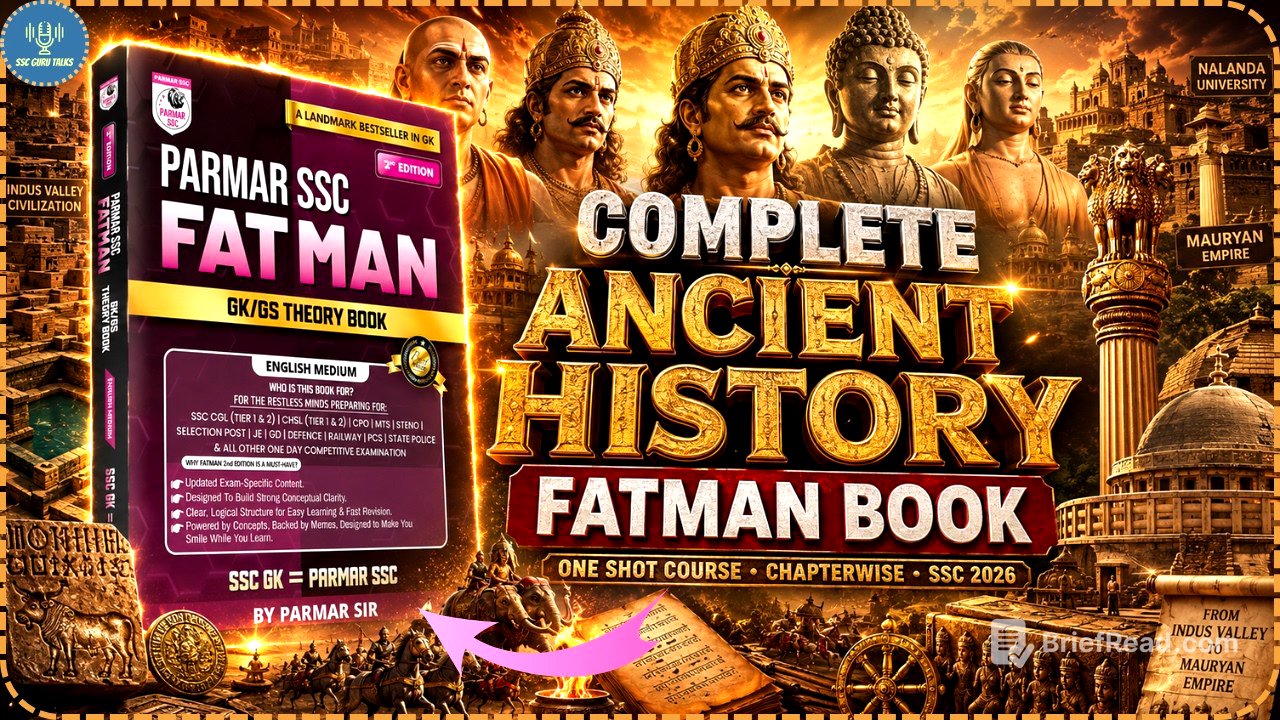
The video provides an overview of ancient Indian history along with details about various significant periods and dynasties, focusing on their political, economic, and cultural aspects. Key points include:
- The division of history into prehistoric, protohistoric, and modern periods.
- Significant periods like the Stone Age, Indus Valley Civilization, Vedic Age, Jainism and Buddhism, and various dynasties including Maurya, Gupta, and regional powers.
- Key historical figures and events, especially the Maurya Dynasty's rise and administration under rulers like Chandragupta Maurya, Ashoka, and later dynasties such as the Post-Maurya, Gupta, and Chola dynasties.
Introduction [0:00]
The video introduces the methods and goals for understanding ancient history, emphasizing an exam-oriented approach that simplifies complex topics. It also invites viewers to grasp the timeline and significant territorial divisions of ancient periods, highlighting the importance of classification in historical studies.
Chapter 1: Stone Age [0:06]
The Stone Age is divided into three stages based on tool usage: the Paleolithic Age (approx. 50,000 BC to 10,000 BC), the Mesolithic Age (9,000 BC to 7,000 BC), and the Neolithic Age (7,000 BC onward). Important archaeological sites are noted, which include various locations across present-day India. Transition signs from hunting-gathering to settled agriculture are discussed, providing a foundational understanding of early human life.
Chapter 2: Indus Valley Civilization [13:49]
The Indus Valley Civilization (2500 BC to 1750 BC) is characterized as a bronze civilization with advanced urban planning, agriculture, and trade networks. Key sites like Harappa and Mohenjodaro are highlighted for their sophisticated drainage systems and town layouts. The chapter stresses agrarian practices and the development of cotton cultivation, establishing the civilization's economic backbone. The chapter concludes with observations on the civilization's decline likely due to environmental changes and overexploitation of resources.
Chapter 3: Vedic Age [36:06]
The Vedic Age (1500 BC to 600 BC) is categorized into early Vedic (1500 BC to 1000 BC) and later Vedic (1000 BC to 600 BC) periods. Emphasis is placed on the Aryans gathering agricultural practices, religion based on natural elements, and the socio-political systems evolving towards a more structured society. Key texts like the Vedas, particularly the Rigveda, are discussed, highlighting their significance in documenting the beliefs and practices of the time.
Chapter 4: Jainism and Buddhism [55:22]
This chapter covers the origin, teachings, and social contexts of Jainism and Buddhism as reactions to Brahminical dominance. Notable figures like Mahavira and Buddha are emphasized, alongside their philosophies of non-violence and renunciation. The chapter also details the significant teachings associated with both religions and discusses religious councils and interpretations during their foundations.
Chapter 5: Mahajanapadas [1:12:53]
The emergence of Mahajanapadas, powerful political entities in ancient India, is discussed. Key factors include territory unification among Aryan tribes and details about the sixteen Mahajanapadas, their capitals, and governing systems, including oligarchy and monarchy. Sources of evidence for this era, including Pāṇini’s texts and Buddhist literature, are also identified.
Chapter 6: Maurya Dynasty [1:35:03]
This chapter delves into the rise of the Maurya Dynasty, founded by Chandragupta Maurya, whose administration details and campaigns are recorded in texts like the Arthashastra. Key rulers, including Bimbisara and Ashoka, and their policies regarding governance, military expansion, and religious patronages are discussed. Noteworthy achievements, including initiatives for public welfare and diplomatic relations, are highlighted.
Chapter 7: Post-Maurya Dynasties [1:48:37]
The subsequent rule of various dynasties following the Mauryas, such as the Shunga and Kanva dynasties, along with the rise of regional powers like the Satavahanas, is examined. Specific details of their capitals, notable rulers, and cultural contributions, particularly in art and architecture, are provided.
Chapter 8: Gupta Dynasty [2:01:57]
The Gupta Empire is characterized as the "Golden Age of India," emphasizing advancements in science, literature, and arts. Key kings like Chandragupta II and Samudragupta are discussed in terms of their military conquests, administrative strategies, and cultural patronage, including their contributions to architecture and literature.
Chapter 9: Post-Gupta Dynasties [2:19:36]
The chapter outlines the power shifts in post-Gupta India, discussing new regional dynasties emerging and their roles in shaping local politics, societal structures, and culture. Focus is also provided on socio-economic conditions compared to the previous Gupta period.
Chapter 10: Sangam Age [2:34:29]
Sangam literature emerges in this chapter, detailing the works produced during this era (300 BC to 300 AD) in Tamil Nadu, focusing on narratives and didactic texts. Key themes of love and warfare, along with significant literary figures and their influence, are analyzed, setting a cultural foundation in southern India.
Chapter 11: Tripartite Struggle and Cholas [2:46:14]
The chapter discusses the conflicts among the Pala, Pratihara, and Rashtrakuta dynasties over control of Kannauj, highlighting their political strategies and military engagements. The Chola dynasty's expansion and achievements in naval power and trade are examined, leading to its dominance in southern India.
Ending & Final Revision [3:04:16]
The video concludes with a rapid review of all key chapters, summarizing essential facts, timelines, and important figures. It emphasizes connections between different historical periods and encourages viewers to reflect on the interconnectedness of India’s rich history, from ancient times to the rise of various dynasties.