TLDR;
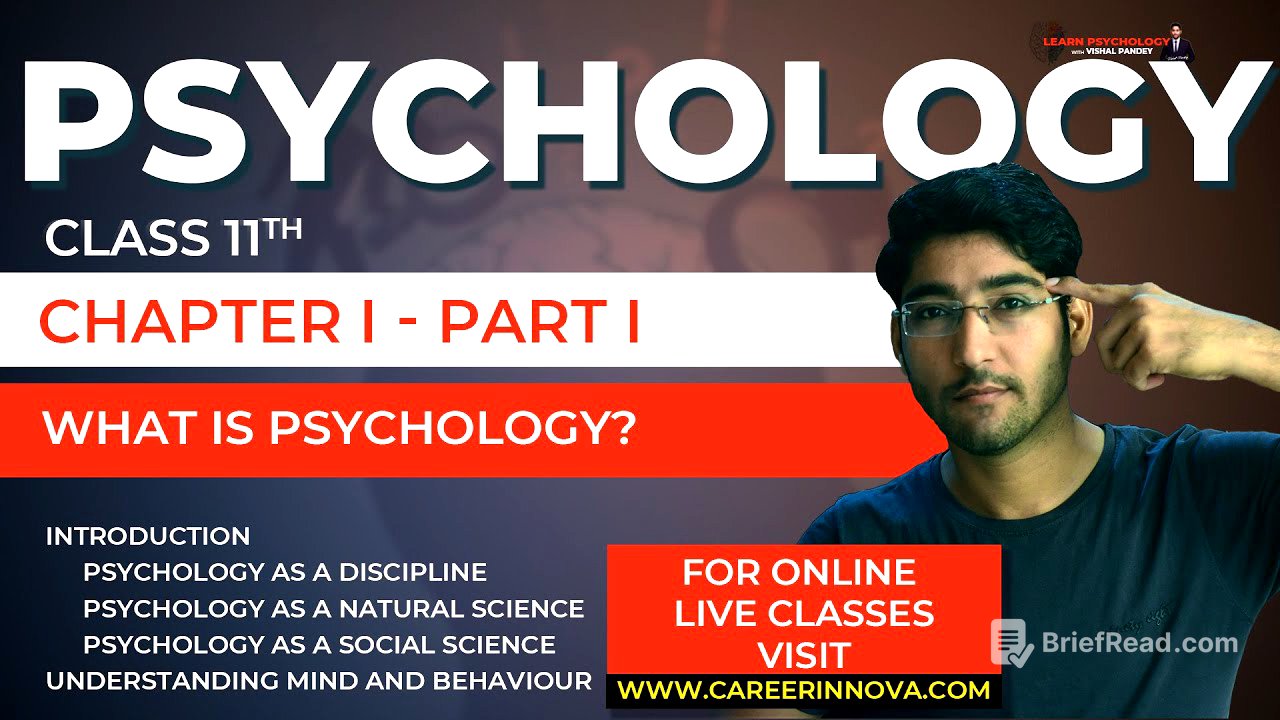
In this video, Vishal Pandey discusses the basics of psychology, its definitions, and its significance as a scientific discipline. Key points include the evolution of psychology, its definition as the science of the mind, processes behind human behavior, and the classification of psychology into social science and natural science.
- Psychology is understood as the study of mental processes, experiences, and behavior.
- The relationship between the mind and behavior is explored, emphasizing how mental processes govern actions.
Chapter 1: What is Psychology? [0:54]
Vishal introduces psychology, explaining its significance and evolution. He emphasizes the common reasons people opt for studying psychology, such as understanding human reactions and personality assessments. The chapter begins with defining psychology by breaking down the term: "psyche" means soul and "logos" means science. Thus, psychology is described as the scientific study of the soul, which evolved over time into a field focused on human experiences and behaviors. He highlights the need to remember definitions but advises that personal interpretations can also contribute to understanding.
He discusses that psychology studies the factors influencing why individuals react differently in similar situations. Moreover, psychology is analyzed at different levels, including individual, dyadic (between two people), and group dynamics, drawing examples like community cooperation during crises.
Vishal differentiates between overt and covert behaviors, where overt actions are visible (like a parent scolding) and covert actions are the underlying thought processes (like the parent’s reasoning for the scolding). This chapter establishes that psychology incorporates both personal and societal influences on behavior as part of its study across various disciplines, including social and natural sciences.
He also mentions the importance of controlled studies in psychology, referencing the first psychology lab established by William Wundt in 1879. This turning point marked psychology's recognition as a discipline that could be studied scientifically. Ultimately, he urges viewers to review their chapter materials post-video for a clearer understanding.
Finally, he touches on how psychological retention is improved by active engagement with the material, thus linking listening, revising, and behavioral application as critical aspects in learning psychology.
The chapter concludes with an exploration of mind and behavior, clarifying the debate over whether the mind is separate from the brain, underscoring that the mind is part of the brain but influences behavior significantly.