TLDR;
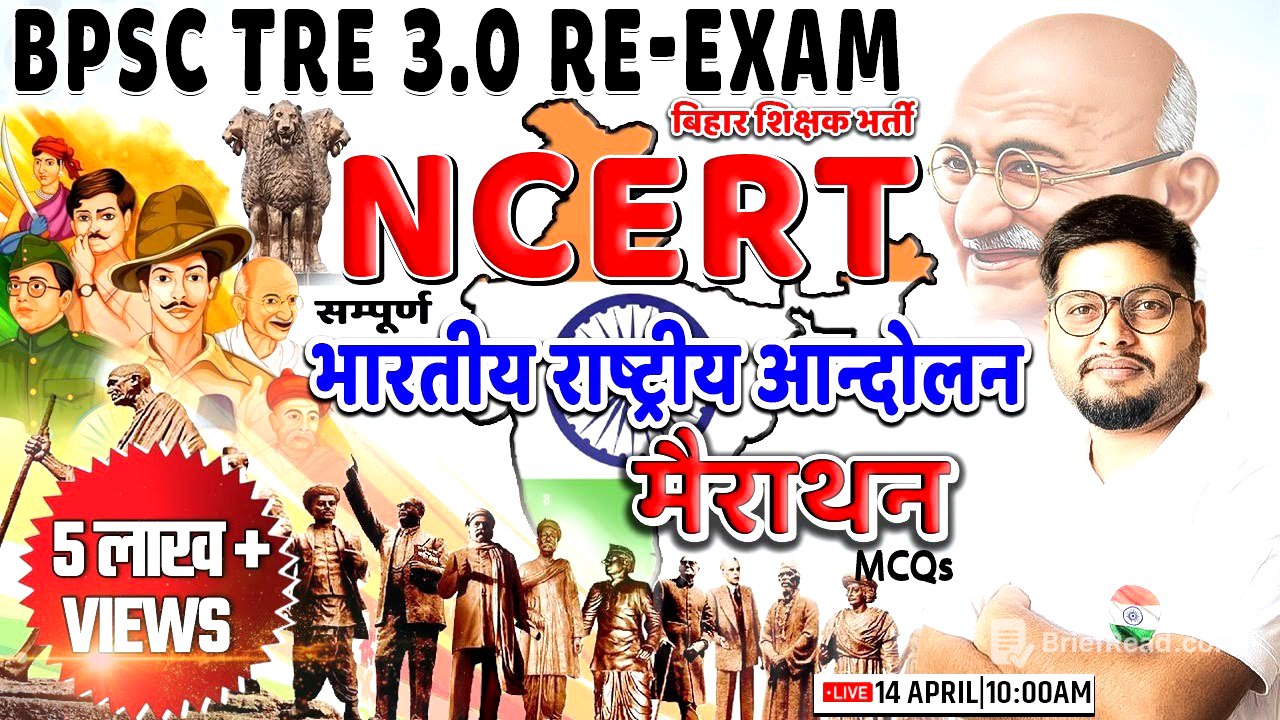
Alright students, let's get cracking on this Indian National Movement business for your TR 3.0 re-exam. We'll cover everything from the organisations before the Congress to the Gandhi era, with a special focus on the revolutionary movements. Think of this as a revision class, not a fresh lecture.
- Congress se pehle kya tha?
- Revolutionary movements, full detail.
- Gandhi Yug, bhai!
INTRO [0:00]
Hello students, this is an intro to the class. We will be covering Indian National Movement for the TR 3.0 exam. We will also be having classes on world history and important topics.
भारतीय रास्ट्रीय आन्दोलन Indian National Movement [2:05]
So, the Indian National Movement was all about getting our country back from the Britishers. They came to trade but ended up ruling us and exploiting our resources. The movement, which started around 1885 and went on till 1947, was a reaction to this oppression.
कांग्रेस के स्थापना से पूर्व भारत में बने संगठन [7:16]
Before the Indian National Congress came along, there were other organisations doing their bit. First up was the Landholder Society, also known as the Zamindari Association, formed in 1837 in Kolkata by Dwarkanath Tagore to look after the interests of the landlords. Then came the Bengal British India Society in 1843, also in Kolkata, set up by George Thompson. These two merged in 1851 to form the British India Association, established by Radhakant Dev. Next, we have the Bombay Association, established in 1852 by Naoroji. Then there was the East India Association, set up in London by Dadabhai Naoroji in 1866 to tell the British public what was happening in India.
भारतीय रास्ट्रीय कांग्रेस Indian National Congress [30:55]
The Indian National Congress was founded by A.O. Hume, a retired civil servant, on 28th December 1885. Lala Lajpat Rai wrote in 'Young India' that the Congress was created as a "safety valve" for the British. The first meeting was supposed to be in Pune, but because of an outbreak of plague, it was shifted to Gokuldas Tejpal Sanskrit Vidyalaya in Bombay. 72 members attended. The organisation was initially called the Indian National Union, but Dadabhai Naoroji changed it to the Indian National Congress.
भारतीय रास्ट्रीय कांग्रेस का अधिवेशन [58:32]
The Congress sessions used to happen in December, but after 1930, they started happening in January. The first session was in Bombay in 1885, headed by Womesh Chandra Bannerjee. The second was in Kolkata in 1886, headed by Dadabhai Naoroji. The third was in Madras in 1887, headed by Badruddin Tyabji. The fourth was in Allahabad in 1888, headed by George Yule. The sixth session, in 1890 in Kolkata, was headed by Pherozeshah Mehta. In 1896, the Calcutta session saw the first singing of Vande Mataram, with Rahimtulla Sayani as president. The 1905 Benares session, headed by Gopal Krishna Gokhale, saw the passing of the Swadeshi movement resolution. The 1906 Calcutta session, headed by Dadabhai Naoroji, adopted Swaraj as the goal. The 1907 Surat session saw the split between the Garam Dal and Naram Dal, with Rash Behari Ghosh as president.
बंगाल विभाजन [2:00:13]
Bengal was divided because the British wanted to curb nationalism, which was spreading like wildfire there. They also wanted to break the Hindu-Muslim unity. The partition was announced on 20th July 1905 by Curzon, and it led to the Swadeshi movement. 16th October 1905 was observed as a day of mourning. In 1911, Lord Hardinge reversed the partition, moved the capital from Calcutta to Delhi, and separated Bihar and Orissa. Gopal Krishna Gokhale compared Curzon to Aurangzeb.
दिल्ली दरबार [2:33:42]
There were three Delhi Durbars. The first in 1877, where Queen Victoria was declared the Empress of India. The second in 1903, hosted by Curzon, was a lavish affair. The third in 1911, saw George V and Queen Mary attend, and the decision to reverse the Bengal partition and move the capital to Delhi was made.
क्रांतिकारी आंदोलन [2:46:08]
The revolutionary movement had two phases. The first, from 1905 to 1910, was sparked by the Bengal partition. Bal Gangadhar Tilak played a big role, using festivals like Ganpati Mahotsav and Shivaji Mahotsav to unite people. The Anushilan Samiti was a key organisation. Khudiram Bose and Prafulla Chaki tried to assassinate Kingsford. The second phase started after the failure of the Non-Cooperation Movement in 1922. The Hindustan Republican Association (HRA) was formed, and they carried out the Kakori train robbery. Bhagat Singh and Chandrashekhar Azad were key figures.
विदेश में हुए क्रांतिकारी आंदोलन [3:21:29]
Outside India, the India House was set up in London in 1905 by Shyamji Krishna Varma. At the Stuttgart Conference in Germany in 1907, Madam Bhikaji Cama unfurled the Indian flag. The Gadar Party was formed in San Francisco in 1913 by Sohan Singh Bhakna. The Komagata Maru incident in 1914 involved a ship chartered by Baba Gurdit Singh that was turned away from Canada.
गाँधी युग [3:30:41]
The Gandhi Era, from 1919 to 1947, saw Gandhi lead the Indian National Movement. He faced racism in South Africa and started the Natal Indian Congress. He was thrown off a train at Pietermaritzburg station. In 1904, he established the Phoenix Farm. He launched the Indian Opinion newspaper. He took a vow of celibacy in 1906. He wrote Hind Swaraj on a ship in 1909.
रोलेक्ट एक्ट [3:53:40]
The Rowlatt Act, which allowed arrest without trial, was opposed by Gandhi, who launched the Rowlatt Satyagraha on 6th April 1919. This led to the Jallianwala Bagh massacre on 13th April 1919, where General Dyer opened fire on unarmed protestors.
असहयोग आंदोलन [4:14:18]
The Non-Cooperation Movement was launched on 1st August 1920. People were asked to boycott British goods and institutions. However, it was called off after the Chauri Chaura incident in 1922.
साइमन कमीशन [4:30:04]
The Simon Commission, formed to review Indian governance, was boycotted because it had no Indian members. Lala Lajpat Rai was injured in a lathi charge during protests and later died.
सविनय अवज्ञा आंदोलन [4:49:51]
The Civil Disobedience Movement started with the Dandi March in 1930, where Gandhi broke the salt law. It spread across India. The Gandhi-Irwin Pact was signed in 1931, and Gandhi attended the Second Round Table Conference.
मुस्लिम लीग [5:08:46]
The Muslim League was formed in 1906 in Dhaka. In 1940, the Lahore Resolution demanded a separate Pakistan. Direct Action Day in 1946 led to communal riots.
सुभाषचंद्र बोस [5:25:56]
Subhas Chandra Bose, after resigning from the Congress, formed the Forward Bloc. He travelled to Germany and Japan, and formed the Azad Hind Fauj.
भारत छोड़ो आंदोलन [5:41:20]
The Quit India Movement was launched on 9th August 1942. Leaders were arrested, but the movement continued. The Cabinet Mission in 1946 proposed a plan for independence, leading to the partition of India and the creation of Pakistan on 14th August 1947, followed by India's independence on 15th August 1947.