TLDR;
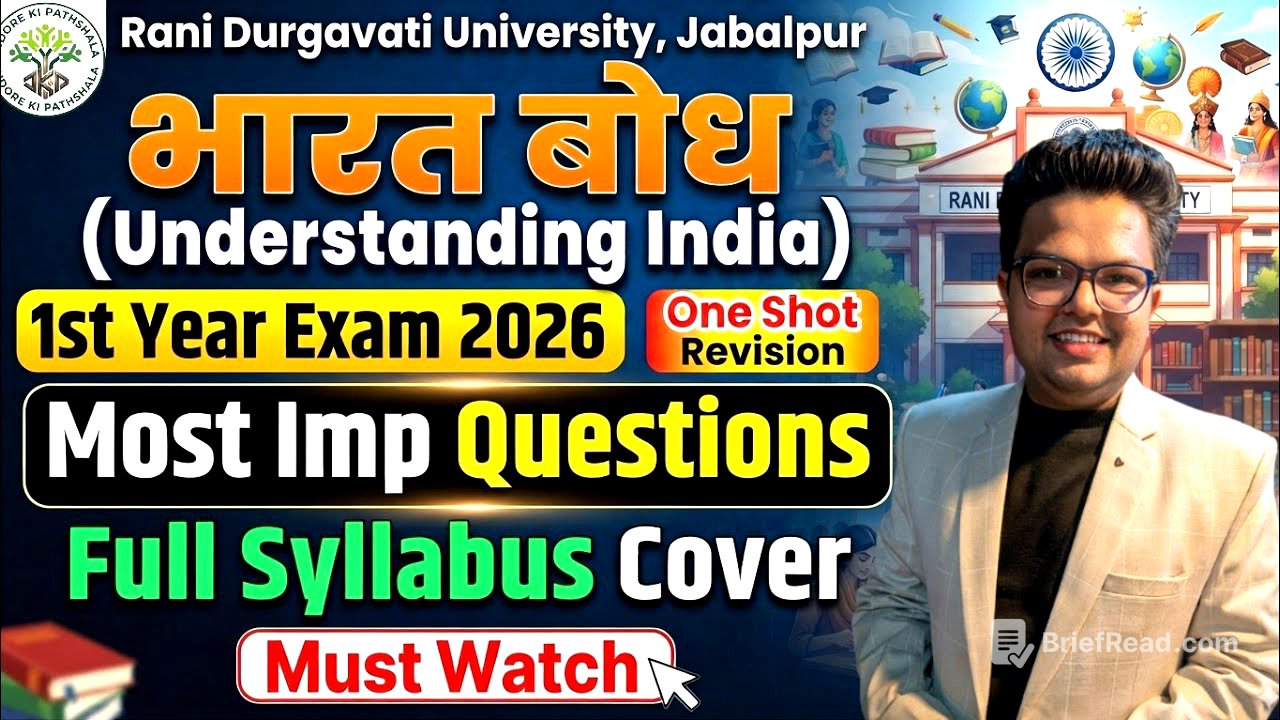
This video covers the most important questions related to the understanding of Indian civilization and culture, which are critical for exams at Rani Durgavati University. Important topics highlighted include the Indus Valley Civilization, Classical Period, coexistence and pluralism in Indian society, cultural symbols in religion and architecture, and the significance of ancient principles in modern governance, among others.
- Overview of important questions for exams
- Understanding of historical civilizations in India
- Importance of cultural heritage and principles in today's context
Introduction to Understanding India [0:00]
The speaker welcomes viewers to the channel and introduces the topic of the video: important questions for understanding Indian civilization, specifically tailored for students of Rani Durgavati University.
Overview of Indus Valley Civilization [0:51]
The first question discusses the Indus Valley Civilization, also known as Harappan Civilization, which is recognized as one of the oldest. Its remarkable urban planning, including well-structured cities and advanced drainage systems, is highlighted. Trade and commerce were significant, with ports like Lothal indicating international trade.
Characteristics of Classical Period [3:12]
The second question focuses on the Classical Period of Indian history, particularly during the Gupta Empire, considered a golden age for art, literature, and science. Prominent figures like Aryabhatta and Kalidasa are mentioned for their contributions, and the period's architectural advancements, particularly in temple construction, are emphasized.
Coexistence and Pluralism in Indian Society [5:03]
This section elaborates on the importance of coexistence and pluralism in Indian society. It explains how diverse groups, including various religions and cultures, have lived together harmoniously, contributing to a rich, composite culture that fosters unity in diversity.
Cultural Symbols in Religion and Architecture [7:00]
The discussion dives into cultural symbols, explaining that temples are more than just structures; they represent devotion and spirituality. Indian classical music and folk traditions play an integral role in expressing cultural identity and moral values.
Significance of Vedic Principles and Constitution [8:55]
The speaker introduces Vedic principles, emphasizing that the governance model in ancient times relied heavily on moral duties. The connection between these principles and modern constitutional values, such as secularism and individual rights, is explained, highlighting the importance of civic responsibilities.
Fundamental Rights and Duties [10:44]
A breakdown of the fundamental rights enshrined in the Indian Constitution is provided, detailing the significance of each right in ensuring a dignified life for citizens while also discussing the corresponding responsibilities that citizens must uphold.
Role of Youth in Democracy [12:20]
The role of youth in shaping democracy is emphasized. Young citizens are seen as crucial to maintaining democratic values through informed voting and social activism, underscoring the importance of education and awareness among the younger generation.
Indian Knowledge Tradition: Role of Vedas and Upanishads [14:00]
This chapter discusses the role of Vedas and Upanishads in the Indian knowledge system, explaining they encompass various fields of study and serve as foundational texts for moral and philosophical understanding.
Gurukul Tradition in Education [15:30]
The significance of the Gurukul education system is reviewed, highlighting its focus on holistic learning and character building, where students learn practical skills alongside theoretical knowledge.
Student-Centered Learning [17:20]
The importance of student-centered learning is discussed, emphasizing that education should focus on the learner's needs and encourage exploration and self-discovery, making education more engaging and effective.
Life Philosophy and Environmental Awareness [18:50]
The concept of "Purusharth Chatushtaya" is explained, detailing the four aims of life (Dharma, Artha, Kama, and Moksha) and underscoring the need for balancing these principles for a harmonious life.
Ashram System and its Relevance [20:30]
The Ashram system, which divides life into stages, is described, highlighting how understanding these stages helps individuals navigate life purposefully.
Role of Yagya in Indian Culture [22:00]
The video explains the significance of Yagya in Indian culture, emphasizing it as a ritual that symbolizes devotion, unity, and environmental balance.
Panchmahabhut Concept [23:40]
The structure of the universe based on the five great elements (earth, water, fire, air, and space) is discussed, explaining how they relate to human existence and ecological balance.
Kautilya's Arthashastra [25:20]
Kautilya's Arthashastra is presented as a comprehensive guide to governance, stating that a stable state leads to prosperity and highlights the ruler's duties towards the welfare of the public.
Freedom Movement: Role of Bal Gangadhar Tilak [27:00]
The contributions of Bal Gangadhar Tilak to the freedom struggle are highlighted, particularly his efforts to mobilize the masses through cultural events and political activism.
Cultural Renaissance in Independence Movement [28:40]
The importance of the cultural resurgence during the independence movement is explained, demonstrating how it helped instill pride among Indians and motivated them to resist colonial rule.
Achievements of Indian Space Program [30:20]
The video outlines significant achievements of ISRO, including successful missions to Mars and the Moon, showcasing India's advancement in space technology.
Self-Reliant India: Integrating Tradition and Innovation [32:00]
This section discusses the "Atmanirbhar Bharat" initiative, emphasizing the need for balancing tradition and modern innovation to achieve economic self-sufficiency.
India's Role in Multipolar World Order [33:42]
Finally, the importance of India's position in a multipolar world is explained, highlighting its commitment to global peace and cooperation as it becomes a key player in international relations.