TLDR;
The video examines the ambitious NEOM project in Saudi Arabia, which aimed to create a futuristic city, highlighting the current failure of its major elements. It describes the grand visions behind the project, the extensive costs involved, and the challenges faced in realising such a massive undertaking.
- NEOM's construction has significantly slowed down or stopped entirely, indicating serious financial struggles.
- The project was plagued by unrealistic expectations set by Mohammed bin Salman (MBS), leading to discrepancies in planning and significant cost overruns.
- There have been cancellations of contracts, revealing a crisis in the project's execution and management.
NEOM’s Failure [0:00]
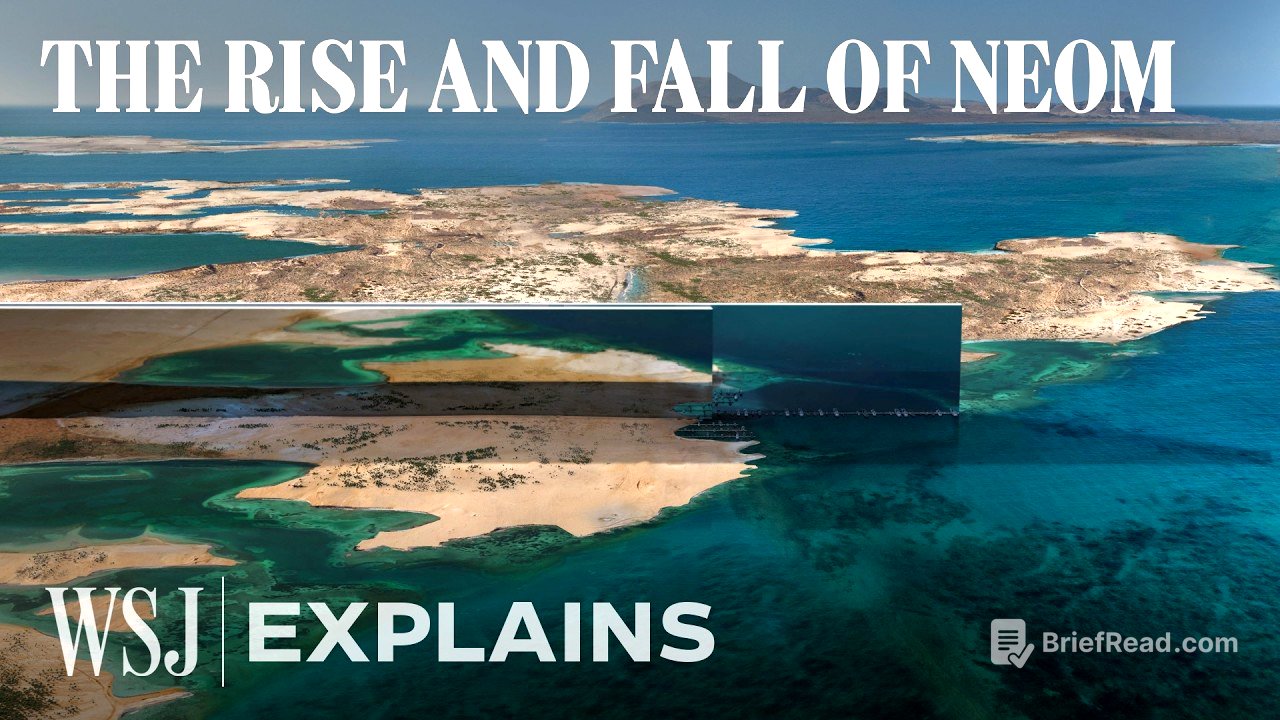
NEOM was intended to be the world's largest city by GDP and promised a futuristic lifestyle. However, the reality is that the project has failed in its primary goals. Reports from former employees and satellite images reveal that major construction efforts have collapsed. Despite efforts to pivot Saudi Arabia away from oil, NEOM has not materialised as envisioned, with significant construction stalling or ceasing entirely. The head of Saudi Arabia's Public Investment Fund claims that no projects have been cancelled, instead suggesting a re-prioritisation.
The Vision and Design [0:39]
The mastermind behind NEOM, MBS, aimed to create a revolutionary city structure called "The Line," spanning over seven billion square feet. MBS proposed extravagant concepts such as zero-gravity architecture. Analysts noted that funding such ideas was implausible, and over time, construction ceased on major aspects of the project. Despite internal alarm among staff, the scaling back of construction has now led to concerns over the project's feasibility and overall costs.
The Latest Updates on the Project [1:37]
Current reporting indicates that construction on major sub-projects has virtually halted. Documents reveal that the cost implications of restarting these projects would be unmanageable. The Public Investment Fund's official statements highlight that while prioritisation is ongoing, the absence of transparency regarding NEOM's finances raises questions about the project's sustainability moving forward.
The Origins [3:19]
The inception of NEOM involved gathering prominent Western consultants who proposed ambitious and innovative ideas, including an artificial moon and weather control. These ideas led to the creation of multiple sub-projects, such as Trojena, an arid ski resort, and Oxagon, a logistics port city. However, as the project developed, staff began to identify serious barriers surrounding environmental sustainability and livability, highlighting the astronomical costs and feasibility issues.
Satellite Images of Projects Today [5:13]
Recent satellite imagery shows extensive groundwork on The Line and Trojena has taken place but has since stopped. Visible structures indicate progress, yet significant projects have ground to a halt. Workers on Trojena reported the abrupt cessation of construction, and areas of Sindalah reveal a decline in progress, including a golf course left in disrepair.
Ballooning Costs [7:02]
Management reported that costs for Trojena soared to $39 billion, which conflicted with MBS's unrealistic profitability expectations for the projects. Adjustments made by staff to expected revenues to meet rising costs further complicated financial projections. External analysis projected that the ultimate cost of realising NEOM could reach an astounding $8.8 trillion, far exceeding the country's annual budget.
Mutual Delusion [9:43]
The fundamental issue plaguing NEOM is described as a "dance of mutual delusion," where the ambitious aspirations of MBS clashed with the harsh realities of project viability. Staff and executives struggled to express the impracticalities of the vision presented, leading to significant misjudgements in financial planning and project execution. The project's downfall represents a cautionary tale of overreaching ambitions in the face of financial limits.