TLDR;
Nigeria’s unreliable electricity grid has driven households and businesses towards petrol generators and, increasingly, solar power with batteries. A 2024 electricity price change made the grid more dependent on a small group of better-paying customers, many of whom can afford alternatives, while poorer communities receive less reliable supply. Meanwhile, the government has considered restricting solar imports even as public institutions invest in solar systems of their own.
- Nigeria generates far less electricity than its installed power-station capacity suggests, and millions of people have no grid connection.
- Removing the petrol subsidy made generator power much more expensive, while grid prices rose for customers promised the most reliable service.
- Cheaper imported solar equipment has helped create a fast-growing alternative, but its upfront cost leaves many people unable to switch.
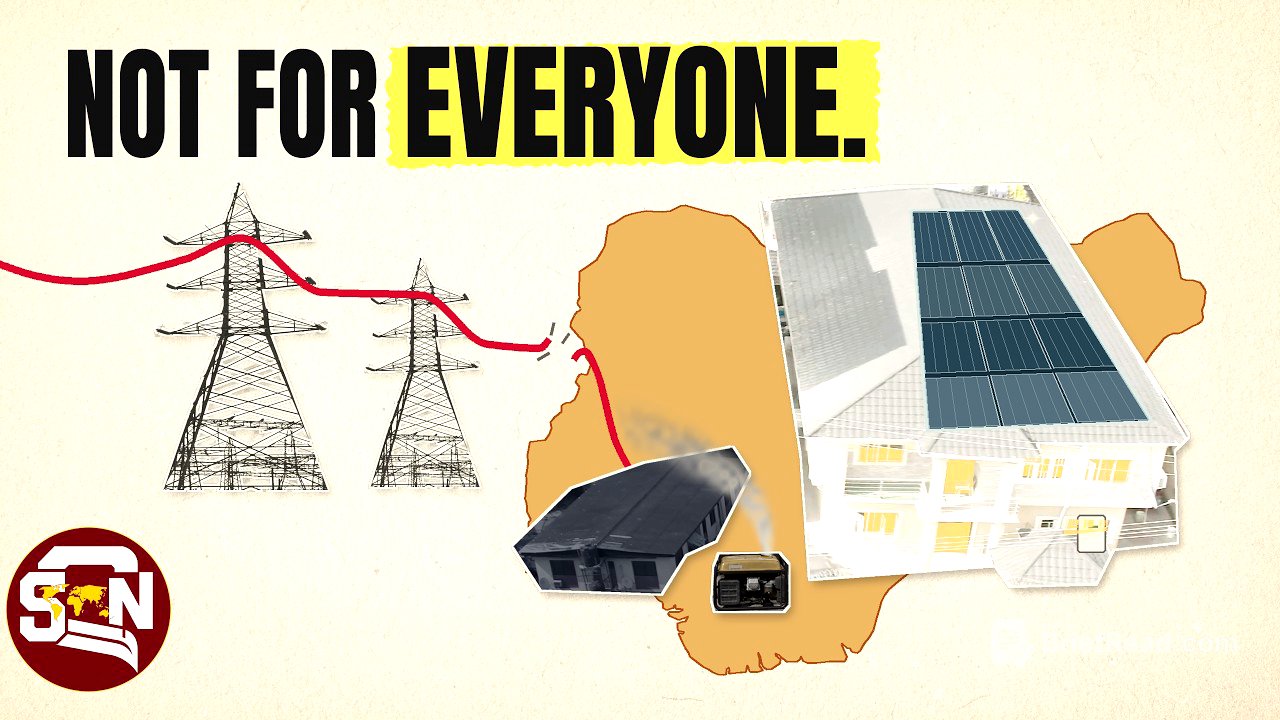
- The grid’s remaining supply is increasingly directed towards customers who pay more, while lower-income areas face limited power and fewer options.
A failing grid and the cost of self-generation [1:09]
Nigeria has around 13,600 megawatts of power-station capacity on paper, but in 2026 the grid generates about 4,000 megawatts in an average hour for a population of more than 200 million. That amounts to roughly 20 watts per person, and about 87 million Nigerians have no electricity connection at all. Even connected customers rely on generators, which the government estimates may provide up to ten times as much electricity as the national grid.
In 2024, the power minister said Nigerians were spending more than 16 trillion naira a year to generate their own electricity, compared with around one trillion naira spent across the grid. Petrol generators acted as an escape route when grid power failed. But after Nigeria ended its petrol subsidy in May 2023, fuel prices rose sharply: within months, petrol cost three times as much as a year earlier, and by the end of 2024 it had passed 1,200 naira—around six times the old price. The alternative to the grid had become far more expensive just as people needed the grid to work.
The 2024 price change and the promise of Band A [3:25]
Grid electricity was also under financial pressure because customers paid less than it cost to provide the service. The government covered the difference, which regulators said was approaching three trillion naira a year. Since 2020, electricity customers have been divided into five service bands based on the number of hours of supply they are promised. Band A customers are supposed to receive at least 20 hours a day, but they make up fewer than 15 per cent of customers.
A price list issued on 3 April 2024 left most tariffs unchanged but raised the Band A price from 67 to 225 naira per unit. The policy was presented as a way to charge customers receiving better service more, while protecting others from price rises; their prices had been frozen since 2022. But the arrangement depended on the grid delivering the promised 20 hours, and it could not reliably do so.
Grid failures push customers towards solar [4:49]
By 2026, about two-thirds of Nigeria’s power stations were unavailable at any given time, and the grid was generating 10 per cent less electricity than a year earlier. The system collapsed in January 2026. In Lagos, one customer said an area formerly classified as Band A had been moved to Band C, and after weeks of blackouts the head of a power-company association apologised on national television. Arguments over responsibility continued, with the grid operator, gas suppliers and minister pointing to different causes.
For a Band A customer in 2026, a unit of grid electricity cost about 209 naira when available. Generator power cost between 550 and 960 naira per unit in fuel alone. Solar offered another option: one Lagos resident reported paying 5.7 million naira in 2025 for 12 panels, an inverter and a battery. The battery was a major part of the cost, but spread over ten years, the system’s electricity worked out at roughly 100 naira per unit—less than half the grid price and far below generator fuel costs. The main barrier was the roughly five million naira or more needed upfront.
Falling solar costs build a new private power system [6:52]
Solar equipment became more affordable as prices fell globally. Chinese customs data shows that between 2022 and 2024, the number of solar panels shipped to Nigeria tripled, while the total money spent on them rose by only about a quarter. Battery prices fell even faster, dropping by nearly half in one year. In a year, Nigeria imported about $240 million of panels and $757 million of batteries, more than any other African country for battery imports and ahead of South Africa.
Research group Ember described batteries paired with solar as “the new diesel generator”. The shift is also creating local business: 56 solar companies registered in Nigeria in 2019, compared with 370 in 2025. Panels are still imported, although a Lagos factory assembles them locally; one young worker there, a petroleum-engineering graduate, was building solar panels in an oil-producing country. The scale of this private power system remains unclear because published estimates of Nigeria’s solar capacity differ by a factor of five, and official statistics do not capture installations funded and operated privately.
The grid prioritises customers who pay more [9:07]
A regulator’s report revealed that in 2026 the grid sold 10 per cent less electricity than the previous year but collected more money. One reason was that the share of electricity allocated to Band A customers increased from 40 to 45 per cent; by September 2026, one Lagos company had a target of 55 per cent. A unit sent to a Band C street brought in about 45 naira, while the same unit sent to a Band A customer brought in 209 naira. Allocating more supply to higher-paying customers, alongside better bill collection, helped maintain revenue even as electricity generation fell.
As a result, the grid became more financially dependent on a small group: fewer than 15 customers in every 100, who the video estimates pay for about three-quarters of its revenue. These are also the customers promised long daily supply, who pay a price that solar can undercut and are more likely to afford a private system. Lower-band customers, by contrast, pay much less, so solar may not make financial sense for them. The video notes that grid accounts do not yet show that falling electricity sales are caused by solar, and no published data directly connects the two; the clear point is that the grid increasingly relies on customers who have alternatives.
Lower-income areas face fewer choices [11:21]
In Ajibo, Lagos, resident Solomon said 5,000 naira of prepaid electricity now lasted him more than a month. This did not mean he was using power more efficiently; there was simply very little electricity available to buy. The regulator reported that power companies strategically limit supply to feeders where they experience high operational losses—in other words, less power goes to areas where companies collect less of the money owed.
The majority of customers therefore retain frozen prices but receive whatever supply is left, and still rely on generators when the grid is off. For them, generator fuel costs five or six times what it did before the subsidy ended. A Lagos shop owner said he wanted to switch to solar but could not afford it, while bank loans cost around 30 per cent a year. Beyond these customers are the 87 million Nigerians without any grid connection. The solar boom is therefore also a sorting process: those able to pay for an alternative can leave the grid, while those unable to afford one remain dependent on its declining supply.
Government solar plans reveal the policy conflict [12:54]
In March 2025, a minister announced plans to ban imported solar panels and encourage domestic manufacturing. But Nigerian factories could assemble only about 300 megawatts of panels a year, while China was shipping more than 2,000 megawatts to Nigeria. The proposed ban did not become law, as far as the video could establish. In October 2026, the minister’s successor explained that imports could not be banned without enough domestic manufacturing capacity.
At the same time, the government was investing in solar for its own institutions. The president’s office received 10 billion naira in one budget, with a further seven billion proposed in the next, for a solar system; it had been installed by the end of 2025. The 2026 budget also included federal agencies seeking 30 billion naira for solar and backup power. The police academy, the auditor-general and other institutions were among those making the change, while five federal universities and a teaching hospital received permission to generate their own electricity.
Every household or institution generating its own electricity could, in principle, free up grid supply for someone else. But how that supply is distributed depends on decisions about prices and allocation. The grid is not dead for everyone; its failure is most severe for those who cannot afford to choose another source of power.