TLDR;
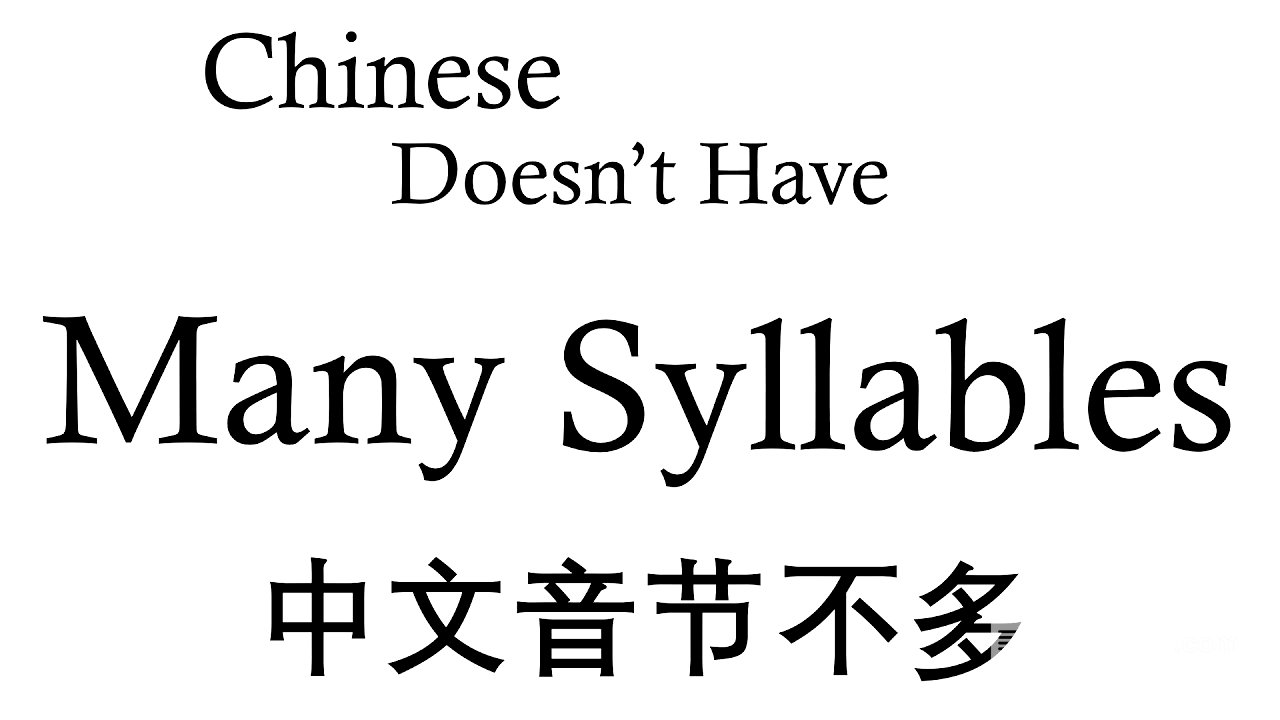
This video explores the complexities of Standard Chinese, particularly focusing on its limited number of syllables and how the language compensates for this constraint. It covers the phonemes and phonotactics of Standard Chinese, comparing them to English, and explains how the one-syllable-per-morpheme rule creates challenges. The video then details the strategies Chinese uses to overcome these limitations, such as set phrases, noun suffixes, and complementary morphemes, highlighting the importance of written characters in resolving ambiguity.
- Standard Chinese, or "Putonghua", has a limited number of syllables (around 1200).
- Chinese phonotactics are far more restrictive than English.
- The language uses set phrases, noun suffixes, and complementary morphemes to disambiguate meaning.
- Written characters play a crucial role in resolving ambiguities that arise in spoken language.
Modern Standard Chinese [0:00]
Modern Standard Chinese, often referred to as Mandarin, is more accurately called "Standard Chinese" or "Putonghua," meaning "common talk". The term "hanyu" encompasses all Chinese dialects, viewed by many as part of a single, greater Chinese language. A challenge with pinyin and other transliterations is that the same sounds can refer to different words, such as "han" and "yu," which have multiple meanings depending on the characters used. This ambiguity arises because Chinese has a relatively small number of syllables.
Standard Chinese Phonemes [1:10]
The exact number of phonemes in Standard Chinese is difficult to determine, but a reasonable estimate is either 30 or 36, including the five tonemes. These tonemes represent the four tones of Standard Chinese, plus the toneless phoneme, exemplified by the /妈/麻/马/骂/吗 distinction. Despite having a seemingly small number of phonemes, the limited number of syllables in Chinese is not due to a lack of phonemes, but rather its restrictive phonotactics.
English Phonotactics [1:55]
Phonotactics govern how a language allows phonemes to be combined into syllables, including consonant clusters and vowel sequences. English has relatively few phonotactic rules, but they still exist. For example, made-up words like "blanicking" sound English because they adhere to these rules, while "knah" or "ngadb" do not. Modern English does not allow "kn" or "gn" consonant clusters at the beginning of words, explaining why the "k" in "knight" and the "g" in "gnome" have become silent. The "ng" sound typically appears at the end of a syllable, as in "singing".
Standard Chinese Phonotactics [2:50]
In Standard Chinese, phonotactics are far more restrictive than in English. The phonemes and phoneme sequences are best understood as initials, finals, and tones. Certain sounds, like "b" and "ai," exist in Chinese but cannot be combined to form a syllable like "aib." The total number of possible syllables is calculated by multiplying the number of initials by the number of finals and then by five for the five tonemes, resulting in 4440 possible syllables. However, many of these combinations are not actually used.
Standard Chinese Syllables [4:05]
Many potential syllable combinations in Standard Chinese are not used, and for many syllables, not all five tonemes occur. The toneless phoneme is rare, mainly appearing in grammatical particles like "ma (吗)" and "ne (呢)". Some syllables have only one possible tone, such as "keng," which typically has a first tone. The total number of syllables used in Standard Chinese is approximately 1200, which is a small inventory compared to languages like German or English.
Morphemes [4:39]
Standard Chinese generally follows a one-syllable-per-morpheme rule, where a morpheme is the smallest unit of meaning in a language. Unlike Japanese, where multiple syllables can form a single morpheme, Standard Chinese typically assigns one syllable to each unit of meaning. This means that the 1200 syllables in Standard Chinese correspond to 1200 phonetically distinct morphemes, posing a challenge since humans need to express more than 1200 concepts.
How does Chinese Handle This? [5:05]
Chinese addresses its limited syllable count through several methods. In written Chinese, morphemic characters eliminate ambiguity. In spoken language, set phrases are used, where the meaning is understood from the combination of syllables, such as "hanyu" (Chinese language). Noun suffixes, like "子" in "桌子" (table), clarify the meaning. Complementary morphemes are also used, where one morpheme clarifies the meaning of another, as in "mingliang" (light) and "huiming" (dark), where "liang" and "hui" complement the meaning of "ming". However, this system has limitations, as some words have purely literary meanings that are only clear when written down.