TLDR;
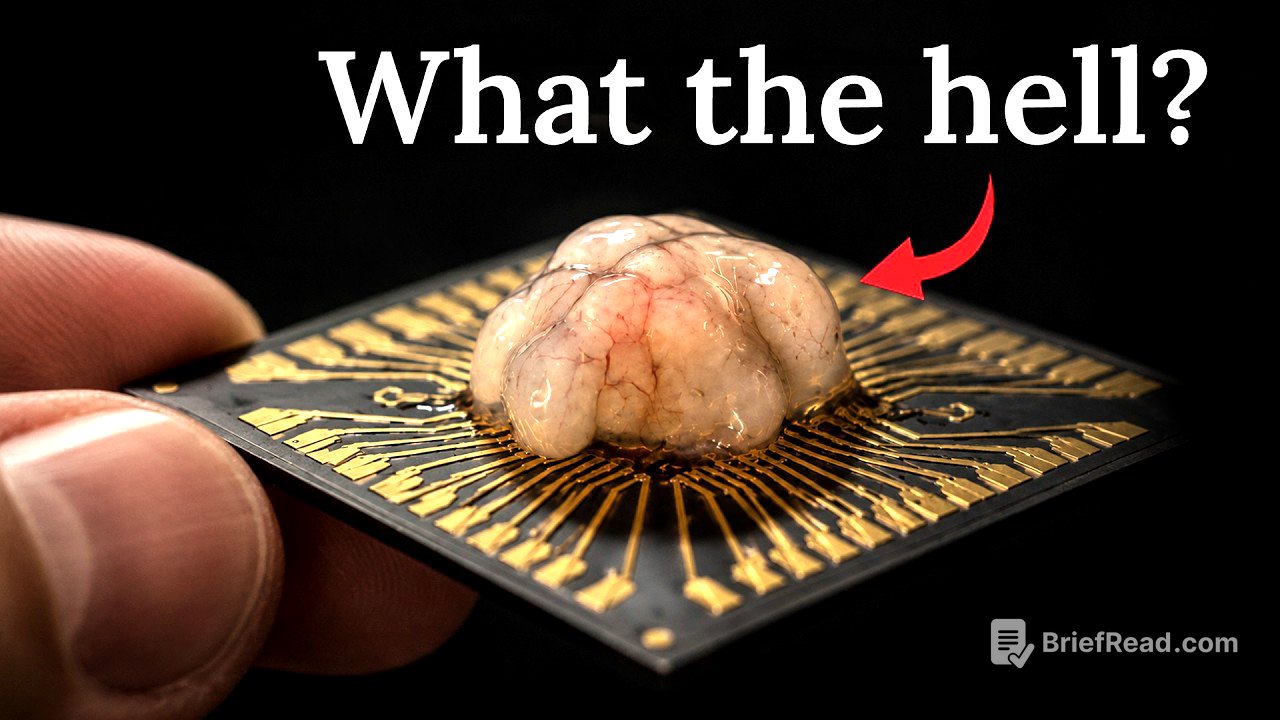
This video addresses a significant and unsettling development in science involving the use of living human brain cells in computer systems. A company named Cortical Labs has developed a system known as CL1, which runs on human neurons and is capable of playing video games, raising ethical questions about sentience and the nature of consciousness in biological systems.
- Living brain cells are being used in computers to operate efficiently while consuming less power.
- The process of teaching these cells to interact with computer systems involves manipulating their responses to chaos and calmness, raising questions about their consciousness.
The Start of a Disturbing Development [0:00]
The video introduces research by Cortical Labs, which has created a computer using living human brain cells that can play video games, notably Doom. The motivation for this innovation arises from the growing demand for computing power in AI, which poses challenges in terms of energy supply. Traditional AI relies heavily on vast amounts of electricity, which is becoming increasingly difficult to sustain.
How the Brain Outperforms Computers [1:40]
The narrator explains that the human brain operates extremely efficiently on approximately 20 watts of electricity while mimicking complex cognitive functions. In contrast, AI systems require power plants to replicate basic brain functions, leading researchers to explore biological computing.
The Steps to Dishbrain Technology [3:20]
The video outlines three key developments leading to the creation of living computer systems. In 2008, rat neurons were grown and connected to a robot. In 2013, the discovery of proteins that could revert mature cells to their initial state revolutionised neuroscience by enabling the production of neurons from skin cells. By allowing neurons to grow in three-dimensional forms, researchers created organoids that somewhat mimic brain regions.
The Emergence of Dishbrain [6:00]
In 2022, Cortical Labs launched a project called Dishbrain, consisting of 800,000 mixed mouse and human neurons trained to play Pong. This development marked a significant milestone, demonstrating that a collection of living cells could work towards a goal and communicate basic responses to stimuli, despite traditional beliefs about the limitations of tissue in a dish.
Training Living Neurons [10:40]
Researchers taught the neurons using the principle that they dislike unpredictable signals. Cells that miss the ball receive chaotic noise, while those that succeed receive steady signals, which encourages a learning process centred on the avoidance of chaos. This method is rooted in the free energy principle, suggesting cells instinctively seek predictability.
The CL1 Gaming System [15:30]
The culmination of their research is the CL1 system, which operates with 200,000 human neurons capable of playing Doom. Similar to the earlier model, this system rewards successful actions with calm signals and punishes failures with chaotic noise. This learning process resulted in the neurons mastering basic game mechanics within a week, highlighting the disturbing yet impressive capabilities of biological systems interfacing with technology.
Ethical and Philosophical Concerns [20:00]
The video poses uncomfortable questions regarding the ethical implications of creating a system reminiscent of a human mind that experiences a limited existence solely within a video game. Critics express concerns about the terminology used to describe the neurons' capabilities and the commercialisation of this technology. The potential applications of cell-based computing for research and disease modelling emphasise the importance of responsible discourse in this emerging field.
Distinguishing Intelligence from Consciousness [26:40]
It is revealed that the majority of learning and functioning in the CL1 system is performed by an AI chip rather than the neurons themselves, which have a minimal role in the process. The distinction between intelligence and consciousness is examined, suggesting that the mere presence of living cells does not imply sentience.
Future Implications of Biological Computing [35:00]
The video foresees a booming market for biological computing, with companies offering access to living neuronal systems for research. The potential for a full 3D mini brain connection might close the gap between biological intelligence and artificial systems, but raises significant philosophical and ethical questions about the nature of consciousness and the essence of sentient experience.
A Reflection on Consciousness and Material Existence [45:00]
The narrator reflects on the broader implications of creating systems that could theoretically develop feelings or experiences. It highlights a crucial point: the fact that consciousness may not solely rely on complex structures but could emerge from basic biological processes, raising profound questions about the nature of life and awareness.