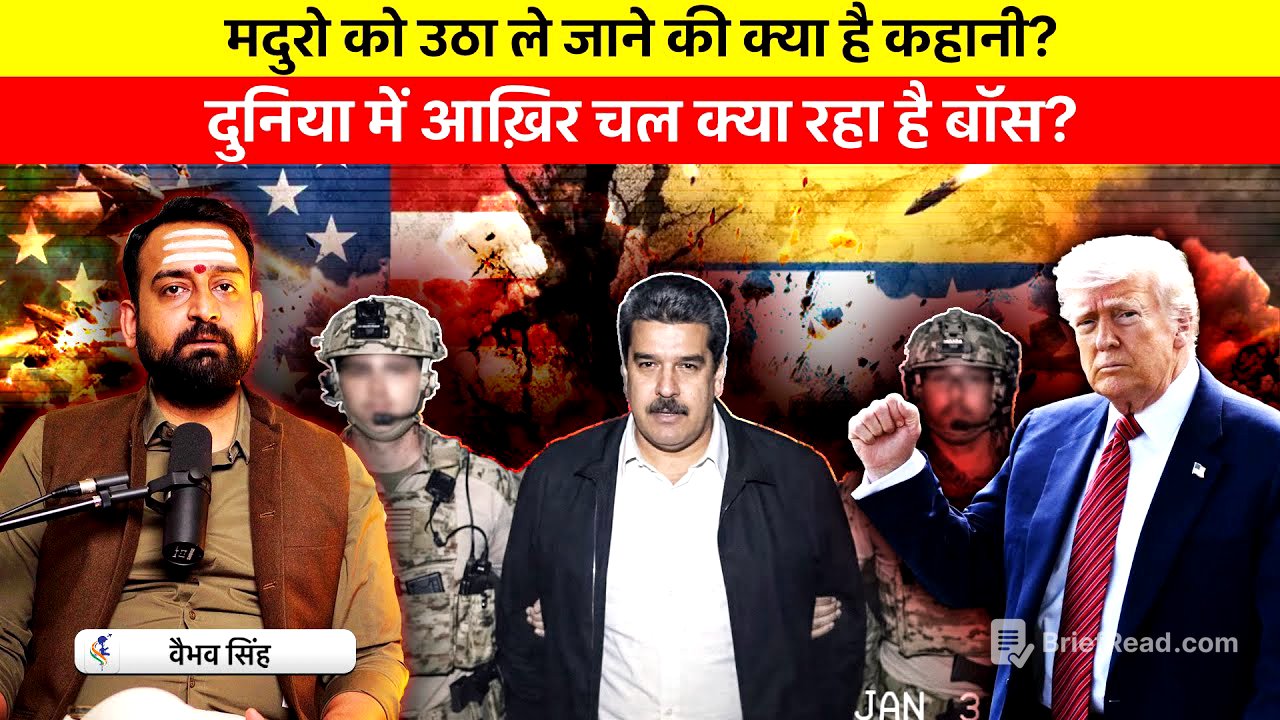
TLDR;
This video discusses America's history of regime change operations, focusing on Venezuela and its oil reserves. It highlights the use of political and economic tactics to destabilise countries and install puppet regimes. The video also touches on the importance of projecting power and strength in international relations, arguing that fear, rather than diplomacy, is the primary driver of respect and influence on the global stage.
- America's regime change operations are often driven by economic interests, particularly oil.
- The US uses political prizes and propaganda to destabilise countries and install puppet regimes.
- Projecting power and strength is more effective than diplomacy in international relations.
Introduction [0:05]
The video begins by addressing the situation in Venezuela, where the US Delta Forces allegedly attempted to kidnap President Nicolas Maduro. This incident sparks a discussion about covert regime change operations and their impact on Latin America. The speaker references a book titled "Covert Regime Change" by Lindsey O'Rourke, which details numerous regime change operations carried out by the US during the Cold War.
The Myth of Covert Regime Change [2:14]
The speaker argues that regime change is never truly covert, as the world generally knows who is behind it. Examples include US involvement in regime changes in Bangladesh and Pakistan. The discussion transitions to Venezuela, where the US has been attempting to exert control since the time of Hugo Chavez, Maduro's predecessor.
Oil and American Interests in Venezuela [2:43]
Venezuela possesses the world's largest proven oil reserves, even greater than Saudi Arabia. However, Venezuelan crude oil is heavy and costly to refine. Under Hugo Chavez, the oil industry was nationalised, ending the dominance of American companies. This led to the US seeking to regain control of Venezuela's oil resources.
Tactics and Propaganda [4:30]
The US has used various pretexts to justify intervention in Venezuela. Donald Trump cited fentanyl coming from Venezuela, despite the fact that 70% of fentanyl entering the US comes from Mexico. The speaker highlights the hypocrisy of not targeting Mexico, which lacks oil reserves. The US has also labelled Venezuelan drug traffickers as foreign terrorist organisations, authorising the US Navy to attack Venezuelan vessels without proof of drug trafficking.
Weapons of Mass Destruction and Regime Change [5:32]
Trump declared fentanyl a weapon of mass destruction, echoing the justification used to invade Iraq under the false premise of Saddam Hussein possessing such weapons. The speaker describes the destabilisation of Iraq and the rise of the sex trade, facilitated by Iranian involvement through Shia clerics.
Modus Operandi and Political Prizes [7:41]
The speaker draws parallels between the situation in Venezuela and previous US interventions, such as in Bangladesh. He points out that the US often awards individuals with political prizes like the Nobel Peace Prize to elevate their status and use them as puppets to advance American interests. This includes creating a narrative of societal problems, economic distress, and democratic collapse to instigate unrest.
Destabilisation Tactics [9:34]
The US employs various tactics to destabilise countries, including imposing sanctions, funding opposition movements, and using youth culture (e.g., rap music) to spread anti-government messages. The speaker notes that Maduro was not in his presidential palace but in a fortress, suggesting inside information was provided to the US.
Bounties and Internal Dissension [11:38]
Donald Trump offered a $5 million bounty for Maduro, highlighting the US strategy of exploiting internal dissension within Venezuela. The speaker mentions a previous offer to Maduro's pilot to fly him to the US, which was refused.
Rule-Based World Order and Hypocrisy [12:56]
The speaker questions the "rule-based world order" and the hypocrisy of the US, which violates international laws and norms with impunity. He contrasts this with Russia's actions in Ukraine, which were framed as a response to NATO expansion. The speaker criticises India's lack of reaction to regime changes in its neighbourhood, such as in Nepal and Bangladesh.
Regional Power and Tolerance [15:19]
The speaker argues that India, as a regional power, should act more assertively. He criticises the country's tolerance and adherence to international rules, noting that global superpowers do not abide by such constraints. He questions the value of the United Nations and its relevance to powerful nations.
The Nature of Power and Fear [19:20]
The speaker asserts that the world is ruled by the strong, not by those who adhere to rules and laws. He quotes an ancient saying that "without fear, there is no love," suggesting that respect and influence are derived from power and the ability to inspire fear. He contrasts this with the idea of becoming a "world guru" through diplomacy and goodwill, which he deems ineffective. The speaker concludes that America's influence stems from fear, as does that of Putin and Xi Jinping.




![The Entire Map of Money in 21 Min. [NO AI]](https://wm-img.halpindev.com/p-briefread_c-10_b-10/urlb/aHR0cDovL2ltZy55b3V0dWJlLmNvbS92aS9tbnVPWmNtb0dEOC9ocWRlZmF1bHQuanBn.jpg)