TLDR;
This video explains the importance of understanding market sessions and aligning trading activity with personal schedules. It highlights key points such as identifying high-volume periods, selecting suitable trading times based on individual availability, and avoiding the pressure to trade during every session. The video also touches on managing FOMO (Fear Of Missing Out) and adapting to varying market conditions.
- Focus on trading during high-volume market sessions.
- Align trading times with your personal schedule and availability.
- Avoid FOMO by accepting missed opportunities and focusing on future setups.
- Adapt to varying market conditions and be prepared for sessions with low volume.
- Less is more: focus on specific sessions for easier management and journaling.
Introduction to Market Sessions [0:00]
The video starts by emphasising the importance of understanding which market session to focus on. The speaker mentions the New York, London, and Asian sessions, noting that while all are viable, traders should choose based on their personal circumstances. He shares his experience of starting with the Asian session due to its convenient timing in Canada.
Asian Session Times [0:35]
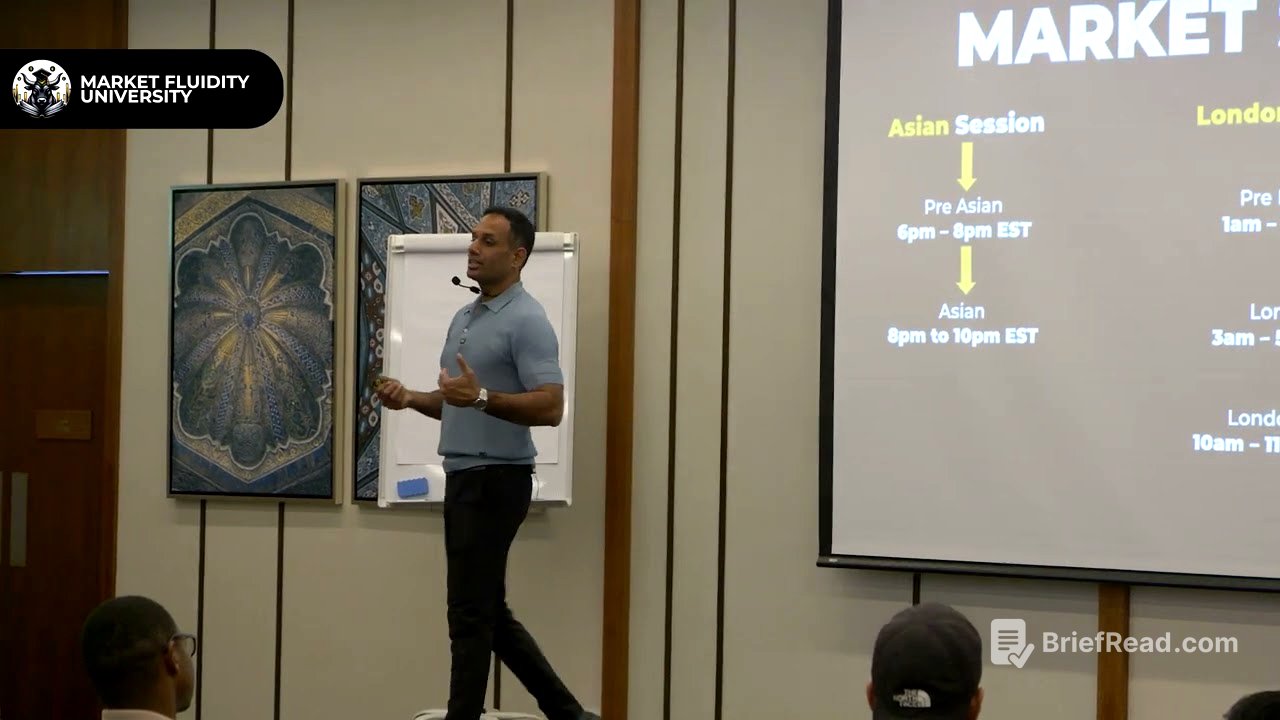
The speaker provides specific times for the pre-Asian and Asian open sessions in Eastern Standard Time (EST). Pre-Asian runs from 6:00 p.m. to 8:00 p.m. EST, while the Asian open is from 8:00 p.m. to 10:00 p.m. EST. These times are crucial for understanding when there is likely to be significant volume in the market.
London Session Times [1:52]
Moving on to the London session, the speaker shares that his favourite time to trade is pre-London, which occurs from 1:00 a.m. to 3:00 a.m. EST. The London open follows from 3:00 a.m. to 5:00 a.m. EST. He advises against trading during work hours, highlighting the importance of aligning trading with available free time.
Aligning Trading with Personal Schedule [2:41]
The speaker stresses the need to align trading sessions with one's daily schedule. He advises viewers to identify their free time and determine which market sessions fall within those hours. For example, he mentions that pre-London and London sessions fit well into his midday free time, while the evening is suitable for other sessions. He cautions against letting the market dictate trading times, criticising the approach of trading solely based on events like FOMC (Federal Open Market Committee) announcements without considering personal availability.
Understanding Market Volume [5:26]
The speaker clarifies that the provided session times indicate periods when volume should be present, but it's not guaranteed. He explains that sometimes the London session might consolidate, with volume appearing later during the New York session. This can lead to FOMO, but it's important to recognise that not every session will have high volume.
Adapting to Market Conditions [7:13]
Drawing a parallel to sales, the speaker notes that some days yield no trading opportunities, similar to encountering days with no sales. He advises that it's acceptable to miss setups and return the next day, rather than forcing trades. Understanding market sessions helps traders decide when to execute trades, but flexibility and acceptance of missed opportunities are key.
Less is More [8:08]
The speaker concludes by discouraging trading all sessions, advocating for a focused approach. He emphasises that "less is more," making it easier to manage and journal trades effectively.