TLDR;
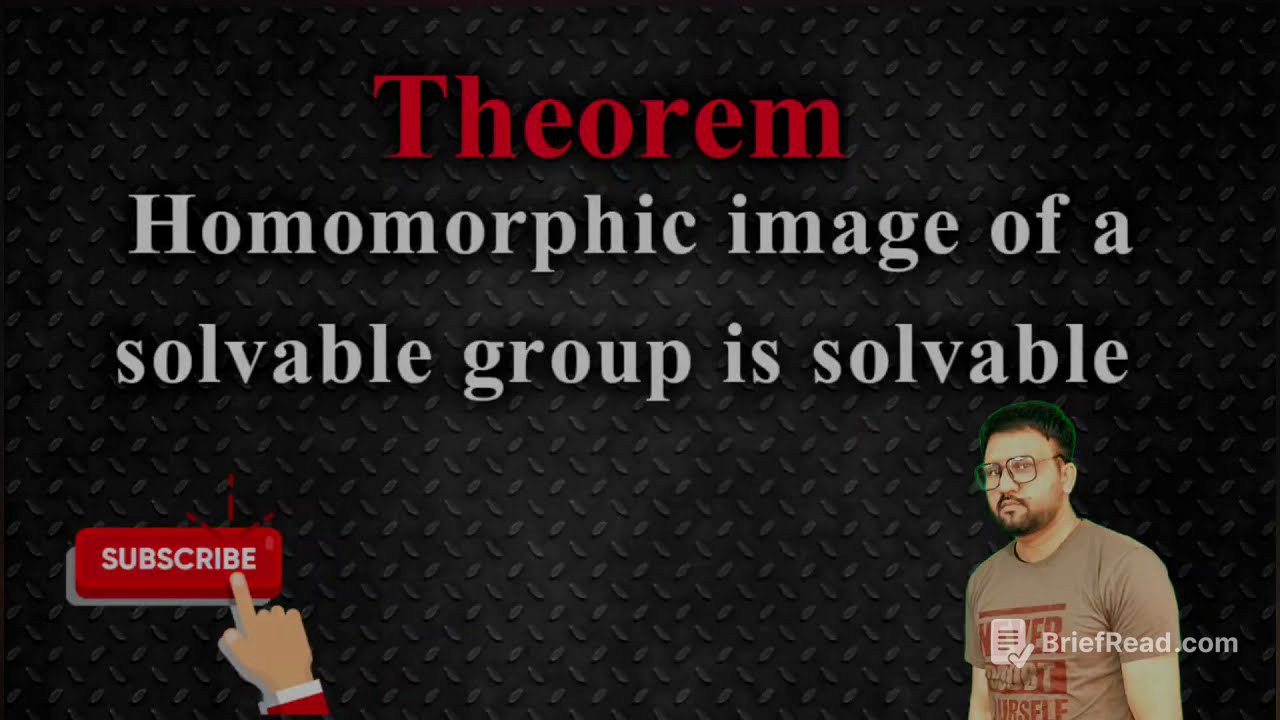
This video explains and proves the theorem that the homomorphic image of a solvable group is solvable. It begins by defining solvable groups and homomorphic mappings, then outlines the steps to prove that the homomorphic image (f(G)) of a solvable group G is also solvable. The proof involves constructing a solvable series for f(G) and demonstrating that it satisfies the conditions for a solvable series, including normal subgroups and abelian quotient groups. The video also uses concepts such as well-defined mappings, one-to-one mappings, onto mappings, homomorphisms, and the fundamental theorem of isomorphism to complete the proof.
- Definition of solvable groups and homomorphic mappings.
- Construction of a solvable series for the homomorphic image f(G).
- Proof that the constructed series satisfies the conditions for a solvable series.
- Application of the fundamental theorem of isomorphism.
Introduction [0:00]
The video introduces the theorem that the homomorphic image of a solvable group is also solvable. It builds upon previous explanations of related theorems and aims to provide a clear, step-by-step proof.
Defining Solvable Groups and Homomorphic Mappings [0:34]
The presenter starts by defining a solvable group G and a homomorphic mapping f from G to G'. The homomorphic image of G, denoted as f(G), is a subset of G'. The goal is to prove that if G is solvable, then f(G) is also solvable.
Setting Up the Proof [2:36]
To prove that f(G) is solvable, it must be shown that f(G) has a solvable series. Since G is solvable, it has a solvable series: {e} = G_n ⊆ ... ⊆ G_1 ⊆ G_0 = G, where each G_{i+1} is a normal subgroup of G_i, and the quotient group G_i / G_{i+1} is abelian.
Constructing a Series for f(G) [5:36]
A series for f(G) is constructed using the images of the subgroups in the solvable series of G: {e'} = f(G_n) ⊆ ... ⊆ f(G_1) ⊆ f(G_0) = f(G), where e' is the identity element of G'. This series is considered as Equation 2, and the original series of G is Equation 1.
Proving the Solvable Series Conditions [7:32]
To prove that the series for f(G) is a solvable series, two conditions must be met:
- f(G_{i+1}) is a normal subgroup of f(G_i) for all i.
- The quotient group f(G_i) / f(G_{i+1}) is abelian for all i.
Proof: f(G_{i+1}) is a Normal Subgroup of f(G_i) [8:46]
To prove the first condition, let x ∈ f(G_{i+1}) and y ∈ f(G_i). Then x = f(a) for some a ∈ G_{i+1}, and y = f(b) for some b ∈ G_i. Since G_{i+1} is a normal subgroup of G_i, b^{-1}ab ∈ G_{i+1}. Applying the homomorphism f, we get f(b^{-1}ab) = f(b)^{-1}f(a)f(b) = y^{-1}xy ∈ f(G_{i+1}). Thus, f(G_{i+1}) is a normal subgroup of f(G_i).
Proof: f(G_i) / f(G_{i+1}) is Abelian [12:43]
To prove the second condition, a mapping φ is defined from G_i to f(G_i) / f(G_{i+1}) as φ(x) = f(x) * f(G_{i+1}). It needs to be shown that φ is well-defined, one-to-one, onto, and a homomorphism.
Proving φ is Well-Defined, One-to-One, Onto, and a Homomorphism [17:16]
The video outlines the steps to prove that the mapping φ is well-defined, one-to-one, onto, and a homomorphism. These proofs involve showing that φ(x) = φ(y) implies x = y, and that for every element in the codomain, there exists an element in the domain that maps to it. Additionally, it is shown that φ(xy) = φ(x)φ(y).
Applying the Fundamental Theorem of Isomorphism [20:17]
By the fundamental theorem of isomorphism, G_i / ker(φ) is isomorphic to f(G_i) / f(G_{i+1}). If it can be shown that ker(φ) = G_{i+1}, then G_i / G_{i+1} is isomorphic to f(G_i) / f(G_{i+1}). Since G_i / G_{i+1} is abelian, f(G_i) / f(G_{i+1}) is also abelian.
Proof: ker(φ) = G_{i+1} [21:38]
To prove that ker(φ) = G_{i+1}, it must be shown that ker(φ) ⊆ G_{i+1} and G_{i+1} ⊆ ker(φ). This involves showing that if x is in the kernel of φ, then x is in G_{i+1}, and vice versa.
Conclusion [25:10]
Since f(G_{i+1}) is a normal subgroup of f(G_i) and f(G_i) / f(G_{i+1}) is abelian, the series for f(G) is a solvable series. Therefore, f(G) is a solvable group, proving the theorem that the homomorphic image of a solvable group is solvable.