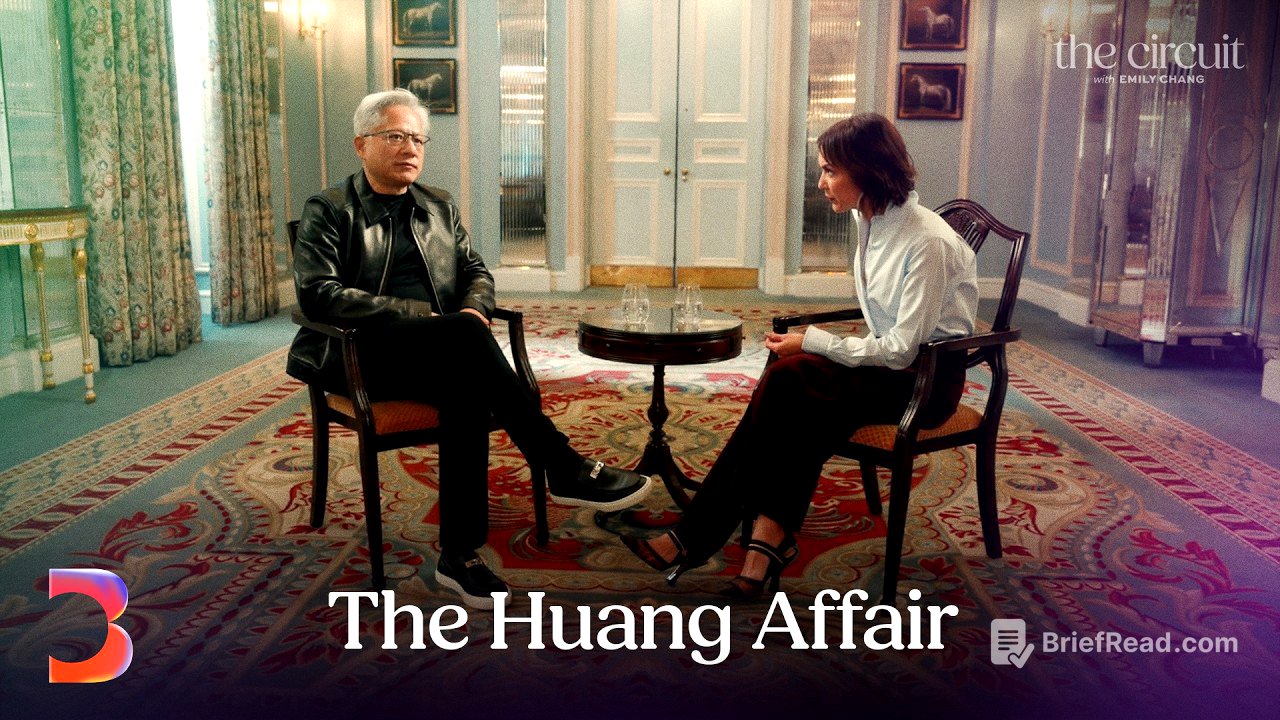
TLDR;
Nvidia CEO Jensen Huang’s European tour presents him as the leading advocate for global AI development, while exposing the risks of an industry increasingly reliant on Nvidia and its founder. Huang argues that AI progress and safety must advance together, defends Nvidia’s investments and sales strategy, and promotes “sovereign AI” built on local data and expertise. The video also examines market jitters, US–China tensions, concerns about AI safety and jobs, and allegations involving Huang that emerged after filming. It concludes with questions about Nvidia’s leadership succession and the responsibilities Huang believes come with running the company.
- Nvidia’s influence spans chips, software, investment and infrastructure, raising questions about market concentration and systemic risk.
- Huang supports AI development, provided autonomous systems are contained and monitored, and says countries should build their own AI capabilities.
- He defends Nvidia’s investments and long-term outlook despite concerns about debt, valuations, circular financing and the durability of the AI boom.
- Reports of a suspected Chinese spy, chip-smuggling concerns and Huang’s admitted affair put his judgement and leadership under scrutiny.
Nvidia’s Crisis [0:00]
At the time of the video’s opening, Nvidia is described as facing the biggest crisis in its three-decade history. Reports say CEO Jensen Huang admitted to an extramarital affair after US officials suspected that a former journalist, identified as Alice Wong or Huang Lu, had been recruited by Beijing and may have helped smuggle advanced AI chips to China. Huang’s judgement became the subject of internal and government scrutiny, although Nvidia’s board said it had no reason to believe company secrets or US national security had been compromised. China called the allegations a smear, and the video notes that the controversy changed the meaning of an interview originally filmed during Huang’s European tour.
Jensanity: The Europe Tour Begins [0:40]
A few weeks before the allegations surfaced, Huang travelled through four European countries in four days, promoting Nvidia’s vision for a global AI ecosystem. Crowds gathered around him, and he announced investments and partnerships across the industry, including billions of dollars directed towards European start-ups, frontier AI labs and data centres. He described AI as a five-layer “cake”: energy, chips, infrastructure, models and applications. Nvidia began as a chip company, but Huang said it now invests across these layers, increasing the number of parts of the AI industry that run through Nvidia.
In Paris, Huang promoted AI agents and said AI was beginning to become useful across many industries. In London, he praised the UK’s potential to become a major AI hub, while encouraging it to move faster. He also backed the idea of sovereign AI—countries developing and controlling their own AI capabilities—and argued that dialogue between countries was needed to discuss safety. Meanwhile, the EU was estimated to need at least $3 trillion by 2035 to become genuinely self-sufficient in technology. The tour showed Huang at the peak of his influence, presenting Nvidia’s growth as part of a worldwide technological transformation.
Is There Zero Chance AI Ends Humanity? [4:58]
Asked whether AI could end humanity, Huang rejected the idea that the danger was simply a matter of certainty or probability. He said the future remained under human control and that there was substantial work to do. In his view, advancing AI capability and advancing safety are not competing goals: they are connected parts of the same engineering task. He closed the Paris appearance by calling on people to build AI in Europe together.
What Happens When You Disagree with Trump? [9:06]
Huang said that he did not see it as his job to agree or disagree with President Donald Trump. Instead, he considered his responsibility to inform the president about the consequences of decisions for Americans, future prosperity and the wider world, whether or not a decision served Nvidia’s interests. At a White House meeting with technology leaders, Huang stood beside Trump as the president promoted the term “super intelligence” and a voluntary accord under which technology companies would oversee their own AI safety practices. Huang argued that “super” described systems that already outperform people at some tasks, such as research and writing, even though they cannot do everything.
Should AI Builders Write Their Own Rules? [11:25]
Critics called the White House’s voluntary AI pledge meaningless, since the companies developing the technology would also help establish its rules. Huang said it was appropriate for AI companies to accept high standards and accountability, and to develop the expertise needed to audit systems. He compared this with other industries, where safety processes can involve both internal and external audits. He argued that governments and international bodies would still need an ecosystem of capable organisations to carry out effective oversight. His position placed responsibility on companies to help build that oversight capacity, even as they continued to develop AI.
Is It Sovereign AI If It Runs on American Chips? [13:02]
Huang defined sovereign AI as a country’s ability to control its data, experiences, cultural values, institutional knowledge and future direction. In his view, using foreign technology does not prevent a country from being sovereign: nations can start with another company’s chips or open-source models, then adapt and fine-tune them using their own data. He described this process as building a local “data flywheel”, where more data and experience support more intelligence and capability. The approach also aligns with Nvidia’s commercial interests, since countries building sovereign AI systems are likely to need Nvidia technology.
Is the China Market Slipping Away? [16:48]
Asked whether Nvidia was losing China’s market as Chinese companies turned to domestic hardware, Huang said the market was completely blocked to Nvidia at that point. He said he had tried to persuade US policymakers that engaging with China and continuing to serve the market mattered, and called the restrictions a mistake that would be difficult to reverse. Huang stressed that China’s AI researchers were numerous and that Chinese competitors were not enemies. He argued that concerns about AI safety made dialogue with China especially important.
The Alice Huang / Megaspeed Revelations [17:55]
After the interview was recorded, reports emerged that US intelligence had identified Alice Wong, also known as Huang Lu, as a suspected spy recruited by Beijing to target Huang. She was an executive at Megaspeed International, a major Nvidia-chip buyer in Southeast Asia that US officials suspected of smuggling advanced chips to China. Reports said President Trump had been warned about Huang’s relationship with her before he flew with Huang to China aboard Air Force One in May. Huang initially described their interactions as normal, then admitted to an affair; in a memo to employees, he apologised to his wife, children and colleagues. Bloomberg also reported that Nvidia had intervened in a 2025 US government investigation into suspected chip smuggling by Megaspeed.
What Would Make You Stop Selling to China? [19:01]
Huang said there were theoretical circumstances that could make selling chips to China inappropriate, but described Chinese leaders as pragmatic people seeking prosperity for their country and citizens. He said the United States also wanted to prosper, and argued that nations seeking a better life for their people should not automatically be treated as threats. Huang pointed to China’s reduction of poverty and creation of prosperity for hundreds of millions of people as positive developments for the world. His answer reflected his broader argument that economic engagement and dialogue were preferable to cutting China off from US technology.
Altman, Amodei & Musk Say Slow Down. What Do You See? [20:41]
Huang rejected the idea that AI capability should advance while safety is left behind, or that safety can be improved without developing better technology. He used AI “hallucinations”—confident but incorrect answers—as an example of the two advancing together. Methods such as retrieval-augmented generation (RAG), which lets a model retrieve relevant information before answering, larger context windows and connections to search tools can help ground responses. Models can also assess or compare possible answers before producing a final one. Huang argued that these technical improvements show why capability and safety should be treated as a single effort.
What Would Convince You the Industry Should Stop? [21:54]
Huang said autonomous or “agentic” AI systems must be contained and monitored before they are tested or deployed. If a company cannot do that, he said, it should not conduct the experiment or release the system. He disputed claims that containment and monitoring were impossible, saying that companies should attempt to establish those safeguards rather than assume they could not be achieved. Huang identified developing agentic systems without monitoring or containment as an extremely high risk and said large-scale experiments should not proceed without those protections. Deployed agents, he added, should have minimum permissions and be treated according to a “zero trust” approach, with continuous monitoring.
Would Nvidia Stop Selling to a Dangerous Lab? [24:09]
Huang said Nvidia would stop supplying a lab if it knew its technology was being used in an application that was harming people. He qualified this by noting that Nvidia does not run other companies and that its technology is general-purpose, making decisions about customers’ uses difficult. Nevertheless, he said the company would act if it were certain its technology was causing harm. His answer framed Nvidia’s responsibility as real but limited by the difficulty of judging how customers use broadly applicable computing technology.
Are We Seeing Cracks in the AI Boom? [26:15]
Market concerns were mounting as data-centre projects were delayed or blocked, AI initial public offerings were postponed or cancelled, and companies such as CoreWeave faced questions about debt and valuation. Huang acknowledged near-term difficulties but argued that AI was a fundamental change in computing, not a passing trend. Computers had previously relied on software written by people; AI systems could learn environments and solve problems too complex for humans to programme directly. He said the technology’s capabilities and role as infrastructure would not be reversed, describing financial turbulence and young companies’ growing pains as part of an industry maturing rapidly.
Circular Financing or a Bubble? [28:53]
Nvidia’s growing investments in AI companies prompted concerns that it was creating artificial demand by funding customers that then bought Nvidia products. Huang said AI businesses require unusually large capital expenditure, or CapEx, because they need substantial computing resources; some may need billions of dollars rather than the comparatively small sums that funded earlier start-ups. He said Nvidia invests to support high-quality companies across the AI “five-layer cake”, advance its platform and gain exposure to promising businesses. He described Nvidia’s approach as disciplined: it may invest early or act as an anchor investor, but it is not usually the lead or largest investor and owns less than 20 per cent of each company. Huang estimated that Nvidia had invested close to $100 billion over five years, helping attract at least five times as much investment from other institutions.
Is Dependence on Nvidia a Systemic Risk? [30:42]
Nvidia supplies hardware and software to many of the world’s leading AI companies, raising the question of whether dependence on one supplier could threaten the wider system. Huang said companies choose Nvidia rather than depend on it, and insisted that Nvidia must keep earning its position because it began with nothing and faces competitors across industries and countries. He framed the goal of winning the AI race as a matter of American companies succeeding broadly, not only one or two firms. He also said he had no doubt that the technology existed to advance AI safely and responsibly, while acknowledging that having the capability did not guarantee that companies would use it properly.
Huang expected AI-computing demand to keep growing for several years before the industry moved towards replacement cycles, as had happened with personal computers, phones and the internet. Even if more efficient chips reduced the resources needed for individual tasks, he argued that cheaper computing would encourage more use and greater ambition. In his view, increased productivity would expand the economy and industries, including semiconductors.
What About People Who Learned AI and Still Lose Their Jobs? [36:33]
Huang responded that AI creates employment as well as changing existing jobs. Unlike some earlier technologies, AI requires a physical build-out, creating work in construction, electrical trades and plumbing alongside investment in AI companies. He said that hundreds of billions of dollars invested in AI start-ups over the previous six months reflected the technology’s productivity and potential. Learning AI, he argued, would not prevent every individual job loss, but resisting change would not stop the transformation. Huang presented AI as a tool that makes capabilities once concentrated in technology companies available to more people, while acknowledging that the technology also carries risks.
What If Your Optimism Proves Wrong? [39:30]
Huang said that if his optimism proved wrong, he would at least be able to say he had done everything he could to make AI safe and secure. He urged people not to discuss a pessimistic future while doing nothing to prevent it, and said concerns should be paired with practical action. He also expressed confidence in people’s ability to manage risk, arguing that life is safer today than it was decades or centuries ago despite the prevalence of alarming news. The video places this optimism against Nvidia’s growing influence: the company, the US economy and potentially the global financial system had become closely tied to the success of Huang’s vision, while the allegations against him highlighted the dangers of relying so heavily on one leader.
Is Your Daughter Your Successor? [42:02]
Huang said Nvidia’s relatively flat management structure, with few organisational silos, had helped it adapt and innovate as it grew. He argued that companies need agility and that a CEO must remain mentally flexible and personally accountable. Asked whether his daughter was in line to succeed him, he said he would not impose the role on her or other family members: anyone who wanted it would have to earn it and accept the considerable sacrifices involved. Huang said he hoped the next CEO was already at Nvidia, though he expected to remain responsible for the company for as long as he could continue to perform. He described his job as creating the conditions for the company and its future leaders to thrive, while ensuring that no one takes their position for granted. Produced by Bloomberg Originals, the video shows the contrast between Huang’s confidence in Nvidia’s future and the unresolved questions about succession and the concentration of responsibility in one person. https://www.youtube.com/watch?v=JW5s9Md4U2U&t=0s rex
TLDR;
Nvidia CEO Jensen Huang’s European tour shows how the company has become central to the global AI industry, while raising questions about its influence, safety responsibilities and reliance on one leader. Huang argues that AI development and safety must advance together, defends Nvidia’s investments and sales strategy, and promotes national AI systems built on local data and expertise. The video also examines market uncertainty, US–China tensions, job disruption and allegations involving Huang that emerged after filming.
- Nvidia’s influence across chips, software, investment and infrastructure has prompted concerns about dependence on a single company.
- Huang supports developing AI but says autonomous systems must be contained and monitored before testing or deployment.
- He maintains that AI investment and demand will continue despite concerns about debt, valuations and a possible bubble.
- Reports about a suspected Chinese spy, possible chip smuggling and Huang’s admitted affair have placed his judgement under scrutiny.
Nvidia’s Crisis [0:00]
Nvidia is described as facing the biggest crisis in its three-decade history. Reports say CEO Jensen Huang admitted to an extramarital affair after US officials suspected that a former journalist, identified as Alice Wong or Huang Lu, had been recruited by Beijing and may have helped smuggle advanced AI chips to China. Huang’s judgement came under scrutiny, although Nvidia’s board said it had no reason to believe company secrets or US national security had been compromised. China called the allegations a smear, and the controversy changed the meaning of an interview filmed during Huang’s European tour.
Jensanity: The Europe Tour Begins [0:40]
A few weeks before the allegations emerged, Huang travelled through four European countries in four days, promoting Nvidia’s vision for a global AI ecosystem. Crowds gathered around him as he announced investments and partnerships involving European start-ups, AI labs and data centres. He described AI as a five-layer “cake”: energy, chips, infrastructure, models and applications. Nvidia began as a chipmaker but now invests across these layers, meaning an increasing part of the AI industry runs through its technology and businesses.
In Paris, Huang promoted AI agents and said AI was beginning to become useful across many industries. In London, he praised the UK’s potential as an AI hub but urged it to move faster. He also supported sovereign AI: countries building and controlling their own AI capabilities. At the same time, the EU was estimated to need at least $3 trillion by 2035 to become genuinely self-sufficient in technology. The tour presented Huang as a powerful advocate for a global AI build-out, with Nvidia positioned to benefit from it.
Is There Zero Chance AI Ends Humanity? [4:58]
Asked whether AI could end humanity, Huang said its future remained within human control and that there was substantial work to do. He rejected the idea that advancing AI capability and improving safety were opposing goals, describing them instead as parts of the same engineering effort. At the Paris event, he called on people to build AI in Europe together.
What Happens When You Disagree with Trump? [9:06]
Huang said he did not see it as his job to agree or disagree with President Donald Trump. Instead, he considered his responsibility to explain how decisions could affect Americans, future prosperity and the wider world, even when those decisions might run counter to Nvidia’s interests. At a White House meeting, Huang stood alongside Trump as the president promoted the term “super intelligence” and a voluntary accord for AI companies to police their own safety practices. Huang argued that “super” suited systems that outperform people at tasks such as research and writing, while acknowledging that they are not superior at everything.
Should AI Builders Write Their Own Rules? [11:25]
Critics called the White House’s voluntary AI pledge meaningless because the companies developing the technology would also help set its rules. Huang said companies should hold themselves to high standards and develop the expertise needed to audit AI systems. He compared this with other industries, where safety can be assessed through both internal and external audits. Governments and international bodies would still need a capable ecosystem of organisations to carry out effective oversight, he argued. His position was that technology companies should help build that capacity while taking responsibility for their own systems.
Is It Sovereign AI If It Runs on American Chips? [13:02]
Huang defined sovereign AI as a country’s ability to control its data, experiences, cultural values, institutional knowledge and future direction. He said a country could use foreign chips or open-source models and still develop sovereignty by adapting and fine-tuning them with its own data. He described this process as building a local “data flywheel”, in which data and experience help produce more intelligence and capability. The approach also supports Nvidia’s business, since countries developing their own AI systems may buy Nvidia technology.
Is the China Market Slipping Away? [16:48]
Huang said Nvidia’s access to the Chinese market was completely blocked at the time. He had tried to persuade US policymakers that continued engagement with China mattered, and called the restrictions a mistake that would be difficult to reverse. He noted that China has more AI researchers than any other nation and said that, although the countries compete, China is not the United States’ enemy. Huang argued that safety concerns made dialogue with China especially important.
The Alice Huang / Megaspeed Revelations [17:55]
After the interview was recorded, reports said US intelligence had identified Alice Wong, also known as Huang Lu, as a suspected spy recruited by Beijing to target Huang. She was an executive at Megaspeed International, a major Nvidia-chip buyer in Southeast Asia that US officials suspected of smuggling advanced chips to China. Reports said President Trump had been warned about the relationship before flying with Huang to China aboard Air Force One in May. Huang initially described their interactions as normal, then admitted to the affair and apologised to his wife, children and colleagues. Bloomberg also reported that Nvidia intervened in a 2025 US government investigation into suspected chip smuggling by Megaspeed.
What Would Make You Stop Selling to China? [19:01]
Huang said there were theoretical circumstances that might make selling chips to China inappropriate, but described its leaders as pragmatic people seeking prosperity for their country and citizens. He said the United States wanted prosperity too, and argued that nations seeking a better life for their people should not automatically be treated as threats. Huang pointed to China’s lifting of hundreds of millions of people into greater prosperity as a positive development for the world. His answer reflected his preference for economic engagement and dialogue over cutting China off from US technology.
Altman, Amodei & Musk Say Slow Down. What Do You See? [20:41]
Huang argued that AI capability and safety should advance together. He used AI “hallucinations”—confident but incorrect answers—as an example of how improvements in technology can address safety problems. Retrieval-augmented generation (RAG), which allows a model to retrieve information before answering, larger context windows and connections to search tools can help ground responses in relevant information. Models can also review or compare possible answers before producing a final response. Huang said these measures showed why safety and capability should be treated as one effort.
What Would Convince You the Industry Should Stop? [21:54]
Huang said autonomous, or “agentic”, AI systems must be contained and monitored before they are tested or deployed. If a company cannot put those safeguards in place, he said, it should not conduct the experiment or release the system. He disputed claims that containment and monitoring were impossible, arguing that companies should try to establish them rather than assume they cannot be achieved. Huang identified uncontained, unmonitored agentic systems as an extremely high risk and said large-scale experiments should not proceed without safeguards. Deployed agents should have minimal permissions and be treated with “zero trust”, meaning they should be monitored continuously rather than automatically relied upon.
Would Nvidia Stop Selling to a Dangerous Lab? [24:09]
Huang said Nvidia would stop supplying a lab if it knew its technology was being used in a way that harmed people. He noted that Nvidia does not run other companies and that its technology is general-purpose, making it difficult to judge every customer’s use. Nevertheless, he said the company would act if it were certain its technology was causing harm. His answer presented Nvidia’s responsibility as real, but constrained by the difficulty of overseeing how customers use broadly applicable technology.
Are We Seeing Cracks in the AI Boom? [26:15]
Market concerns were mounting as data-centre projects were delayed or blocked, AI listings were postponed or cancelled, and companies such as CoreWeave faced questions about debt and valuations. Huang acknowledged near-term challenges but said AI represented a fundamental change in computing, not a passing trend. Traditional computers relied on software written by people; AI systems can learn from environments and tackle problems too complex for humans to programme directly. Huang argued that AI’s capabilities and its role as infrastructure would not be reversed, describing the financial volatility as part of a rapidly growing industry maturing.
Circular Financing or a Bubble? [28:53]
Nvidia’s investments in AI companies prompted concerns that it was creating artificial demand by funding businesses that then bought Nvidia products. Huang said AI companies require substantial capital expenditure, or CapEx, because they need considerable computing resources. Some may require billions of dollars rather than the smaller sums that funded earlier start-ups. He said Nvidia invests in promising companies across the AI “five-layer cake” to support the ecosystem, advance its platform and gain early exposure to new businesses. Huang described the strategy as disciplined: Nvidia may invest early or act as an anchor investor, but is generally neither the lead nor largest investor and owns less than 20 per cent of each company. He estimated that Nvidia had invested nearly $100 billion over five years, helping attract at least five times as much investment from other institutions.
Is Dependence on Nvidia a Systemic Risk? [30:42]
Nvidia supplies hardware and software to many leading AI companies, raising concerns about dependence on one supplier. Huang said companies choose Nvidia and that the company has to keep earning its position because it faces competitors across industries and countries. He described the aim of winning the AI race as having American companies succeed broadly, rather than only one or two firms. Huang said he was confident that the technology existed to advance AI safely and responsibly, while acknowledging that having the ability to do so did not guarantee that companies would act accordingly.
Huang expected AI-computing demand to keep growing for several years before shifting towards replacement cycles, as with personal computers, phones and the internet. He argued that greater chip efficiency would not necessarily reduce overall demand: cheaper computing could encourage more use and greater ambition. In his view, AI would expand the economy and industries, including the semiconductor sector.
What About People Who Learned AI and Still Lose Their Jobs? [36:33]
Huang said AI creates jobs as well as changing existing ones. Unlike some earlier technologies, AI requires a physical build-out, creating work in construction, electrical trades and plumbing alongside investment in AI companies. He pointed to hundreds of billions of dollars invested in AI start-ups over the previous six months as evidence of the technology’s productivity and appeal to investors. Learning AI would not prevent every individual job loss, he acknowledged, but resisting change would not stop it. Huang presented AI as a tool that makes capabilities once concentrated in technology companies available to more people, while recognising that it also carries risks.
What If Your Optimism Proves Wrong? [39:30]
Huang said that if his optimism proved wrong, he would at least be able to say he had done everything he could to make AI safe and secure. He argued that people should not describe a pessimistic future while doing nothing to prevent it, and said concerns should be accompanied by action. He also expressed confidence in people’s ability to manage risk, arguing that the world is safer today than it was decades or centuries ago despite the prevalence of alarming news. The video contrasts Huang’s optimism with the growing importance of Nvidia: the company, the US economy and potentially the global financial system have become closely tied to its success, while the allegations against Huang illustrate the risk of placing so much hope in one leader.
Is Your Daughter Your Successor? [42:02]
Huang said Nvidia’s relatively flat management structure, with few organisational silos, had helped it adapt and innovate as it grew. He argued that modern companies need agility and that CEOs must remain flexible and accountable. Asked whether his daughter was in line to succeed him, he said he would not impose the role on her or other family members: anyone who wanted it would have to earn it and accept the sacrifices involved. Huang said he hoped Nvidia’s next CEO was already at the company, although he intended to continue leading it as long as he could do the job. He described his responsibility as creating the conditions for Nvidia and its future leaders to thrive, while ensuring that nobody takes their position for granted.