TLDR;
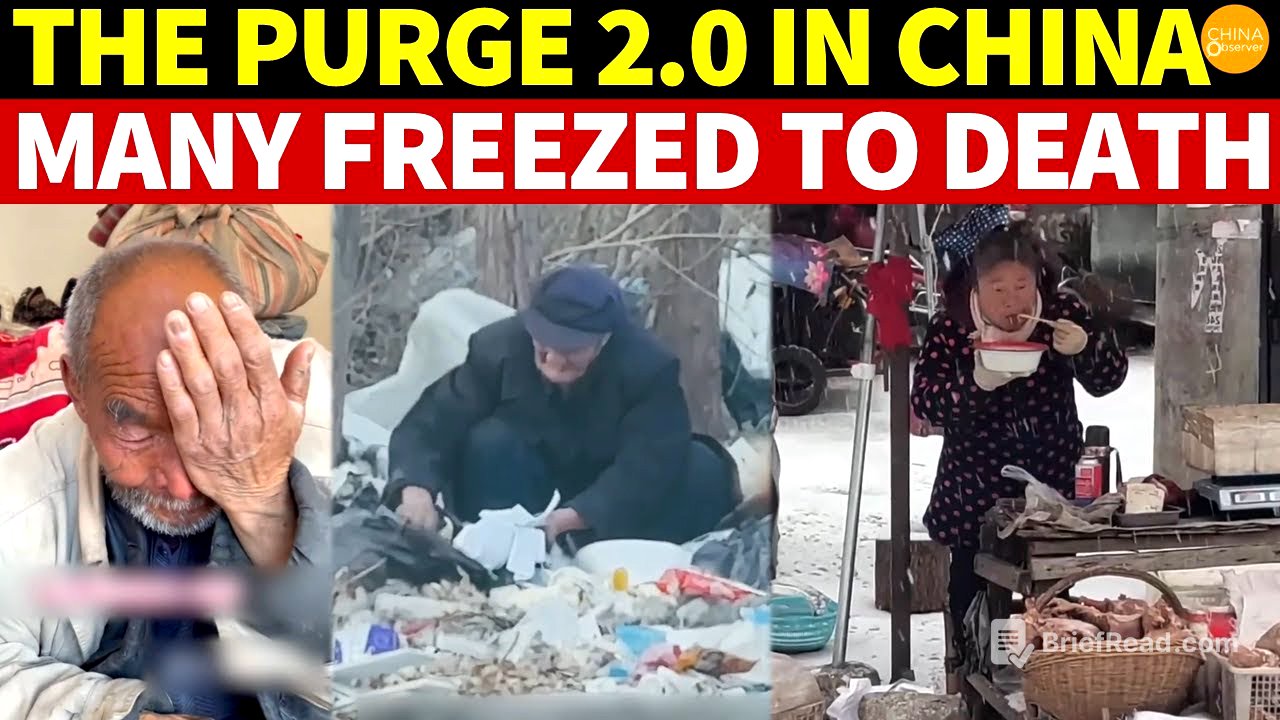
This video highlights the severe winter heating crisis in rural Hub province, China, in 2026. It exposes the contradictions between government policies and the lived experiences of villagers, who face high gas prices, dwindling subsidies, and strict bans on coal burning. The video also touches on the use of environmental policies to advance government interests, exemplified by "dust-driven evictions," and contrasts the CCP's domestic neglect with its extensive foreign aid spending.
- Villagers in rural Hub province are struggling to afford winter heating due to high natural gas prices and declining subsidies.
- Strict bans on coal burning, enforced by drone surveillance and citizen reporting, leave residents with few alternatives.
- The government's "coal to gas" policy is criticised for increasing financial pressure on rural households and serving as a justification for restricting cheaper fuel options.
- "Dust-driven evictions" demonstrate how environmental policies are used to advance government interests, highlighting the disconnect between the CCP's words and actions.
- The video contrasts China's domestic neglect with its extensive foreign aid spending, questioning who bears the suffering and who benefits under the current conditions.
Winter Heating Crisis in Rural Hub [0:00]
In the winter of 2026, residents of KBE province are struggling with extreme cold, with quilts freezing to windows. Despite online suggestions, villagers are heavily monitored by drones and face fines for burning coal or firewood. The Chinese Communist Party encourages residents to report each other for rewards, creating an atmosphere of fear and distrust. While natural gas is presented as an alternative, fewer than 10 out of 100 households can afford it, leaving most to endure the cold. Videos exposing the plight of elderly residents freezing to death are quickly removed by regulators, highlighting the suppression of truth.
The High Cost of Natural Gas [2:55]
Although a People's Daily article acknowledged the heating problem in Hub, it was quickly removed, revealing the government's reluctance to address the issue. Natural gas heating is prohibitively expensive for rural residents, costing over 60 yen (approximately $8.60) per day, potentially reaching 7 to 8,000 yen (about $1,000 to $1,150) for the entire winter. This expense can consume nearly half a year's income for many farmers. Some families only turn on the heating when their children visit, while others find their homes so cold that their children suffer from frostbite.
Disparities in Income and Gas Prices [4:33]
Rural residents in Hub face the lowest per capita income in the Beijing, Tanzin, Huay region, yet they are charged the highest natural gas prices for winter heating. In 2024, the per capita disposable income for rural residents was only 22,22 yen in Hub, compared to 39,856 yen in Beijing. Despite this, gas prices in Hub are 3.15 yen per cubic meter, higher than in Beijing (2.6 yen) and Tanzhin (2.86 yen). The government attributes this pricing gap to local fiscal capacity and transport costs, but critics argue that the government is capable of resolving these issues. Heating subsidies have also declined significantly, from 1 yen per cubic meter in 2017 to just 0.2 to 0.3 yen today, with strict usage caps limiting the maximum annual subsidy to a negligible amount.
Fast Gas Meters and Banned Alternatives [6:35]
Villagers are alarmed by the high gas prices and the unusually fast gas meters installed in their homes. Some meters appear to count by the second, leading to exorbitant bills. Despite promises of government subsidies, residents pay more than 3 yen per cubic meter, higher than in Beijing. Coal burning, once a cheaper alternative, is now banned in the name of environmental protection, with monthly gas bills reaching unaffordable levels. The problem extends beyond Kubay, with families in rural Hunan also struggling to afford gas heating and facing freezing conditions indoors. Authorities have physically sealed household stoves, preventing residents from burning any fuel.
The "Coal to Gas" Policy and Uneven Subsidies [9:17]
The "coal to gas" program, promoted since 2015, has led to slogans like "If coal is found, remove it. If smoke appears, impose a fine." Reports of gas shortages, high prices, and fines for burning coal have persisted for years. The government invested heavily in coal to gas and coal to electricity conversions, offering subsidies for natural gas and electricity. However, these subsidies were unevenly distributed, favouring cities like Beijing and Tanzin over Hub, which has the largest rural population. Critics argue that the policy has increased financial pressure on rural households by restricting cheaper coal and pushing them towards expensive natural gas.
Dust-Driven Evictions and Environmental Policies [11:21]
In 2026, "dust-driven evictions" emerged as a new issue, with demolition teams using fog cannon vehicles to generate artificial dust storms to pressure businesses into relocating. This action affected car showrooms, local residents, and even a kindergarten, disrupting business and daily life. While construction projects face fines for failing to control dust, the deliberate generation of heavy dust to force relocation raises questions about the government's true intentions. The incident highlights the disconnect between the CCP's words and actions, questioning whether environmental policies are genuinely aimed at protecting the environment or merely advancing its own interests.
The CCP's Priorities and Neglect of its Citizens [14:11]
Critics argue that a survival threshold exists within China, particularly for elderly people in rural areas struggling to afford heating. The CCP presents a false choice between protecting basic livelihoods and protecting the environment, extracting wealth from the public while treating human life as expendable. The government's work is aimed at following party directives and safeguarding party interests, rather than meeting social or public needs. Despite widespread poverty at home, China continues to spend billions of dollars in foreign aid, securing support at the United Nations while its own citizens freeze to death. The video concludes by questioning who bears the suffering and who truly benefits under the current conditions.






![[타로]🌹갓 신내림 받은 것처럼 잘맞는🔥현재 그 사람, 100% 이런 감정 느낍니다🔮상대방의 진짜 속마음](https://wm-img.halpindev.com/p-briefread_c-10_b-10/urlb/aHR0cDovL2ltZy55b3V0dWJlLmNvbS92aS9UWVVVQmZEdUNXOC9ocWRlZmF1bHQuanBn.jpg)