TLDR;
The video discusses the 2014 film "The Imitation Game," focusing on Alan Turing's pivotal role in cracking the Enigma code during World War II. It highlights the challenges he faced, his contributions to the Allied victory, and the personal struggles he endured due to his homosexuality, ultimately leading to his tragic death. The speakers provide their ratings of the film, praising its handling of themes like bullying, homophobia, and political power.
- The film portrays Alan Turing's work on deciphering the Enigma code.
- It addresses themes of homophobia and political oppression.
- The speakers recommend the film, giving it high ratings.
Introduction to "The Imitation Game" [0:11]
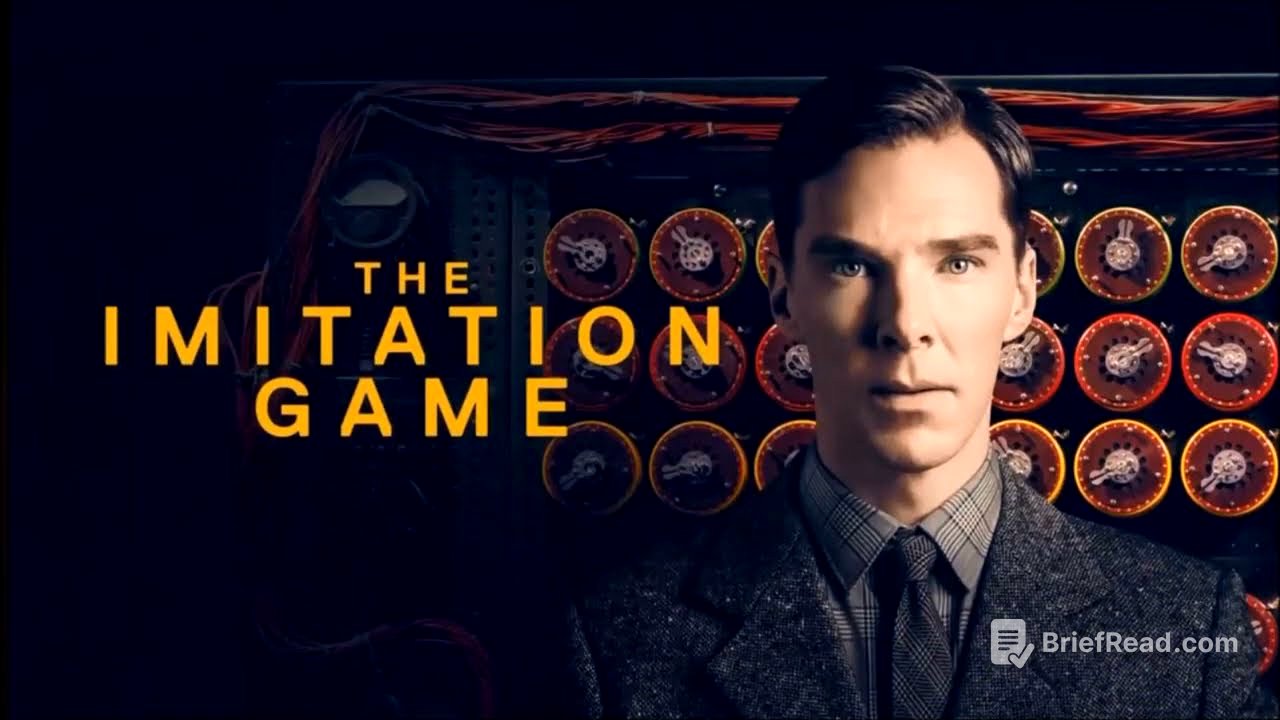
The film "The Imitation Game" (2014) stars Benedict Cumberbatch as Alan Turing, alongside Keira Knightley as Joan Clarke, Matthew Goode as Hugh Alexander, and Matthew Beard as Peter Hilton. The film received the Oscar for Best Adapted Screenplay in 2015. It also won Best Thriller at the Empire Awards in 2015 and was named one of the top ten films of the year by the National Board of Review in 2014.
Plot Summary: Cracking the Enigma Code [0:47]
During World War II, the brilliant mathematician Alan Turing is recruited by the British government to break the Nazi's Enigma code. Turing, initially disliked by his colleagues and boss Hugh Alexander, leads the top-secret operation. He aims to create a machine, named Christopher, to automatically decipher the messages, which change every 24 hours. Joan Clarke joins the team, proving her intellect and skill.
Team Dynamics and Personal Struggles [1:54]
With John's advice, the team rallies around Alan, securing more time to make Christopher functional. To prevent Joan from being forced into marriage, Alan proposes to her, despite concealing his homosexuality. When Joan discovers his secret, she remains supportive. Alan later tries to push her away, deeming the work too dangerous for a woman, but Joan insists on staying involved.
Breakthrough and Moral Dilemmas [2:44]
During a night out, Alan has a breakthrough idea to narrow down the Enigma key by using common words found at the end of weather reports. This enables them to decipher Enigma, but they face the dilemma of how to use this knowledge to win the war without revealing their code-breaking ability to the enemy. This decision leads to casualties, including the brother of one of Turing's colleagues.
Aftermath and Tragic End [3:21]
After being accused of homosexuality, Alan is faced with the choice of imprisonment or chemical castration. He chooses the latter. Joan visits him and tries to comfort him. Sadly, Alan Turing dies by suicide on 7 June 1954.
Film Review and Ratings [3:56]
The speaker gives the film a rating of 8 out of 10, highlighting its exploration of relevant themes such as bullying, homophobia, and political abuse of power. Another speaker rates the film a 9, agreeing with the points made and praising the script. The overall recommendation is that the film is definitely worth watching.