TLDR;
Mike Adenuga’s rise from trader to owner of an oil company and the telecommunications network Globacom has fuelled three long-running theories: that he held wealth for military figures, that public funds helped finance his telecoms business, and that his political connections made him untouchable. A 2006 anti-corruption investigation recorded serious allegations, including links between public money and Adenuga’s bank, but the funds were reportedly returned with interest and the claims were never tested in court. Adenuga was never charged, later received national and foreign honours, and has remained exceptionally private. More recently, financial, regulatory and operational problems at Globacom have raised fresh questions about the company and its future.
- The allegations remain unresolved: the report and investigations did not lead to a trial.
- Adenuga’s public silence and Globacom’s private ownership have limited scrutiny.
- The evidence supports the record of his arrest and subsequent lack of prosecution, but does not prove the other theories.
Cold Open: The Three Theories [0:00]
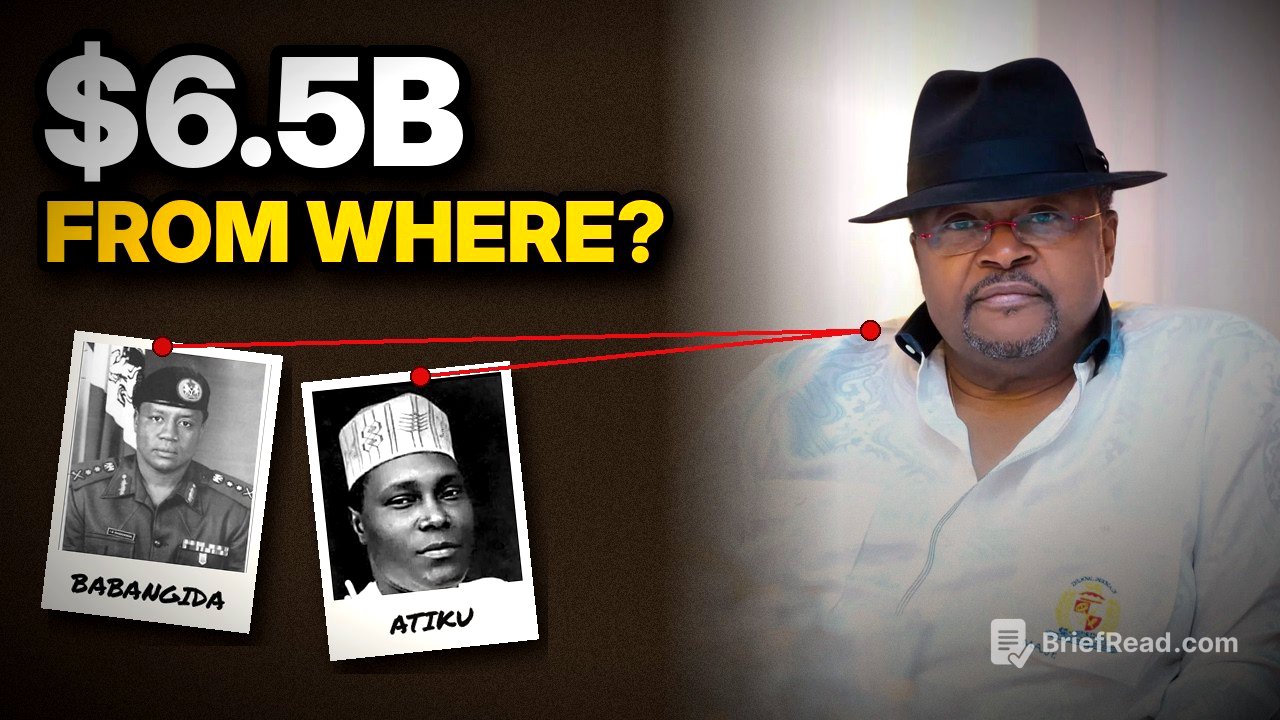
Three theories have surrounded Nigerian billionaire Mike Adenuga for more than 30 years: that he acted as a front for powerful military figures, that public money helped pay for his telecommunications company, and that he is too well connected to face consequences. Adenuga owns the oil company Conoil and founded Globacom, yet rarely speaks publicly and has no social media presence. In 2006, investigators arrested him, searched his company and produced a 156-page report alleging that Globacom had undisclosed owners. The account examines these theories through documented events rather than rumour.
The Man Who Works While Nigeria Sleeps [1:26]
Adenuga was born in Ibadan in 1953 to a schoolteacher. His biographies say he studied business in the United States, paying his way by driving a taxi in New York, then returned to Nigeria and traded lace and distributed soft drinks. According to the familiar origin story, he made his first million by the age of 26. In the early 1980s, armed robbers attacked his home; although he cooperated, one shot him as they left, and he was flown to London for surgery. People close to him describe him as private and intensely demanding, recalling stories of him checking bank branches at night and holding meetings that lasted into the early morning. However, the account notes that lace and soft drinks alone do not readily explain how he acquired a bank and an oil field in the same year.
1990 [2:51]
In 1990, Nigeria was under the military government of General Ibrahim Babangida. Equatorial Trust Bank was established in Lagos that January, with Adenuga as its owner. That year, the government also changed the rules to allow individual Nigerians into oil exploration, distributing licences at its discretion to only 11 companies rather than through an open auction. Adenuga’s Consolidated Oil was among the recipients. The following year, it found oil off Ondo State and became the first Nigerian-owned company reported to have discovered oil in commercial quantities. His rapid acquisition of both a bank and an oil licence prompted speculation about his relationship with the regime, but at this stage there was no investigation or documentary evidence.
Twice [4:11]
Adenuga’s early attempts to enter mobile telecommunications did not go smoothly. He received a conditional mobile licence in 1999, but it was revoked. In Nigeria’s 2001 auction, his company won one of three licences and paid a $20 million deposit, but failed to pay the remaining amount by the deadline; competitors MTN and Econet paid, while Adenuga lost both the licence and his deposit. He later insisted that he had not defaulted. In 2002, his new company, Globacom, bid for the remaining licence. It paid another $20 million deposit by 6 August and, according to one account, found the further $180 million only 35 minutes before the deadline. The sudden availability of $200 million would later become a focus of investigators.
The Hero [5:48]
Globacom became a major force in Nigerian telecommunications after launching in August 2003. At a time when customers were charged by the minute, it charged by the second, reducing the cost of calls. It also gave away SIM cards when competitors charged around 2,000 naira, prompting other networks to respond. Globacom signed music stars, sponsored African football and built its own undersea cable linking Britain and Lagos. For many Nigerians, its success showed that a Nigerian company could compete with foreign-owned networks. Adenuga became a national business hero, making the investigation that followed particularly shocking.
The Knock on the Door [6:40]
On 9 July 2006, officers from the Economic and Financial Crimes Commission (EFCC), Nigeria’s anti-corruption agency, arrested Adenuga at his Lagos home. He was questioned, released reportedly without his passport and told to report to the agency in Abuja. About a month later, EFCC officers searched Globacom’s headquarters and removed documents and computers. News reports said Adenuga then left Nigeria, travelling first to Ghana and then to London, despite reports that investigators had retained his passport. The investigation was connected to a political conflict between President Olusegun Obasanjo and Vice-President Atiku Abubakar: while Obasanjo’s allies pursued a possible third presidential term, the EFCC was investigating Atiku’s finances, and the inquiry’s trail led to Adenuga.
The 156 Pages [7:53]
The EFCC’s 156-page report examined the Petroleum Technology Development Fund (PTDF), a public fund supervised by the vice-president’s office. It stated that $50 million of PTDF money was moved into Equatorial Trust Bank on 25 June 2002, about six weeks before Globacom’s $20 million licence deposit was due. Another $115 million reportedly followed a year later, and the report described a meeting at the vice-president’s residence attended by Adenuga. It also said that Globacom’s ownership did not match Adenuga’s claim that he owned it alone, listing other shareholders and saying one was believed to be acting for Atiku. Nigerian news reports also linked a Globacom stake to Muhammad Babangida, son of the general whose government had awarded Adenuga his oil licence.
Muhammad Babangida denied holding shares, while Atiku denied wrongdoing and said Obasanjo was using the EFCC as a political weapon. Adenuga’s representatives said the licence payments came from a loan from French bank BNP Paribas and that they had supporting documents. The report also stated that the full $165 million placed in Adenuga’s bank had been returned to the Central Bank of Nigeria with interest in 2004. A Senate inquiry into the PTDF later blamed both the vice-president and the president, leaving accusations against people at the highest levels of government.
Nothing Happened [10:01]
According to the memoir of a traditional ruler who was close to Adenuga, Obasanjo met him in exile in Nice and said he had nothing against him, describing the dispute as a matter of principle. The memoir also claimed that, while the EFCC case was still outstanding, Obasanjo asked Adenuga to fund a building at Bells University, which Obasanjo had founded. After leaving office in 2007, Obasanjo reportedly asked the ruler to persuade Adenuga to return to Nigeria. Adenuga came back, but was never tried or charged, and the EFCC report did not become a court case.
Equatorial Trust Bank was examined during a Central Bank crackdown in 2009. Its shareholders were asked to inject capital, Adenuga joined its board, and the regulator said it had found no criminal activity by the board. The bank was absorbed into Sterling Bank in 2011. In 2010, the EFCC questioned two Globacom directors over a bribery scandal involving German company Siemens. Adenuga said he was in South Africa on national duties during the World Cup; although reports claimed the EFCC had declared him wanted, he later appeared publicly in Lagos to launch his undersea cable. In 2012, Nigeria awarded him the Grand Commander of the Order of the Niger, and France made him a Commander of the Legion of Honour in 2018. Supporters argue the accusations were political; critics see his treatment as evidence that some people are too connected to fall.
The Silence [12:42]
Adenuga has no Twitter or Instagram account and rarely gives interviews. His public appearances are so uncommon that one Nigerian columnist compared them to Halley’s Comet. Globacom is not listed on a stock exchange, and Adenuga reportedly still owns the entire company more than 20 years after its launch. Unlike publicly listed rivals such as MTN and Airtel, Globacom does not have to publish its accounts in the same way, leaving outsiders with little information about its revenue or debts. His silence has meant there are few public explanations to challenge or confirm rumours. Yet it has also allowed speculation to grow, and the company’s lack of public disclosure has not prevented operational and financial difficulties from emerging.
The Cracks [13:52]
Financial disputes began to surface in Adenuga’s oil businesses. In 2016, a Lagos court issued an injunction against one of his companies after it failed to pay oil-services firm Baker Hughes $9.4 million. A Nigerian drilling contractor also claimed that Conoil owed it $40 million and that the unpaid bill had forced it to lay off workers. In 2023, Nigeria’s telecommunications regulator suspended services to Globacom over unpaid spectrum fees and levies; reports put the bill at close to 200 billion naira, which Globacom paid in October.
On 13 July 2023, Globacom suffered a cyber-attack. TechCabal reported that customer service could not handle calls or emails for at least three weeks and that the attackers demanded a ransom. Staff were reportedly using WhatsApp to run parts of the business into early 2024. Although Nigerian law requires breaches of this kind to be reported within 72 hours, Globacom did not publicly explain what happened. In January 2024, the regulator allowed MTN to partially disconnect Globacom over interconnection fees reportedly accumulated over 15 years.
That year, a regulatory change meant inactive phone lines would no longer count towards subscriber totals. MTN and Airtel also lost lines, but Globacom’s reported subscriber count fell by more than 43 million in one quarter—around seven out of every ten lines it had previously reported. Globacom later hired telecoms veteran Ahmad Farroukh as its first outside chief executive, but he resigned after about a month. People familiar with the company described it as a one-man business where decisions required Adenuga’s approval. Globacom now has about 12 per cent of the market, while Adenuga is 73.
The Verdict [16:06]
The first theory—that Adenuga was a front for military wealth—rests on his receiving a bank and an oil licence in the same year from a military government, without an open auction. Investigators later linked a Globacom stake to the general’s son, but he denied owning shares and no court examined the claim. The verdict is that the theory remains unproven, although the rumours persist.
The second theory—that public money financed Globacom—is supported by the EFCC report’s account of $50 million in public funds entering Adenuga’s bank shortly before his licence deposit was due. However, the report said the funds were returned with interest, Adenuga’s side said the licence was paid for with a bank loan, and the matter was never tested in court. The timing is documented, but it does not establish the allegation. The third theory, that Adenuga is untouchable, is judged against the public record: he was arrested and his company searched, then he left the country, returned after Obasanjo reportedly invited him home, was never charged and later received honours. The account presents this sequence as the clearest of the three theories.
What’s Really Going On [17:17]
More than 30 years of rumours, two investigations, a Senate inquiry and the EFCC’s 156-page report have still not provided a complete explanation of Adenuga’s fortune. He is the one person best placed to answer the questions, but he has never publicly done so. His daughter, Bella Disu, is already Globacom’s executive vice-chairman, meaning the company and its ownership will eventually pass to a new generation. A change of control could make the long-standing silence harder to maintain, as companies are sold, successors give interviews and documents emerge. For now, Nigerians are left with a visible fortune and a story that remains unresolved.