TLDR;
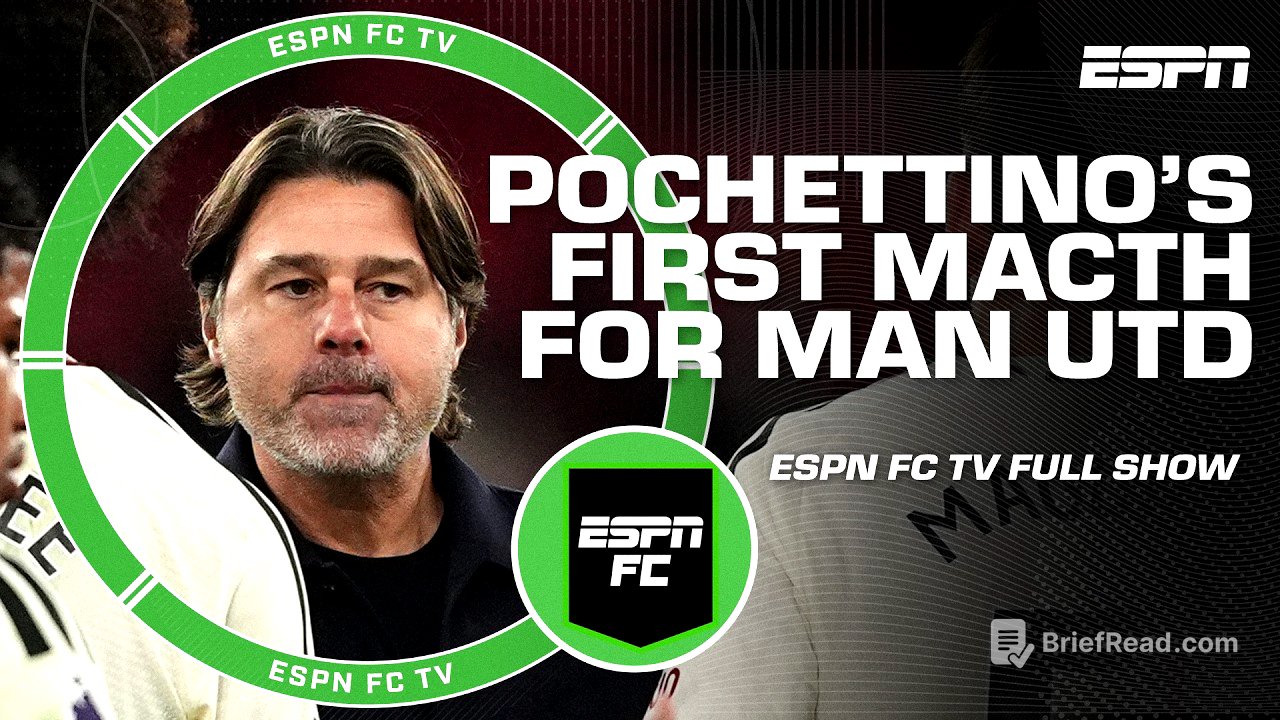
Liverpool thrashed Manchester United 4–0 at Anfield, exposing serious problems in United’s defence despite Mauricio Pochettino taking charge for his first match. Barcelona recovered from an early 2–0 deficit to beat Villarreal 3–2, though their defensive risks and penalty-taking uncertainty remained concerns. Inter Miami lost 3–0 to Columbus Crew in the MLS play-offs after going down to ten men; the panel strongly argued that a throw-in incident involving Lionel Messi should have resulted in a red card. The discussion also covered United’s need for defensive reinforcements, Juventus’s financial constraints, Chelsea’s squad problems and Como’s promising football under Cesc Fàbregas.
- Liverpool’s win lifted them into fourth, while United remained second from bottom.
- Barcelona stayed three points clear of Real Madrid after a spirited comeback.
- Columbus Crew took a 1–0 lead in the best-of-three play-off series against Inter Miami.
Liverpool vs. Man United [0:00]
Liverpool won 4–0 in Mauricio Pochettino’s first match as Manchester United manager. The victory put Liverpool fourth and left them one point off second, while United stayed second from bottom. Liverpool controlled the match, particularly after United were reduced to ten men, and created enough chances to score seven or eight. Steve Nicol viewed the result as a useful win for Liverpool but said it revealed how disorganised and slow United’s defence was.
The panel disagreed over whether the early sending-off was justified. Nicol argued that the attacker’s first touch meant a Liverpool player was likely to reach the ball, so the incident did not deny a clear goalscoring opportunity. Gab Marcotti and Stewart Robson favoured a red card, pointing to the defender’s unnecessary challenge from behind and its danger. Robson also criticised United’s selection and positioning, especially Diogo Dalot’s return after a long injury absence. He said Dalot did not appear physically or mentally ready, while United’s back four lacked organisation and confidence.
The discussion broadened to United’s club-wide problems. Marcotti argued that changing managers alone would not fix the club: its medical, fitness and sporting processes also needed scrutiny. Robson called the squad relegation-quality and warned that United were poor both individually and collectively, while Marcotti cautioned against declaring a relegation battle too early. He expected Pochettino to improve their position, but said the club needed to assess its leadership and recruitment as well as support the manager in January.
The panel also debated whether Liverpool could finish second. Robson felt their attacking options, improving midfield and defensive solidity gave them a strong chance, especially as other contenders were faltering. Nicol argued that Liverpool were not yet a complete side and questioned whether they were better than Brighton. Marcotti described the season as a transition project under manager Iraola: staying in the top four and building a stronger team could matter more than finishing second rather than third. He added that Liverpool would need to make difficult decisions about their midfield and squad as they develop.
Barcelona vs. Villarreal [19:14]
Barcelona beat Villarreal 3–2 after falling 2–0 behind in the opening ten minutes. Eric García said Villarreal had prepared well to press early and made the most of their chances, while Barcelona needed to learn from a poor opening period. He felt the team improved when it returned to its intended style and played with greater passion.
Robson remained concerned despite the comeback. Barcelona’s passing and movement lacked their usual sharpness in the first half, and Raphinha was not making the runs he had shown earlier in the season. The team improved after the break: Pedri took control, Frenkie de Jong was excellent carrying the ball out from defence into midfield, and the substitutes added energy. However, Barcelona’s defensive setup remained vulnerable, particularly with De Jong playing at centre-back, and stronger opponents could punish similar mistakes.
Raphinha’s penalty miss prompted discussion about who should take Barcelona’s spot-kicks. Hansi Flick said the players had decided on the pitch and that he would speak with them about how to handle penalties in future. Nicol said every penalty mattered and argued for a designated taker, with backups established in advance. Robson suggested Raphinha might have lacked confidence because he was not playing at his best; he stressed that the winger had been crucial to Barcelona and hoped his excellent early-season form would return.
Marcotti saw the performance as a return to normal levels after an exceptional start, rather than a temporary blip. Barcelona’s attacking approach produces strong chances but also carries defensive risks, and the contrast between their expected goals and Villarreal’s two goals illustrated the role of variation in a match. He considered De Jong’s centre-back role an emergency measure and said these uneven performances were part of the cost of Barcelona’s high-output style.
Inter Miami’s 3–0 loss [25:48]
Inter Miami lost 3–0 to Columbus Crew in the opening match of their best-of-three MLS play-off series. Lionel Messi had just received his second consecutive MLS Golden Boot. Columbus took an early lead from a penalty, and Inter Miami were later reduced to ten men after a challenge by Luján. The panel thought that incident warranted a yellow card rather than a red. Columbus added two more goals in the second half, leaving them one win ahead in the series.
The main dispute concerned a player throwing the ball towards Messi as he tried to take a throw-in quickly. Nicol said it was a clear red card, and Marcotti agreed, arguing that deliberately throwing the ball at an opponent should be punished regardless of whether the action was violent. Robson also supported that view, saying the player had already put the ball into Messi’s face and appeared frustrated.
Marcotti warned that failing to send the player off could fuel claims that referees apply different standards to Messi than to other players. He said inconsistent decisions can encourage conspiracy theories about whether the league protects its biggest star. The panel therefore focused not only on the incident itself, but also on the importance of applying the rules consistently.
Extra Time [29:24]
The panel considered what Manchester United must achieve for Pochettino to remain in charge next season. Marcotti suggested that a top-eight finish should be the target, assuming the club brings in reinforcements in January, while stressing that the decision should also account for performance and progress. Robson said defence must be the priority: United needed stronger centre-backs and more defensive athleticism in midfield, as well as a clearer structure.
Marcotti explained why Juventus can struggle to spend at the level of clubs such as Bayern Munich and Paris Saint-Germain. Those clubs can plan with greater certainty because they regularly qualify for the Champions League, whereas several Serie A sides compete for a limited number of places. He also attributed Juventus’s financial restrictions to past overspending and poor decisions, including expensive signings and the loss of young players who might have generated transfer income. By contrast, Bournemouth’s strategy of buying young players and developing or selling them was presented as more sustainable.
The conversation then turned to players returning after long-term injuries. Robson described his own recovery from an 18-month absence: he returned only after getting himself fit, but began to tire after four or five weeks of regular matches and needed time to recharge. He said a player must be mentally as well as physically ready, and felt that De Ligt looked hesitant and focused on getting through matches rather than influencing them.
Marcotti said Chelsea’s problems reflected a poorly constructed squad, individual errors and vulnerability in midfield. When Moisés Caicedo came off injured, opposition attacks had too much space in transition, while Leeds had also played particularly well. Finally, he judged Como’s footballing prospects sustainable, especially within Serie A, but warned that financial-rule breaches and fines could lead to sporting consequences. He singled out manager Cesc Fàbregas for improving an otherwise average squad, with Nico Paz standing out as an exceptional talent and younger players continuing to develop.