TLDR;
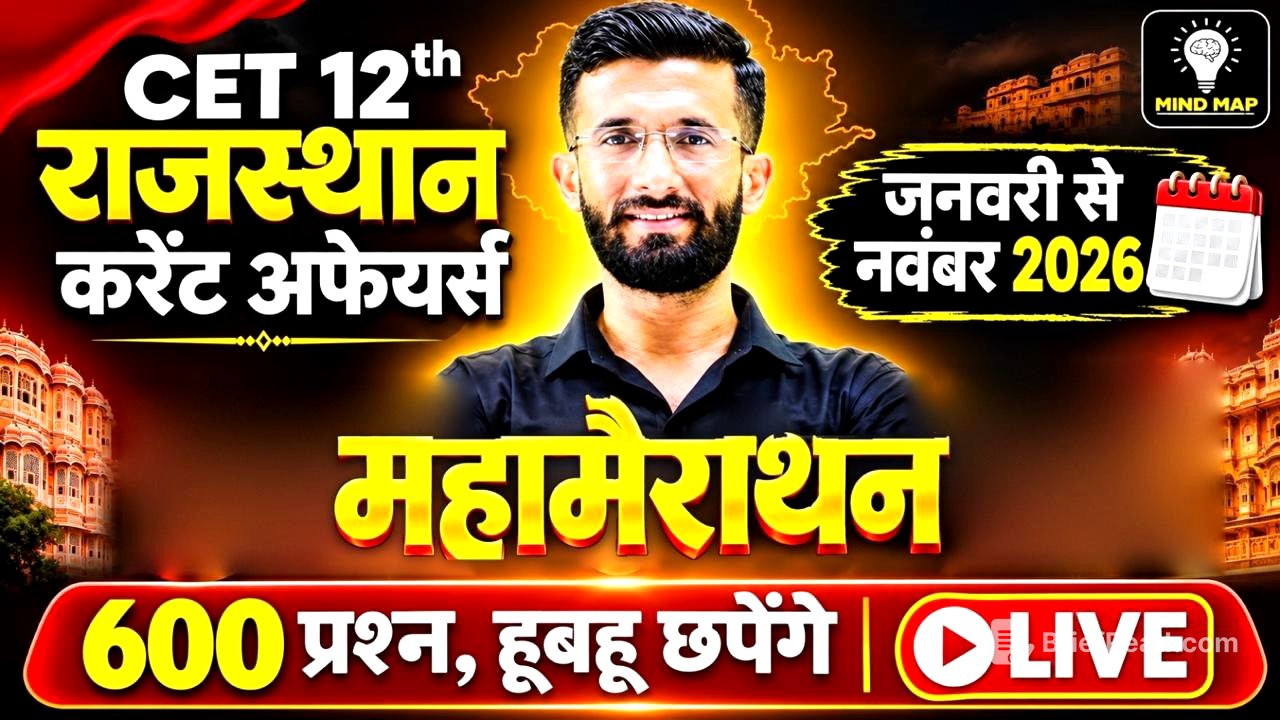
This marathon revises Rajasthan current affairs from January to November 2026 for competitive exams, covering government schemes, awards, appointments, infrastructure, environment, tourism, culture and sport. It places particular emphasis on newer developments, notable firsts, key dates and figures, and Rajasthan-specific facts that may appear in exam questions.
- Major themes include Rajasthan’s development policies, public services, energy projects, transport and environmental initiatives.
- The revision also covers important people, cultural events, sporting achievements and rankings.
- The instructor stresses revising the final months especially carefully, while still reviewing earlier current affairs.
Exam Revision Guidance and January Current Affairs [0:11]
The session begins with exam preparation advice: revise the available Rajasthan and India general-knowledge material, and focus on understanding and remembering key facts. The instructor presents a rapid-fire revision of Rajasthan current affairs from January, noting that schemes, awards, important locations, themes and recent developments are common exam topics.
January’s topics include the Jodhpur Mojari receiving Rajasthan’s 24th Geographical Indication (GI) tag, the road safety month theme, the Green Credit Voucher Initiative, and the Pachpadra refinery’s capacity and ownership shares. Other facts include Jaipur’s Khati-pura high-tech railway terminal, the Jaipur Police’s Najar app award, the first defect-free electricity distribution company, and IIT Jodhpur’s hydrogen innovation cluster.
The revision also covers events and locations such as Rajasthan DigiFest, a Napier-grass-based bio-CNG plant in Barmer, the vehicle-scrapping policy, and the disaster data recovery centre in Jodhpur. It highlights Piplantri village in Rajsamand, known for planting 111 trees after the birth of a girl, and Bamanwas Kankad in Kotputli-Behror, described as Rajasthan’s first fully organic village. Further topics include the PM-JANMAN scheme and the Sahariya community in Baran, Rajasthan’s major festivals, and the National Camel Festival in Bikaner.
The month’s other key facts include the Chief Minister’s Youth Self-Employment Scheme, which offers interest-free loans to eligible young people; Rakshita Rathore’s appointment as the Indian Navy’s first technical woman officer from Rajasthan; Rajasthan’s export preparedness ranking; grain ATMs in pilot districts; and appointments to the High Court. The instructor also reviews awards, the Jaipur Literature Festival, Army Day events in Jaipur, renewable-energy projects, new crop varieties, nutrition initiatives, the Kumbhalgarh sanctuary’s eco-sensitive zone, and Rajasthan’s semiconductor and aerospace policies.
February Current Affairs: Local Government, Wildlife and Sport [59:11]
February begins with policy updates and local-government facts. The session gives Rajasthan’s figures for gram panchayats, panchayat samitis and district councils, and notes the increase in elected representatives’ honorariums. It also covers compensation for deaths caused by human–wildlife conflict, dedicated Ram Ashray wards for older patients, and Rajasthan’s performance under the Pradhan Mantri Matru Vandana Yojana.
Wildlife and conservation questions include the transfer of a tiger from Pench in Madhya Pradesh to Ramgarh Vishdhari Tiger Reserve in Bundi, the Kumbhalgarh eco-sensitive zone, and sightings of a carnivorous plant and other species in Keoladeo National Park. The session also mentions bird festivals at Keoladeo and Tal Chhapar.
Infrastructure and development topics include the India Stone Mart, a hard-rock block auction in Balotra, rooftop solar installations under the PM Surya Ghar scheme, and a proposed biological park at Kati Ghati in Alwar. It reviews the Rajasthan International Film Festival in Jodhpur, the Rajasthan semiconductor policy and its proposed industrial corridor, and several proposed centres of excellence and cultural panoramas.
The sports section features Rajasthan athletes’ results in archery, boxing, kayaking, para-badminton, powerlifting and other competitions. It also covers the Rajivika agreement with Barefoot College to train rural women as “Solar Didis”, and the state’s military exercises, including Khadak Shakti and operations conducted by the Border Security Force.
March Current Affairs: Policies, Awards and Major Projects [1:47:59]
March’s revision covers literary and cultural awards, including the Sahitya Akademi Award for Rajasthani-language writing, the Jaipur Literature Festival awards, and the Rajasthan Shree Samman. Other notable recognition includes Safina Husain’s inclusion in the TIME Women of the Year list and awards received by Rajasthan’s housing and startup sectors.
The session reviews Rajasthan Day events, including the state celebrations held from 14 to 19 March, with the concluding programme in Jalore. It also discusses sustainable-development rankings, agricultural land-management carbon projects, the Rajasthan Startup Summit, the second Ayurveda university planned for Ajmer, and a proposed greenfield airport at Shambhupura in Kota.
Major infrastructure and public-policy topics include the Jaipur Metro extension, a regional AI conference, a proposed water-management centre of excellence, and policies for semiconductors, aerospace and defence. The instructor also covers the Vande Ganga water-conservation campaign, the Parvan–Akawad drinking-water project and its beneficiary districts, and plans for industrial parks.
The month’s sports and public-service facts include Rajasthan athletes’ international achievements, the first integrated soldiers’ welfare complex in Didwana-Kuchaman, the first lacrosse academy in Udaipur, and the Rajasthan government’s “Raj Savera” programme to prevent drug use. The session additionally reviews revised panchayat-election rules, including the removal of the disqualification linked to having more than two children.
April Current Affairs: Education, Environment and New Initiatives [2:57:28]
April’s rapid revision includes awards, health and education initiatives, environmental developments and sporting achievements. The Rajasthan Shiro-mani award went to folk singer Anwar Khan Manganiyar, while Jaipur and Jodhpur were identified as high-risk cities for groundwater management. The eighth Poshan Pakhwada ran from 9 to 23 April, focusing on brain development during the first six years of life.
The session covers the Rajasthan government’s “Dream” education and employment initiative, the selection of 400 schools for the CM Rise programme, and the “School on Wheels” initiative under the Raj Pahal programme. It also reviews the Lado Protsahan Yojana, which provides financial support to girls through seven instalments, and explains its eligibility conditions.
Sports coverage includes medals won by Rajasthan athletes in archery, boxing, kayaking, para-badminton, shooting and other competitions. The instructor also mentions the first women’s professional kabaddi league in Rajasthan, the Jaipur athlete Krishna Nagar’s achievements, and the selection of Rajasthan players for national teams.
Other April topics include the Jaipur Literature and travel events, the first free-Wi-Fi city initiative in Kekri, the world’s smallest gold table-tennis set made by Iqbal Sakka, and new educational and technology projects. The session also covers Rajasthan’s highways modernisation programme, the Vande Bharat train trial, clean-energy projects and new tourism facilities.
May Current Affairs: Industry, Conservation and Rural Development [3:53:20]
May’s revision begins with the Brahmagupta Awards, named after the mathematician associated with Bhinmal in Jalore, and the achievement of chess player Dakshita Kumawat. It also covers Rajasthan’s first high-tech park library, the state’s performance in the Panchayat Advancement Index, and awards connected to tobacco control and Rajasthani literature.
Industrial and environmental developments include Rajasthan’s first semiconductor plant at Khushkhera in Alwar, the state’s new Assembly emblem, and the proposed artificial lake in Jaisalmer. The session discusses a goat bank in Jaisalmer intended to reduce conflict between people and wildlife, as well as the establishment of a regional centre for conservation and research.
The instructor reviews the Vande Ganga water-conservation campaign, its launch at Bisalpur and its conclusion at Budha Pushkar. Other village-related topics include Deepawas in Sikar as a water-conservation model village, Piplantri’s tree-planting tradition, and villages recognised for renewable energy, carbon neutrality and waste management.
Further topics include the Pachpadra refinery, Rajasthan’s milk and wool production rankings, the proposed matikala centre of excellence at Bichoon near Jaipur, a goat-milk soap and shampoo plant in Sojat, and the country’s first panchagavya medical course in Jodhpur. The month also includes military exercises, the environmental day campaign, and the opening of women’s facilities at a border post.
June Current Affairs: Energy, Transport, Health and Wildlife [4:55:44]
June’s revision focuses on government services, public transport, energy and health. The Rajkaj digital platform had connected 71 administrative departments, while the PM e-Bus service was planned for nine cities, with Jaipur receiving the largest number. The session lists the planned distribution of 1,150 electric buses across Jaipur, Jodhpur, Bikaner, Kota, Alwar, Ajmer, Udaipur, Sikar and Bhilwara.
Other public-service topics include Rajasthan’s ranking in ABHA health-ID creation, the PM Street Vendor scheme’s extended term, and the state’s first organised goat-milk soap and shampoo plant in Sojat. The instructor also reviews the proposed Kota-Bundi greenfield airport, the revised pension amount, and the use of high-security registration plates.
Environmental and scientific developments include new species discovered in the Thar, a rare sand boa sighting after a long gap, a new gecko species, and turtle surveys at Keoladeo National Park. The session also covers the “One Tree for Mother” campaign, launched in Jaipur, and the Vande Ganga campaign’s water-conservation message.
The sports and awards section includes achievements in yoga, archery, cycling, wrestling and cricket, alongside the selection of Rajasthan athletes for the 2028 Los Angeles Olympics. It also mentions Rajasthan’s first Vande Bharat sleeper maintenance depot, the largest goat-semen laboratory in Ajmer, and projects connected with rare-earth minerals and solar energy.
July Current Affairs: Industry, Agriculture and Public Services [5:50:47]
July’s topics include Rajasthan’s industrial development policy and its four strategic pillars: green growth, governance, globalisation and related development measures. The instructor also reviews the state’s economic targets, new industrial clusters, a proposed industrial corridor and plans to develop textile exports through a dedicated state-level cell.
Public-health and social initiatives include the Prasav Sakhi scheme for high-risk pregnancies, the Roshan campaign against anaemia in Sirohi, and the state’s aim to become tuberculosis-free by 2030. The session also covers the Mission Madhuhaari programme, which supports people with diabetes and aims to prevent child deaths from Type 1 diabetes.
Agricultural and infrastructure topics include the expansion of solar power in Bikaner, a new automatic seed plant in Kota, irrigation projects, and a milk-processing plant planned for Jaipur. It also reviews the state’s proposed urban-development programme, new municipalities, road modernisation and the Namo Bharat corridor.
Other facts include the first AI-based centre of excellence in western Rajasthan, a proposed observatory for astronomy tourism in Bikaner, new rules on wages and mining, and the state’s performance in several national schemes. The month’s sports and wildlife questions include sightings of rare species and athletes’ national and international results.
August Current Affairs: Elections, Schemes and Rajasthan Rankings [6:21:22]
August focuses on policy changes, elections, awards and state rankings. The Rajasthan State Backward Classes Commission, chaired by Madan Lal Bhati, submitted its report on reservation for Other Backward Classes (OBCs). The session also covers the “One State, One Election” model and the state’s food-park development policy.
The revision gives figures for urban local bodies, including municipal corporations, councils and municipalities, and explains the spending limits for candidates in local elections. It also covers Rajasthan’s tree-protection legislation, which includes 29 tree species, and the “Mission Madhuhari” programme for fatty-liver and diabetes support.
Other government initiatives include the PM Setu skills programme, healthcare centres under Ayushman Arogya Mandir, the “Shishu Sanjeevani” nutrition programme, and the “Sutra” urban-development project supported by the World Bank. The session also reviews programmes for tribal children, industrial development and digital administration.
Awards, appointments and rankings include Rajasthan’s results in the tobacco-control programme, tourism rankings for Udaipur and Jaipur, the state’s performance in PM-KUSUM, and several literary and sporting awards. The instructor highlights new species, wildlife projects, the Shishuvani helpline and developments in solar and clean-energy storage.
September Current Affairs: Governance, Environment and Major Appointments [6:55:13]
September’s revision covers new policies, including the Rajasthan Food Park Development Policy, the agriculture and food-processing policy, and the PM Setu scheme. It also reviews the “Adopt a Heritage” programme, which allows organisations to support the upkeep of forts, palaces and stepwells.
The session discusses Rajasthan’s farmer-registration ranking, rural development initiatives, oil and gas production, and the state’s involvement in the Kishau multipurpose project. It explains the state’s status in crude-oil and natural-gas production, and identifies major petroleum basins and production locations.
Other topics include a new wages code, the first indigenous-breed excellence centre in Sanderav, the Vande Bharat freight-train trial, and the 29 species protected under the Rajasthan Tree Protection Bill. The revision also covers new appointments, including a Rajasthan High Court chief justice, a woman officer appointed as the President’s aide-de-camp, and university leaders.
The instructor highlights notable Rajasthani personalities, national awards, teachers recognised at national level, and sports achievements. The session also includes the Shekhawati havelis’ inclusion on a UNESCO tentative list, new wildlife sightings, and the “Setu Referral” app for monitoring patients transferred between medical institutions.
October Current Affairs: Awards, Festivals and Conservation [7:44:15]
October’s revision covers national awards received by Rajasthan departments and institutions, including recognition for school education, energy, local-fund auditing and tobacco control. The session also reviews the Eco-Warrior awards, the Dhanvantari awards for Ayurveda, and the Ustad Bismillah Khan Yuva Puraskar for folk musicians.
Cultural and literary topics include the Rajasthan Film Festival, the second Pravasi Rajasthani Diwas, the Jaipur International Film Festival, and several awards for Rajasthani writers and performers. The instructor also explains the “Pratibha” scheme, which identifies sports talent among children aged 8 to 14 and tracks development through the Khel Mitra portal.
The session covers the first distribution-transformer-level sodium-ion battery pilot project in Jaipur, manuscript digitisation under the Gyan Bharatam Mission, and new tourism and environmental initiatives. It also reviews Rajasthan’s ranking in the national Poshan month and HPV vaccination campaign, and the state’s performance in water conservation.
Further topics include military exercises, new species, the launch of a fertiliser-sales app, the “Godaavan” rewilding aviary, and public-policy updates. The month’s key takeaways include the importance of remembering event venues, editions, award recipients and scheme objectives.
November Current Affairs and Final Revision [8:21:23]
The final section briefly reviews November developments, including police medals, a wolf-conservation project in the Hadoti region and literary figures from Rajasthan. It also revisits the ceramic-storage solar project at Bhadla, Rajasthan’s first uranium plant proposed at Rohil in Sikar, and the appointment of young elected representatives.
Other facts include Rajasthan’s first transgender sarpanch, the state’s dry port near Hirnoda, the transfer of railway cargo operations, and Rajasthan athletes’ achievements in Asian competitions. The session also mentions the world’s largest shelter home in Bharatpur, the appointment of Rajasthan officials to national roles, and awards for athletes and coaches.
Throughout the marathon, the instructor repeatedly recommends giving greater attention to recent months, especially September and October, while still revising earlier developments. The revision’s overall method is to memorise high-value facts—names, dates, districts, rankings, themes, capacities and policy provisions—and distinguish similar places or schemes that may appear as confusing exam options.