TLDR;
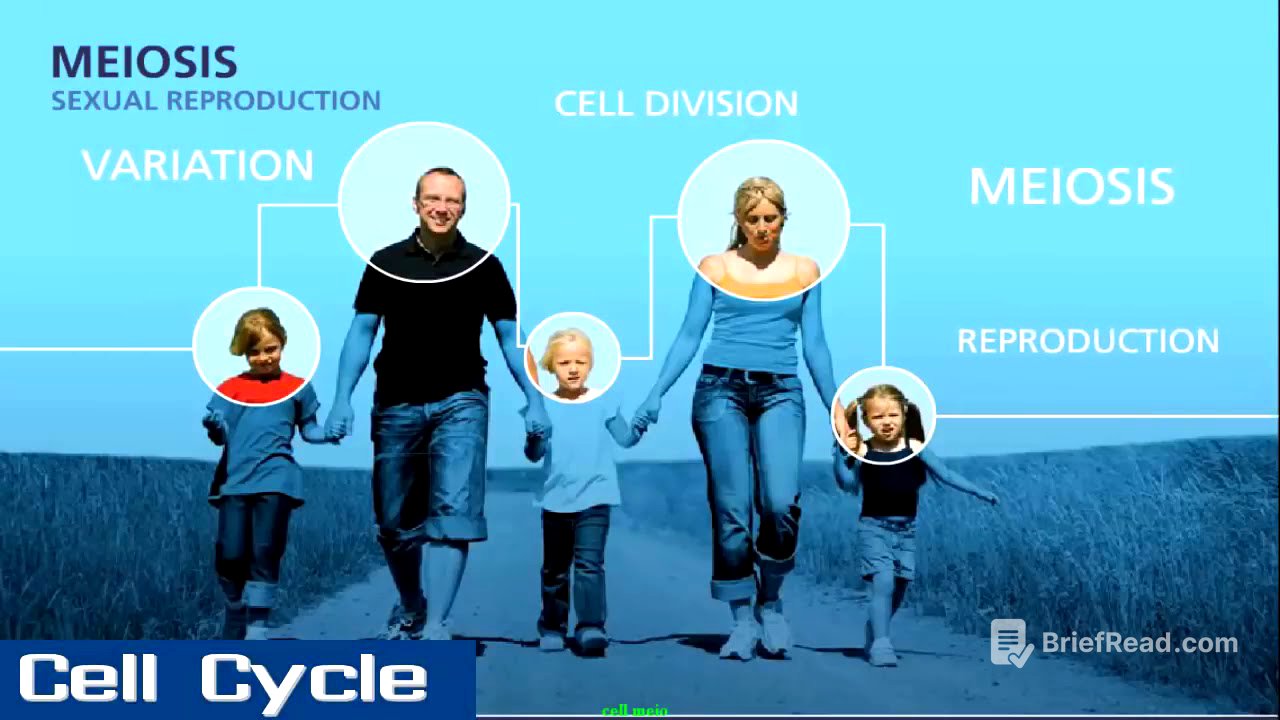
This video explains the process of meiosis, highlighting how it generates genetically unique gametes and contributes to genetic diversity. It details the two rounds of meiotic division, contrasting them with mitosis, and explains the significance of crossing over and independent assortment in creating diverse offspring. The video also clarifies why siblings, despite sharing parents, exhibit different traits due to these genetic variations.
- Meiosis produces four haploid cells from a diploid cell through two rounds of division.
- Crossing over and independent assortment during meiosis increase genetic diversity.
- Genetic diversity explains why children don't look exactly like their parents or siblings.
Introduction to Meiosis [0:00]
The video introduces meiosis as the process that generates gametes for reproduction, explaining why children don't look exactly like their parents or siblings. Meiosis involves the production of haploid cells from a diploid cell, requiring the correct sorting and distribution of chromosomes to create genetically unique cells with half the number of chromosomes as the original cell. This process occurs in germ cells within the gonads and necessitates two rounds of divisions, termed meiosis 1 and meiosis 2, to successfully reduce the number of chromosomes in the new haploid daughter cells.
Meiosis vs. Mitosis [0:49]
While mitosis and meiosis appear similar, mitosis results in two diploid daughter cells, whereas meiosis results in four haploid cells. Meiosis begins after a cell has completed the G1, S, and G2 stages of interphase, similar to mitosis. During the S phase, DNA is replicated, producing sister chromatids, and centrioles duplicate, extending microtubules to form the mitotic spindle. Sister chromatids remain attached at the centromere and condense as the cell enters prophase one of meiosis.
Prophase 1: Synapsis and Crossing Over [1:43]
Up to prophase 1, the cell looks similar to mitosis, but two unique events occur that lead to genetic diversity. The first event is synapsis during prophase 1, where homologous pairs of sister chromatids lie side by side, forming a tetrad or bivalent. The second event is crossing over, where a physical exchange between chromosome segments of non-sister chromatids occurs, increasing genetic diversity. Prophase one concludes with the fragmentation of the nuclear envelope as centriole pairs move to opposite poles, extending spindle fibres to form the mitotic spindle.
Prometaphase 1 and Metaphase 1 [2:46]
In prometaphase 1, the mitotic spindle is fully formed with paired centrioles in place. Sister chromatids attach to spindle fibres via kinetochores. A key difference between mitosis and meiosis is that, due to synapsis and crossing over, homologous chromosomes remain aligned, so a pair of sister chromatids is attached to only one pole by the kinetochore microtubules. During metaphase 1, bivalents randomly align along the metaphase plate due to independent assortment, further enhancing genetic diversity.
Anaphase 1, Telophase 1, and Meiosis 2 [3:36]
In anaphase 1, homologous chromosomes separate and move toward opposite poles. Meiosis 1 ends with telophase 1, where chromosomes decondense, the nuclear envelope reforms, and cytokinesis separates the cytoplasmic material, resulting in two haploid daughter cells. Meiosis 2 begins without another round of DNA replication. Centrioles duplicate and move to opposite poles. Prophase 2 sees sister chromatids condense and the spindle start to form as the nuclear envelope disappears.
Prometaphase 2, Metaphase 2, Anaphase 2, and Telophase 2 [4:21]
In prometaphase 2, sister chromatids attach to the spindle by kinetochore microtubules, with sister chromatids attached to opposite poles. During metaphase 2, the spindle aligns the sister chromatids along the metaphase plate. In anaphase 2, sister chromatids separate, and individual chromosomes move toward the poles. The process concludes with telophase 2, where chromosomes decondense, the nuclear envelope reforms, and cytokinesis separates the two daughter cells into four haploid daughter cells.
Gamete Formation and Genetic Diversity [5:02]
The haploid daughter cells specialise into gametes (sperm or egg), which fuse during fertilisation to form a zygote that grows into a child. The child receives half its chromosomes from each parent. Men and women produce millions of gametes, and the selection of gametes in fertilisation is random, contributing to genetic diversity and explaining why a child isn't identical to either parent.
Sources of Diversity: Crossing Over and Independent Assortment [5:30]
Diversity arises from several sources. In prophase one, non-sister chromatids exchange DNA through crossing over, increasing the genetic diversity of individual chromatids. Additionally, in metaphase one, pairs of homologous chromosomes align independently along the metaphase plate and sort independently into daughter cells, a process called independent assortment.
Calculating Genetic Diversity [6:01]
Independent assortment produces four genetically distinct haploid gametes. As the total number of chromosomes increases in an organism, the number of genetically distinct gametes increases by 2 to the nth power. For humans, with N equals 23, there are 2 to the 23rd power unique gametes formed, resulting in over a million different possible combinations.
Conclusion: Genetic Variation [6:29]
The combination of independent assortment, crossing over, and the random pairing of gametes during sexual reproduction increases genetic diversity. This explains why a child will not look exactly like his or her parents or siblings.