TLDR;
This video provides an overview of the hip, knee, and ankle joints, detailing their structure, movements, and functions. It explains how each joint contributes to overall mobility and stability, highlighting the importance of ligaments and synovial fluid in maintaining joint health.
- The hip joint is a stable ball-and-socket joint that allows for flexion, extension, adduction, abduction, and rotation.
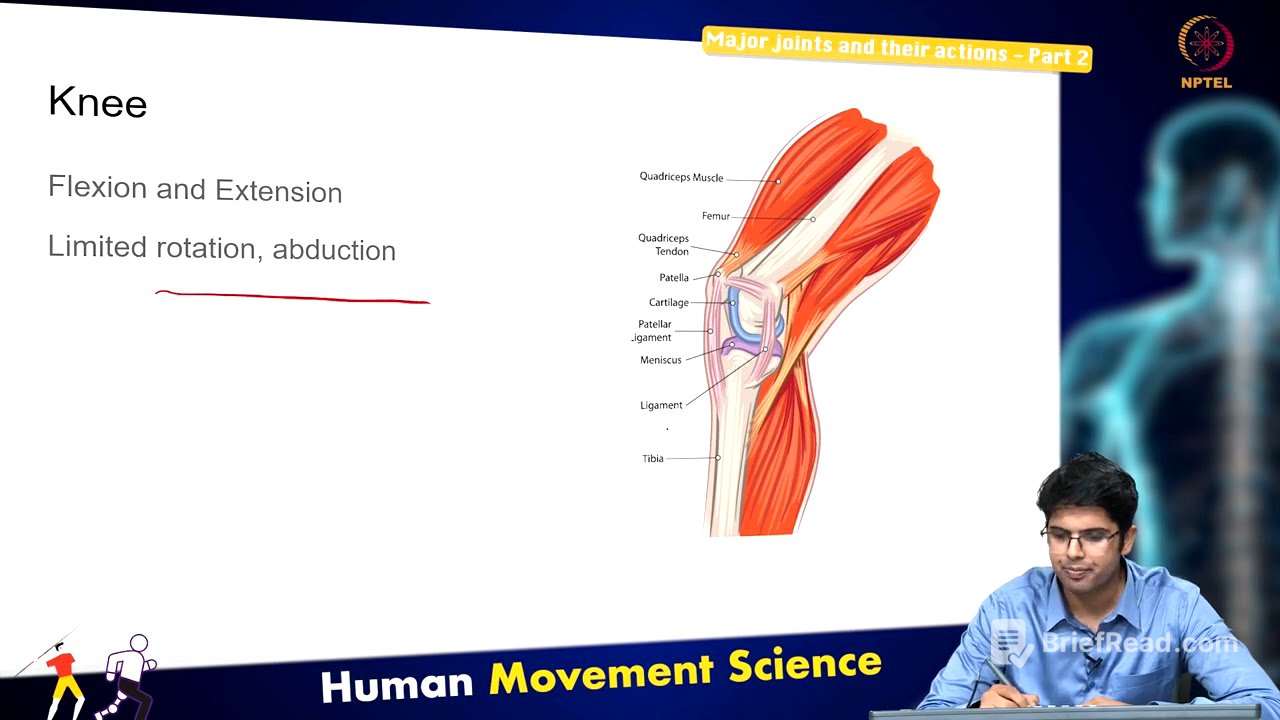
- The knee joint is primarily a hinge joint, facilitating flexion and extension, and is stabilised by four cruciate ligaments.
- The ankle joint, or talocrural joint, is a complex hinge joint that enables plantar flexion, dorsiflexion, eversion, and inversion, crucial for adapting to varied terrains.
Hip Joint [0:00]
The hip joint, a ball-and-socket synovial joint connecting the femur to the pelvic bone, is crucial for stability and movement. Unlike the shoulder joint, the hip prioritises stability over a wide range of motion, providing hard stops and limits to prevent overextension. The hip joint facilitates movements such as flexion (bringing the thigh towards the chest), extension (moving the thigh backward), adduction (bringing the leg towards the midline), and abduction (moving the leg away from the midline). Horizontal abduction and adduction, along with internal and external rotation, contribute to dynamic activities like changing directions in sports. Combining these movements results in circumduction, allowing for full 3D movement.
Knee Joint [6:07]
The knee joint, formed by the femur, tibia, and patella, is a synovial joint stabilised by four cruciate ligaments: the anterior cruciate ligament (ACL), posterior cruciate ligament (PCL), medial cruciate ligament (MCL), and lateral cruciate ligament (LCL). The primary movements of the knee joint are flexion and extension, essential for walking, running, and maintaining dynamic stability. While the knee joint primarily functions as a hinge joint, it also allows for limited rotation and abduction. The cruciate ligaments form a tight structure that prevents sideways movement, and injuries can occur if these ligaments are overloaded, leading to tears and instability.
Ankle Joint [10:55]
The ankle joint, also known as the talocrural joint, is a synovial joint connecting the tibia and fibula to the talus of the foot. It is a complex hinge joint that allows for movements in the sagittal plane, including plantar flexion (downward movement) and dorsiflexion (upward movement). Plantar flexion is critical for generating propulsive force during walking and running, while dorsiflexion helps adjust the foot's position. Additionally, the ankle joint enables eversion (movement away from the body's centerline) and inversion (movement towards the centerline), allowing adaptation to rough terrain. These movements can be combined into a rotation, facilitating navigation over uneven surfaces.