TLDR;
This video provides an overview of major joints in the human body and their functions, focusing on the neck, shoulder, elbow, and wrist joints. It explains the structure of these joints, the types of movements they allow, and their roles in daily activities and sports. The importance of muscles in stabilising and controlling these joints is also highlighted.
- Joints enable movement or form rigid structures.
- Synovial joints have a synovial cavity filled with lubricating fluid.
- The shoulder joint is the most mobile joint in the body.
- The elbow joint primarily acts as a hinge joint.
- The wrist joint allows for flexion, extension, abduction, and adduction.
Introduction to Joints [0:17]
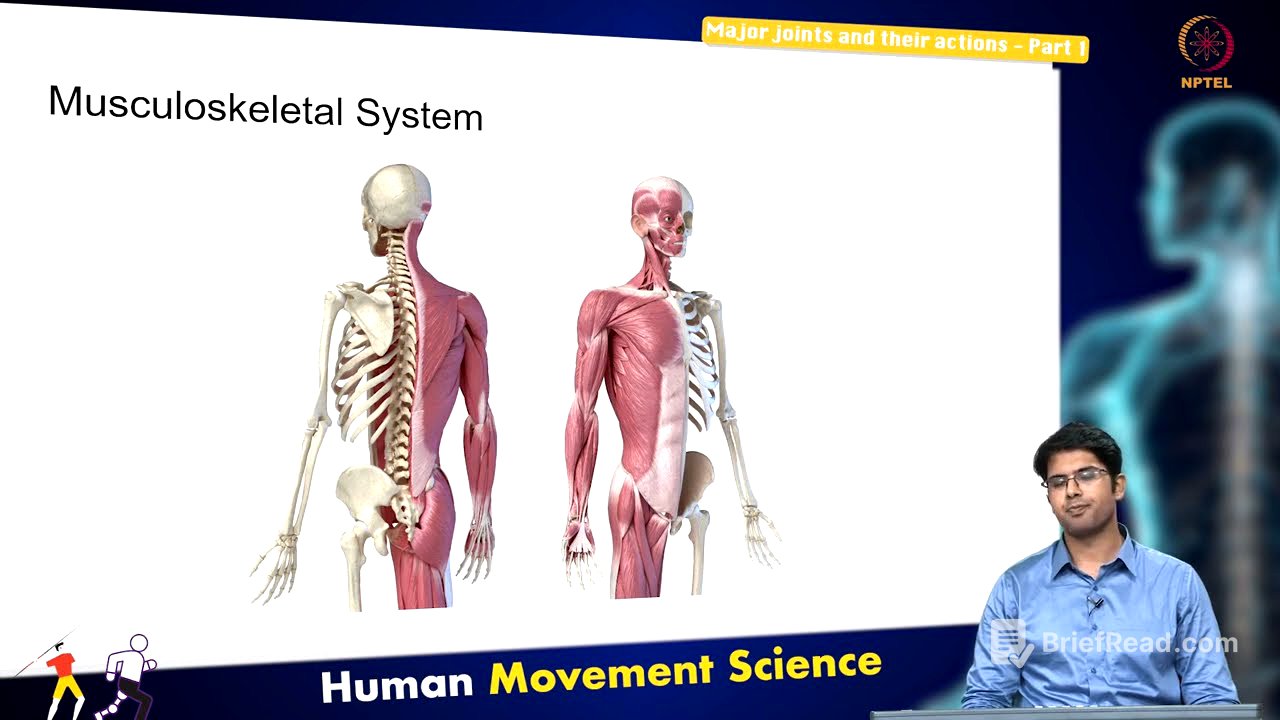
The video introduces the concept of joints as the points of attachment between bones, forming the musculoskeletal system. Joints either enable movement or create relatively closed, rigid structures. The video will focus on joints responsible for the main movements of the body, particularly those involved in daily and sports activities. The discussion will progress from the neck joint down to the shoulder, elbow, wrist, hip, knee, and ankle joints, primarily focusing on synovial joints, which contain a synovial cavity filled with lubricating synovial fluid for efficient movement.
The Neck Joint (Cervical Spine) [2:47]
The neck joint, or cervical spine, comprises seven vertebrae (C1-C7). The first vertebra, Atlas (C1), is ring-shaped and interfaces with the skull, while the second, Axis (C2), allows the Atlas to pivot. The neck joint is a compound-complex structure due to the articulation of the vertebral column, controlled by muscles, nerves, and intervertebral discs. The primary function of the neck is to keep the head upright, enabling interaction with the world. Weak neck muscles can lead to poor posture and altered perception.
Movements of the Neck [4:59]
The neck allows for several movements, including flexion and extension, which involve tilting the head forward and backward in the sagittal plane. Lateral flexion allows for side-to-side movement of the neck, moving the head towards the shoulder in the frontal plane. The neck's stability, provided by muscles and ligaments, is crucial for maintaining an upright head position and interpreting the environment.
The Shoulder Joint (Glenohumeral Joint) [7:25]
The shoulder joint, or glenohumeral joint, is a synovial ball-and-socket joint and the most mobile in the body, attaching the upper limb to the axial skeleton. It is primarily dynamically stable, relying on surrounding muscles for mobility, stabilisation, and movement control. Without muscle support, the limb would simply hang due to external forces.
Movements of the Shoulder [9:00]
The shoulder joint allows for flexion and extension in the sagittal plane, moving the shoulder forward and backward. Abduction is movement away from the body, while adduction is movement towards the body's centre line in the frontal plane. Internal and external rotation involve rotation along the humerus axis, engaging different muscle actions. Horizontal abduction moves the arm away from the body, and horizontal adduction moves it towards the front of the body.
The Elbow Joint [11:54]
The elbow joint connects the arm (humerus) and forearm (radius and ulna). It is a synovial joint enclosed by a fibrous capsule, primarily functioning as a hinge joint. While primarily a hinge joint, the elbow also facilitates pronation and supination at the wrist due to the relative movement of the radius and ulna. The elbow joint's dynamic nature and musculature enable it to handle loads during pushing and pulling tasks, maintaining stability through muscle support.
The Wrist Joint (Radiocarpal Joint) [16:09]
The wrist joint, or radiocarpal joint, is located between the distal end of the radius, an articular disc, and three proximal carpal bones. It is a synovial joint that allows for flexion and extension when the palm faces forward. Abduction and adduction of the wrist, also known as ulnar and radial deviation, respectively, enable side-to-side movement. Combining these movements results in circumduction, a rotational motion. The wrist joint itself does not rotate; the rotational motion is due to the nature of the radius and ulna and their connection to the humerus.