TLDR;
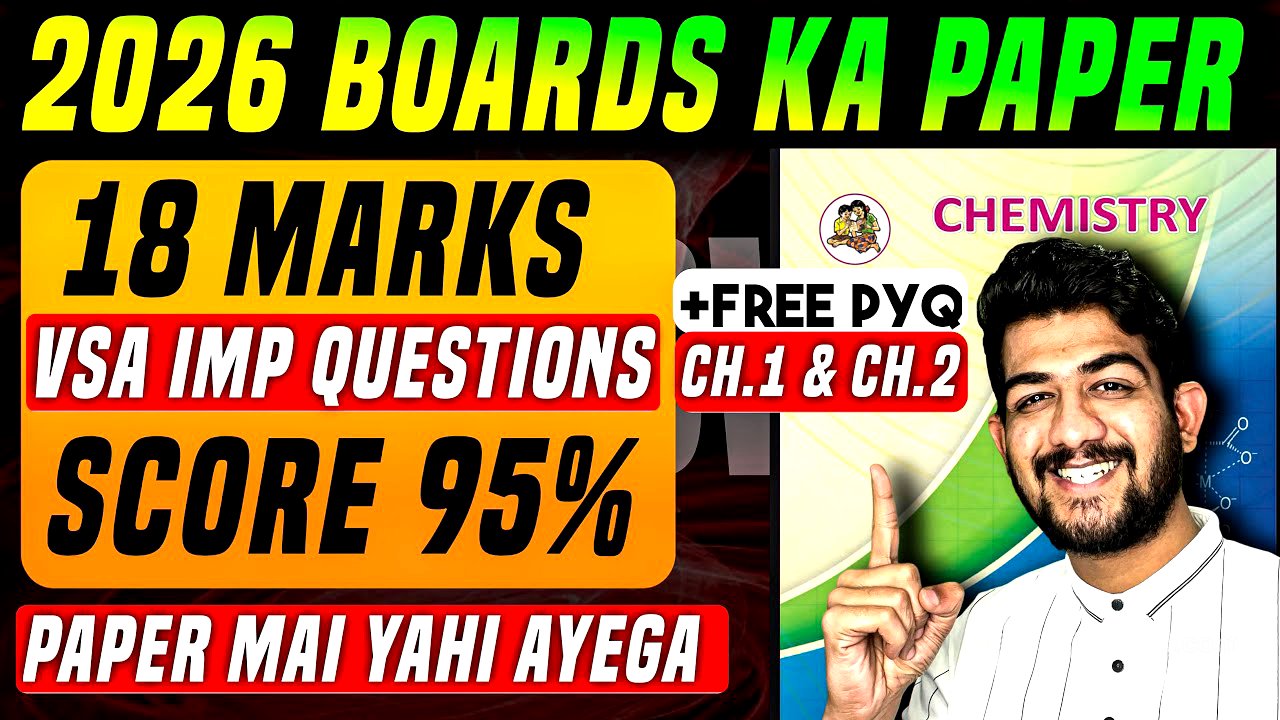
This YouTube video by State Board Wale Bhaiya - SENIORS, led by Ajay Bhaiya, focuses on helping students prepare for their chemistry exams by covering key topics and high-weightage sections. The session aims to cover 18 marks from Section A within eight days, followed by Section C (24 marks). The video includes interactive Q&A, hand-written notes, and a plan to tackle important questions for the upcoming exams.
- Covers key topics and high-weightage sections for chemistry exams.
- Aims to cover 18 marks from Section A within eight days, followed by Section C (24 marks).
- Includes interactive Q&A, hand-written notes, and a plan to tackle important questions.
Introduction [0:02]
Ajay Bhaiya welcomes students to State Board Wale Bhaiya - SENIORS, outlining the session's goal to cover 18 marks of the chemistry syllabus. He emphasises the importance of focusing on high-weightage sections to score well in the exams. He encourages students to engage actively and promises hand-written notes for the session.
Exam Strategy [1:09]
The video highlights that chemistry exams are typically out of 100 marks, with 30 marks allocated for internal assessments and 70 marks for the written paper. The strategy focuses on covering Section C (24 marks) and Section A (18 marks) first, as these have the highest weightage. The presenter guarantees to cover the 18 marks in eight days and will provide important questions for the remaining sections.
Molecular Solids and Crystal Lattices [4:06]
The session includes a series of multiple-choice questions. The first question asks about the nature of molecular solids, with the correct answer being "amorphous". The second question covers the coordination number of atoms in a BCC (Body-Centred Cubic) crystal lattice, which is eight. The presenter emphasises the importance of remembering these facts for the exam.
Radius and Edge Length in FCC [6:02]
The video discusses the relationship between the radius of an atom (r) and the edge length (a) in an FCC (Face-Centred Cubic) unit cell. The correct formula is r = a / 2√2. The presenter corrects students who answer incorrectly, stressing the need to remember the correct formulas.
Substances in Multiple Forms and Crystal Types [7:32]
The session covers substances that exist in two or more forms, which are referred to as "polymorphous". It also identifies graphite as a covalent crystal. Students are encouraged to assess their understanding, and the presenter moves on to more complex questions.
Ionic Compounds and Crystal Structures [8:39]
The video addresses a question about an ionic compound that crystallises in an FCC structure. The correct formula for the compound is A3B. The presenter then discusses the relationship between edge length and radius in a simple cubic lattice (SCC), where a = 2R.
Frenkel and Schottky Defects [10:01]
The session explains Frenkel defects, noting that the overall electrical neutrality is preserved. It also covers Schottky defects, which are observed in calcium chloride. The presenter reiterates the importance of remembering coordination numbers in BCC structures.
Polymorphism and Types of Particles [11:47]
The video defines polymorphism as a phenomenon where a single substance crystallises in two or more forms under different conditions. It also identifies the types of particles in crystalline solids as atoms, ions, and molecules, explaining each in detail.
Molecular Crystals and Crystal Lattices [13:51]
Molecular crystals are defined as crystals where the constituent particles are molecules held together by intermolecular forces. The presenter uses examples like hydrogen and oxygen molecules to illustrate the concept. Crystal lattices, also known as space lattices, are regular arrangements of constituent particles in three-dimensional space.
Unit Cells and Common Properties of HCP and CCP [17:26]
A unit cell is the smallest repeating structural unit in a crystal lattice. The video also mentions two common properties between HCP (Hexagonal Close-Packed) and CCP (Cubic Close-Packed) crystal lattices: a coordination number of 12 and a packing efficiency of 74%.
Coordination Number of SCC and Metal Deficiency Defects [20:27]
The coordination number of a simple cubic crystal (SCC) is six. The session briefly touches on metal deficiency defects, which occur in compounds showing variable oxidation states, using nickel oxide (NiO) as an example.
Introduction to Solutions [24:03]
The presenter transitions to the topic of solutions, encouraging students to answer questions actively. He provides a Telegram link for students to access the PDF notes from the session.
Solubility and Colligative Properties [25:32]
Among the given options, sodium sulphate (Na2SO4) is identified as the ionic solid whose solubility decreases with an increase in temperature. Colligative properties depend only on the number of solute particles in a solution.
Ebullioscopic and Cryoscopic Constants [27:15]
The ebullioscopic constant is related to the boiling point elevation when the concentration of a solution is 1 molal (small m). The cryoscopic constant depends on the nature of the solvent. Isotonic solutions are defined as solutions having the same osmotic pressure.
Exam Strategy and CET Eligibility [28:55]
The presenter discusses exam strategies, emphasising the importance of securing passing marks. For CET (Common Entrance Test), students need to score above 135 out of 300. Focusing on Section A and key questions can help achieve this.
Osmotic Pressure and Freezing Point [32:16]
When calculating osmotic pressure, the concentration of the solute is expressed in molarity. Among the given solutions, 0.05m of NaCl will have the highest freezing point. The session also includes numerical problem-solving and identifying correct statements related to boiling points.
Relative Lowering of Vapour Pressure [36:15]
The video explains relative lowering of vapour pressure, defining the formula as ΔP/P0. It also discusses why the solubility of gases in liquids depends on pressure, attributing it to the high compressibility of gases.
Point Defects and Hypotonic Solutions [40:39]
Point defects are imperfections in the arrangement of point-like constituent particles. Hypotonic solutions are defined as solutions with a lower osmotic pressure compared to another solution.
Ideal Solutions and Molal Elevation Constant [44:24]
An example of an ideal solution is a liquid mixture of benzene and toluene. The molal elevation constant (Kb) has units of K kg/mol. It is the elevation in boiling point produced by a 1 molal solution of a non-volatile solute.
Cryoscopic Constant and Session Conclusion [50:59]
The cryoscopic constant, also known as the molal depression constant, is the depression in freezing point produced by dissolving 1 mole of solute in 1 kg of solvent. The presenter concludes the session, encouraging students to stay engaged and follow the channel for more updates.