TLDR;
This lecture defines motion using mathematical descriptors such as position, distance, displacement, speed, velocity and acceleration. It explains these concepts with examples, including an athlete's movements and a soccer ball kick, and relates them using equations of motion. The lecture also covers projectile motion, breaking it down into horizontal and vertical components to analyse the motion of a soccer ball.
- Defines motion mathematically using position, distance, displacement, speed, velocity and acceleration.
- Explains the relationship between displacement, velocity and acceleration.
- Introduces equations of motion and their application in projectile motion.
- Analyses a soccer kick example, calculating maximum height, total time of flight and horizontal distance.
Position, Distance and Displacement [0:00]
Motion is defined by changes in position over time and can be mathematically described using position, distance, displacement, speed, velocity and acceleration. Position is the location of an object relative to a reference frame, while distance is the total path travelled. Displacement, on the other hand, is the shortest distance between the initial and final positions. These quantities are typically measured in metres, although other units can be used.
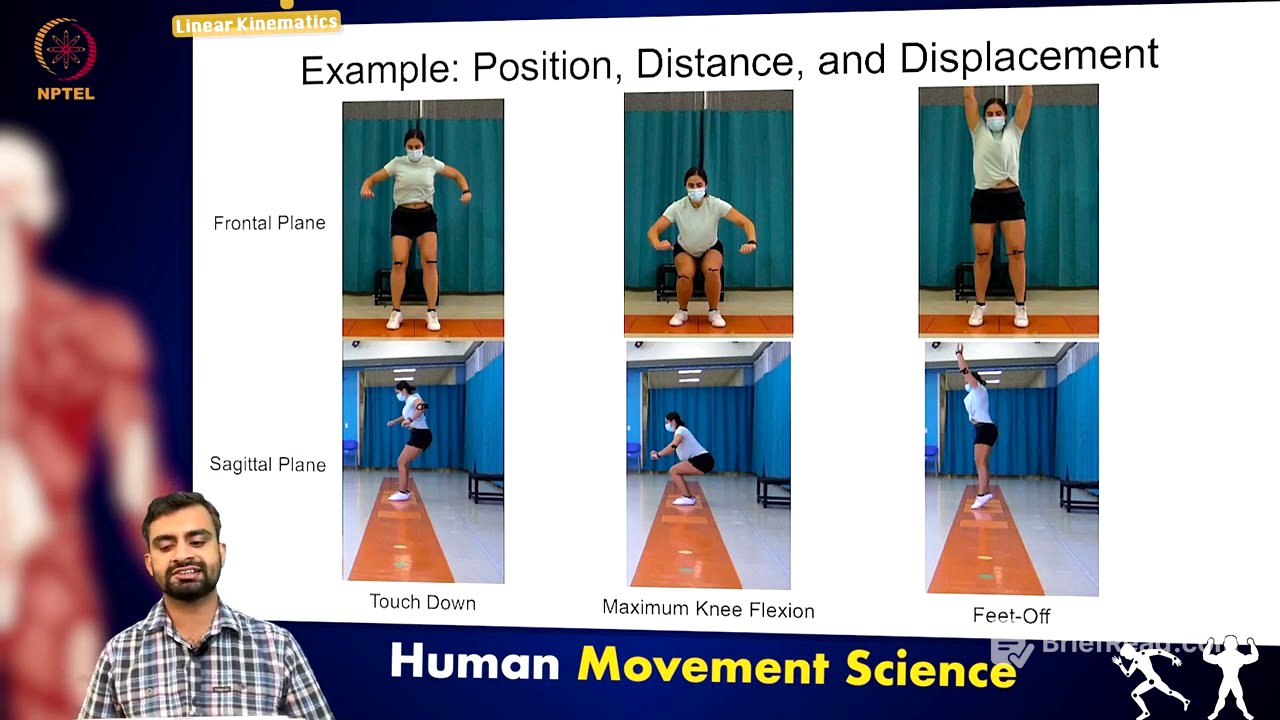
An example is given of a person moving from point A to point B, following a green path. The total distance covered is 160 metres, while the displacement, calculated using the Pythagoras theorem, is approximately 113.14 metres. Another example involves an athlete moving between positions A, B, C and D, illustrating the differences between distance and displacement in one-dimensional motion. The lecture also touches on how these concepts apply to vertical jumps, noting the changing positions of joints like the knee and elbow.
Applying Position, Distance and Displacement [5:37]
The lecture considers a frontal view of a movement, using a reference frame with x and y axes to record 2D coordinates. The location of joints such as the ankle, knee and hip are noted with respect to the origin (0, 0). Coordinates are given for ankle joint, knee joint and hip joint at different phases of a movement, such as touchdown, maximum knee flexion and toe-off. Participants are encouraged to calculate the distance and displacement between different locations (A, B, C) using the provided coordinates to better understand the application of these concepts in sports.
Speed and Velocity [11:49]
Speed is defined as how fast something is moving, measured by the distance moved in a specific amount of time (distance/time). Velocity, however, is speed in a given direction. Distance is a scalar quantity, while displacement is a vector quantity, making speed a scalar and velocity a vector. Both are measured in metres per second.
Using the earlier example of a person moving from point A to point B, if the person takes 80 seconds to cover a distance of 160 metres, the speed is 2 metres per second. If the displacement of 113.14 metres is covered in 60 seconds, the velocity is 1.89 metres per second. The lecture revisits the athlete moving between points A, B, C and D, calculating average speed and average velocity for each segment, highlighting that average speed remains constant while average velocity varies.
Acceleration [19:35]
Acceleration is the rate of change of velocity with respect to time, measured in metres per second squared. An example is given of an athlete starting from rest (0 m/s) at point A and reaching a velocity of 10 m/s at point B in 5 seconds. The average acceleration is calculated as (10 - 0) / (5 - 0) = 2 metres per second squared.
The relationship between displacement, velocity and acceleration is explained: displacement divided by time results in velocity, and change in velocity divided by time results in acceleration. Conversely, average acceleration multiplied by time gives velocity, and average velocity multiplied by time gives displacement. The effect of the direction of motion on the direction of acceleration is also discussed, considering scenarios where an object is speeding up, not changing speed or slowing down, with motion in both positive and negative directions.
Direction of Motion and Acceleration [22:33]
The lecture explains the relationship between the direction of motion and acceleration. It breaks down scenarios into three conditions: speeding up, constant motion and slowing down, considering both positive and negative directions of motion. When motion is positive and speeding up, acceleration is positive. With constant positive motion, acceleration is zero. When slowing down in the positive direction, acceleration is negative.
Conversely, when motion is negative and speeding up, acceleration is negative. With constant negative motion, acceleration is zero. When slowing down in the negative direction, acceleration is positive. These concepts are useful for observational analysis of movement.
Equations of Motion [28:17]
The lecture introduces equations of motion, which assume constant acceleration. Key variables include displacement (s), initial velocity (u), final velocity (v), acceleration (a) and time (t). The five equations of motion are:
- v = u + at (relates initial velocity, final velocity, acceleration and time)
- s = (u+v)/2 * t (relates displacement, initial and final velocity and time)
- v² = u² + 2as (relates initial and final velocities, acceleration and displacement, without time)
- s = ut + 1/2at² (relates displacement, initial velocity, time and acceleration)
- s = vt - 1/2at² (relates displacement, final velocity, time and acceleration)
The derivation of these equations is not covered, but their application in sports is discussed.
Projectile Motion [31:14]
Projectile motion, common in sports, assumes that after the initial force, the object is only under the influence of gravity, ignoring air resistance. The lecture explains projectile motion and how to calculate various parameters using previously studied concepts. A reference system is drawn with positive x and y directions. The complex motion is divided into simpler horizontal and vertical motions, each with x and y components.
For horizontal motion, the subscript 'x' is used, and for vertical motion, the subscript 'y' is used (e.g., ux, uy, vx, vy, ax, ay). There is only vertical acceleration due to gravity, with no horizontal acceleration.
Analysing a Soccer Kick [35:48]
The lecture analyses a soccer kick, where an athlete kicks a ball with an initial velocity (u) of 20 metres per second at a launch angle of 45 degrees. The acceleration due to gravity is 9.81 metres per second squared. The goal is to find the maximum height of the ball, the total time of flight and the horizontal distance (range).
To find the maximum height, vertical components are used. The initial velocity components are calculated using trigonometry: ux = 20 * cos(45) ≈ 14.14 m/s and uy = 20 * sin(45) ≈ 14.14 m/s. At the maximum height, the final vertical velocity (vy) is 0. Using the equation v² = u² + 2as, the maximum height (displacement in the y direction) is calculated to be 10.19 metres.
Calculating Time of Flight and Horizontal Distance [42:49]
To calculate the total time of flight, the motion in the vertical direction is analysed. The final vertical velocity (vy) is equal to the negative of the initial vertical velocity (uy). Using the equation v = u + at, where v = -u, it is found that -uy = uy - gt. Solving for t gives t = 2uy / g. Plugging in the values, the time of flight is calculated as 2.88 seconds.
To calculate the horizontal distance, the equation s = ut + 1/2at² is used. Since there is no horizontal acceleration (ax = 0), the equation simplifies to s = ux * t. Plugging in the values, the horizontal distance is calculated as 40.72 metres. By breaking down the problem into simpler components and using basic mathematical knowledge, complex problems can be solved effectively.






![The Entire Map of Money in 21 Min. [NO AI]](https://wm-img.halpindev.com/p-briefread_c-10_b-10/urlb/aHR0cDovL2ltZy55b3V0dWJlLmNvbS92aS9tbnVPWmNtb0dEOC9ocWRlZmF1bHQuanBn.jpg)