TLDR;
A solar-yacht project gets under way in Sweden, where the team begins preparing to build a 16-metre solar-powered catamaran. They construct a nearly five-metre test catamaran from foam, create a scale model to assess speed and stability, and work through early construction problems. The project aims to develop practical, efficient boats for energy-autonomous travel and living, while testing ideas openly and sharing build plans.
- The main catamaran is planned to be 16 metres long, with a 5.2-metre beam and extensive solar capacity.
- A smaller foam catamaran will help test the hull design and stability before work advances on the larger boat.
- The team learns that longer foam sheets and suitable joining materials could save considerable time.
- A sauna is planned for the main boat, alongside comfortable living spaces.
Journey to Sweden and the Solar Catamaran Vision [0:05]
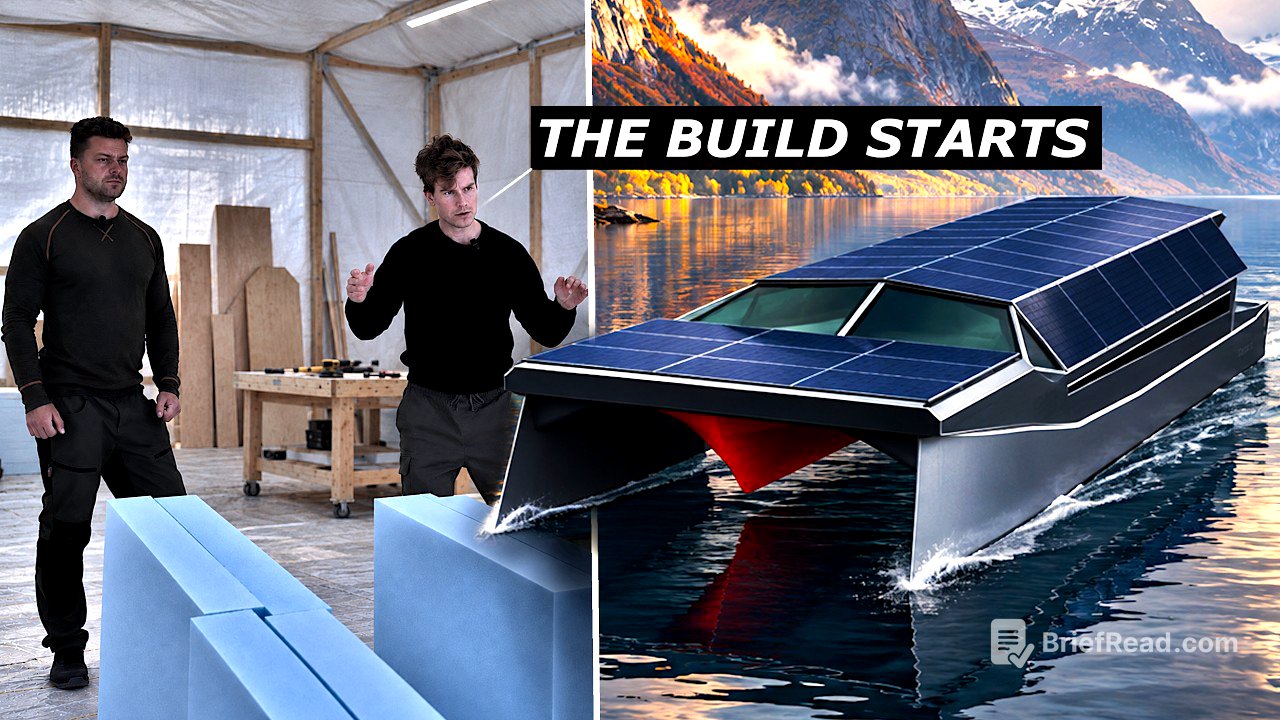
The builder travels by ferry to Sweden, where a friend has prepared a 20-metre build hall for constructing a 16-metre solar-powered catamaran. Updated 3D models and AI visualisations show the evolving design. Some viewers have questioned its 5.2-metre beam, but the builder says a narrow catamaran can still be designed to be stable and safe, with the details to be explained as the project develops.
The design builds on experience with the Helios 11, a low-budget solar prototype that sailed in the northern archipelago through winter. That roughly €20,000 boat demonstrated that solar travel was more practical than expected, despite design choices that reduced efficiency. The new catamaran is intended to be more efficient, quicker to build and able to carry more solar panels without sacrificing comfort.
The goal is energy-autonomous boating and living, supported by improving solar and battery technology. The builder is careful not to claim that solar boats can yet provide unlimited energy in every condition: the first prototype was uncomfortable in winter, and a more capable system—or further technological progress—will be needed for that.
Arriving in Sweden and Planning the Living Space [3:17]
The ferry journey from Finland to Sweden costs €20, including a cabin. Its roughly three-square-metre bathroom prompts the builder to note that the PowerCat could have a larger bathroom and shower of four to five square metres, as well as a sauna. The nearby Åland archipelago, where the prototype sailed the previous winter, is described as an appealing place to explore, especially with a larger boat and solar heating.
After arriving, the team settles into a temporary cabin near the build site. Materials are expected shortly, and the first construction task will be a tender—a small boat carried by the larger vessel. The group is ready to begin work in the prepared hall.
The Build Hall and First Construction Preparations [5:11]
The team visits the 20-metre build hall, where some bulkheads—internal structural partitions—are already prepared from 12 mm plywood. The hall took about ten days to build and cost roughly €2,300, with land rent of about €330. The builder and friend point out that a basic workshop can be created without renting a large commercial space, given some land, money and practical effort. The bow bulkhead is tall and will lead to a pointed hull that sits about 50 cm into the water.
The hall is substantially stronger than the shelter used for the earlier prototype, and it has stayed dry despite heavy rain. The team also has a break room and a nearby cabin for living during construction. Their first materials include epoxy resin from Germany and foam intended for the smaller test catamaran.
The foam costs about €600 and is not marine-grade, so the team limits its use to the tender rather than the main vessel. It is light and buoyant, and the plan is to cover it with fibreglass to create a rigid shell. The tender will be nearly five metres long, with pontoons about 20 cm wide and 60 cm high.
Building the Foam Tender and Working Out the Dimensions [10:45]
The team lays out the foam sections to understand the shape and proportions of the tender. Although initially described as a dinghy, at nearly five metres long it looks more like a small boat. It could be pulled along for short trips and lifted at the stern with a simple crane when travelling longer distances on the PowerCat.
They consider making the boat 1.5 to 1.6 metres wide. A wider catamaran becomes much more stable, but the bridge deck—the structure connecting the two hulls—then needs to be much stronger. The narrow pontoons are compared to racing kayaks strapped together, an arrangement intended to reduce drag and improve efficiency. The tender’s proportions are close to those planned for the full-sized boat, so testing it on the water should provide a useful indication of how the hulls and spacing behave.
The first circular saw does not cut deeply enough, and its rough cuts are unsuitable for gluing. The team switches to another saw, which produces smoother edges. After cutting the pieces into rough shapes, they finish the first couple of hours’ work with the tender’s components ready for assembly. The foam for the small catamaran costs roughly €1,000 in total, and the next step is to obtain tools and materials for making the epoxy seams.
A Sauna Test and Plans for the PowerCat [16:19]
The team visits a traditional Nordic sauna, lights a fire using birch bark as tinder and warms the room before going in. The experience reinforces the plan to include a sauna in the PowerCat. The proposed unit would be around 2.5 metres long and rated at approximately 4–5 kW. The builder estimates that it would not consume an excessive share of the boat’s daily energy budget, even in autumn.
A sauna and swimming would make the DIY yacht more comfortable for living aboard. Back at the temporary cabin, the team prepares for colder weather with a 2,000 W heater, replacing a much smaller 400 W heating element. They plan to move into a cabin built near the hall, which will serve as their home during the project.
Making a Scale Model to Test Speed and Stability [20:27]
While waiting for a thickening agent needed for the epoxy, the builder works on visualisations and buys a remote-controlled boat. Its motor and steering system will be adapted for a scale model of the 16-metre PowerCat. The model is built to scale at about 1.48 metres long and 48 cm wide, with five-centimetre-wide pontoons, and initially weighs around two kilos.
The plan is to test how the model handles, then add weight and try it in larger waves. These tests should help assess the position of the centre of mass and how a poor centre of gravity affects performance and stability. The team spends about €260 on assorted supplies. The first simple model test reveals that the remote-controlled boat has almost no proper rudder, so it turns slowly by varying the propeller’s motion. Nevertheless, it travels at an estimated six or seven knots and returns successfully.
The model later proves difficult to steer, and the team recognises that the waves at the nearest beach are too small for a meaningful rough-water test. To challenge its stability, the builder places weight high up and tries to tip it in breaking waves. It remains stable in those conditions, but larger waves and an improved model will be needed to gather more useful data. The team also continues cutting and assembling the tender’s bridge deck.
Early Build Problems and Lessons for the Next Stage [27:00]
After losing their home in an accident, the team settles into the unfinished cabin near the build hall. It is not yet fully equipped, but it provides a place to continue building and testing solar prototypes. Support from viewers helps the team make its boat-building plans publicly available and move towards completing the 16-metre catamaran safely.
The tender’s pontoons are attached and its bridge deck is ready to install, but the team encounters problems joining the foam sheets. Building glue does not hold the sheets together, while epoxy is not an efficient solution for assembling such large sections. Polyurethane construction foam works better: it hardens quickly, and the test joint becomes firm after about 20 minutes. Because the foam core mainly spaces apart the outer fibreglass layers, rather than acting as the boat’s primary structural skin, the seams do not need to carry the full structural load.
The biggest mistake was not ordering longer foam sheets. Short sections required extra joints in both the pontoons and bridge deck, adding unnecessary work. The team treats this as part of learning the most efficient way to build with limited resources. The next stage is to reinforce the bridge deck, shape the pontoons, cover the structure in fibreglass and launch the tender for further testing.